
Why SEO Audit Is Important When Everything Looks Fine

Summarize with AI
Why SEO audit is important: because search performance decays silently. Rankings, traffic and sales can slide for months without a single error message, and the numbers an owner checks daily are usually the last place the problem becomes visible. An audit exists to find what is costing you money somewhere you have no reason to look.
That is a different answer from the one almost every article on this question gives. The usual one is a list of benefits: better rankings, faster pages, more traffic. All true, and all useless for deciding whether it is worth paying for. The question that helps is what an audit catches that your own reports will never show you.
The signals you check are the ones least likely to break
When a paid campaign fails, the platform tells you the same day. Ad disapproved, budget exhausted, conversions at zero. You get a notification.
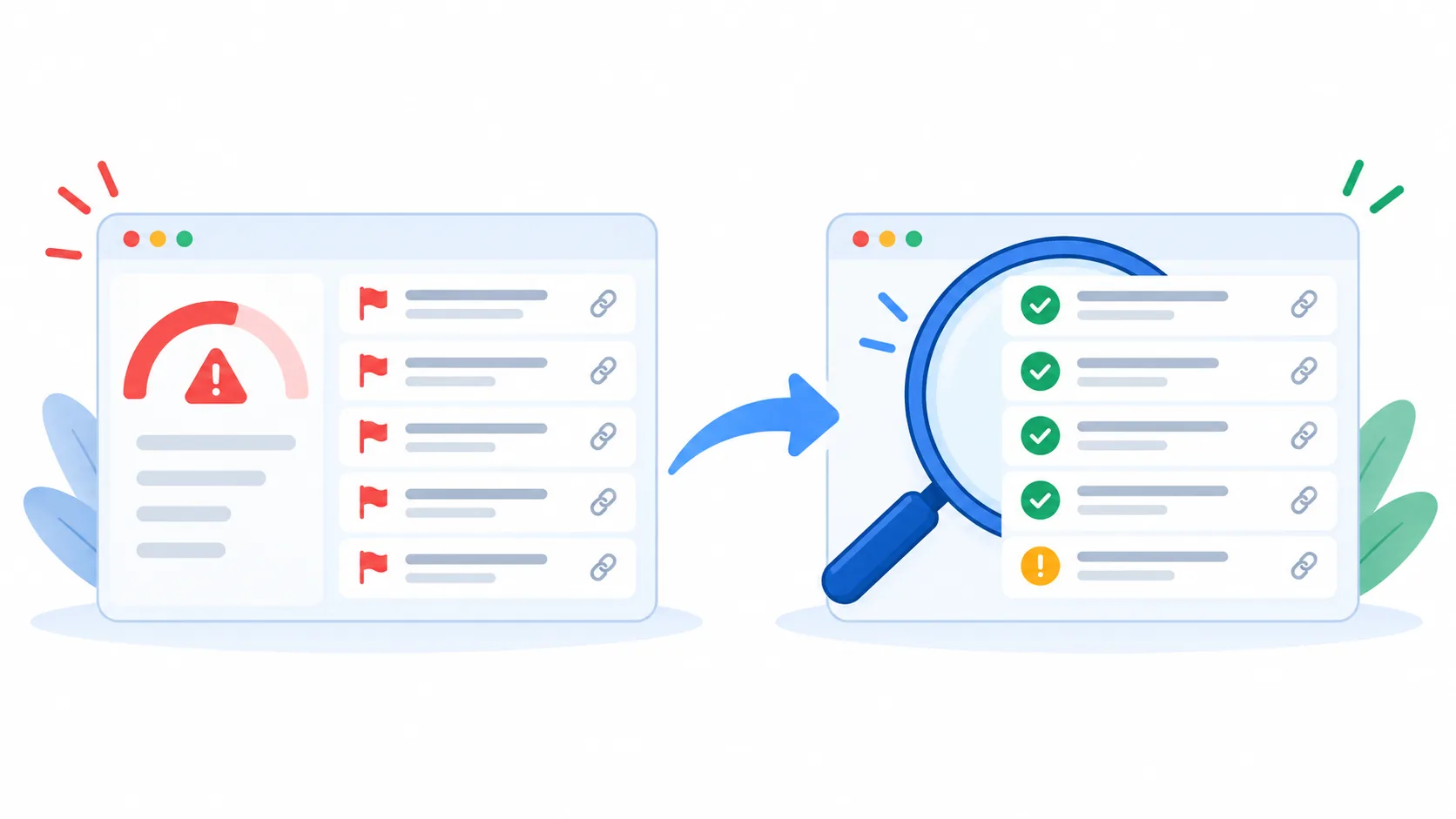
Organic search tells you nothing. Pages drop out of the index and your site keeps loading exactly the same. A redirect chain left over from a redesign two years ago keeps draining authority while every URL answers with a clean 200. Two of your own articles have been splitting the same query since 2023, and both look perfect when you open them separately.
The broken state and the healthy state look identical from the dashboard. That is the underlying reason diagnosis became an entire category in SEO and never did in paid media, and it explains why the honest answer to this question has less to do with rankings than with visibility into your own operation.
What an SEO audit is, and what it actually looks for
An SEO audit is a structured review of everything that decides whether a search engine can find your pages, understand them, and prefer them over someone else's. In practice, a complete audit covers:
- Crawling and indexing: whether your pages are in the index and Google can reach them.
- Technical health: speed, redirects, errors, the mobile version.
- Content and intent: how what you publish maps to what people actually search for.
- Internal linking and the authority reaching you from other websites.
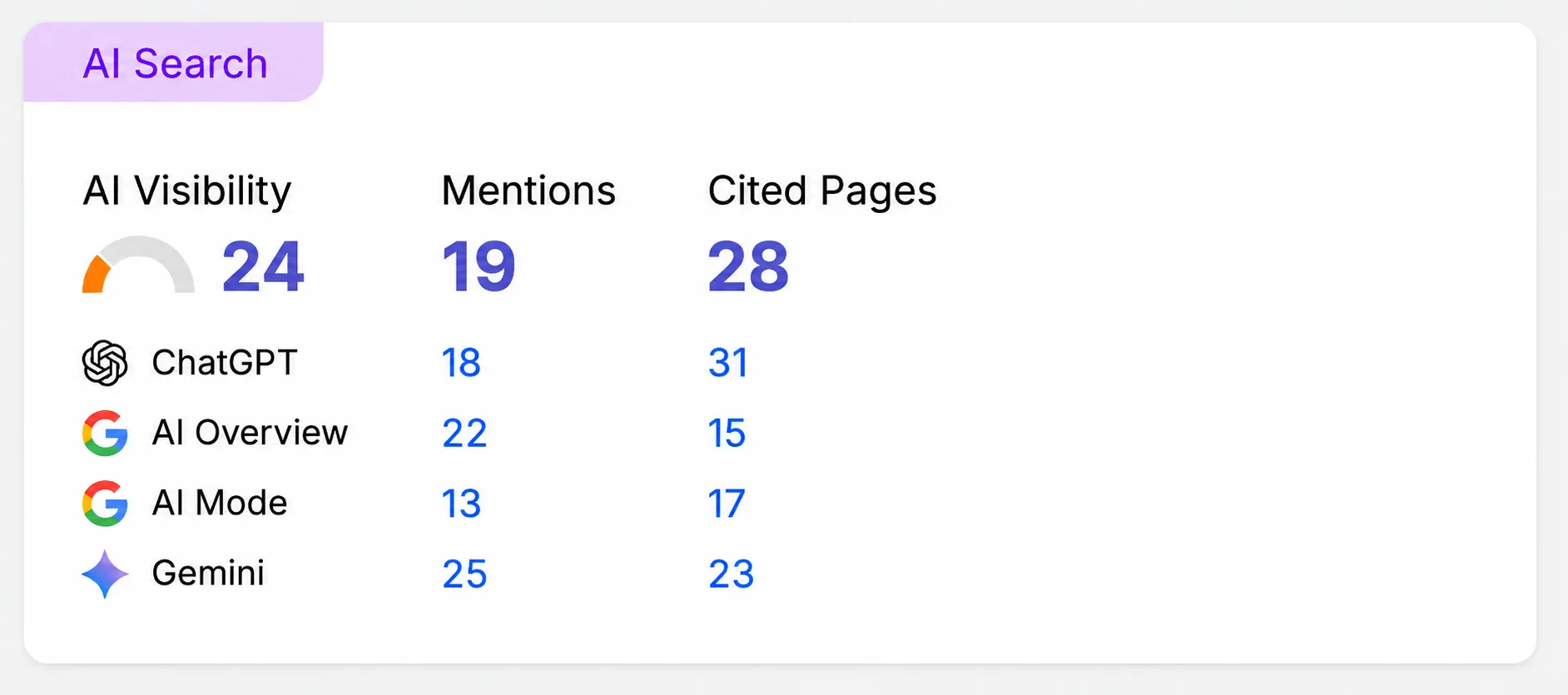
- Visibility in AI answers: whether generated summaries cite you or erase you.
- Competitors: how all of the above compares with whoever is beating you today.
It is worth pointing out that the pages ranking for this question do not even agree on the definition. Some treat a website audit and an SEO audit as two separate things. Others use both terms as synonyms inside the same article. If you are collecting quotes, ask each provider exactly what theirs covers before you compare prices, because you are probably not comparing the same work.
The deliverable that matters is not the list of problems. It is the order. Any crawler (Screaming Frog, Semrush, Ahrefs) produces three hundred findings in twenty minutes. Knowing which five are holding up your business is the part that takes judgment, and it changes completely depending on the kind of business you run. A long list of toxic backlinks flagged by a tool is a common example: most of it is noise Google already ignores.
A local business can rank well and still be invisible
Picture a business with a good reputation. Solid reviews, customers who come back, first in the map when people search its name. By every signal the owner can see, search is working.
Now look at what is producing that result. In the Local Search Ranking Factors 2026, Whitespark's study where 47 local search specialists score 187 factors, what weighs most in the map pack is things like branded search volume for the business name, CTR from the pack, driving-direction requests and the review profile. All of them are traces of people who already know that business exists.
Now look at what wins in the organic results sitting underneath the map. Having a dedicated page for each service is the number one factor there, and number twenty-four in the pack. The primary category on the Google Business Profile, the strongest factor in the map, drops to eighty-fifth in local organic. Same business, same screen, two competitions with almost inverted priorities.
So the business wins when people search its name and disappears when they search what it sells. Its entire presence is built on people who already knew it. An audit there is not about fixing rankings, because the rankings are fine. It is about turning street reputation into words that business has never shown up for.
You can check this yourself in two minutes. Open the performance report on your Google Business Profile, look at the list of searches people arrived with, and count how many are your own name. If most of them are, you are not being discovered. You are being looked up. If the profile does not appear even for your own name, that is a different problem, with its own fixes for a Google Business Profile that is not showing up.
In an online store, the expensive problems surface when there is no time left
Retail runs on a calendar, and that calendar closes a door.
Most stores freeze their code before peak season so nothing breaks during the weeks that pay for the whole year. Some start on October 1. In a seasonal business the freeze can last months, as long as the season itself, and plenty of teams begin it three or six months out. Anything that has to be live for the peak has to be finished, deployed and working before that door shuts.
Now add the natural lag. A change on your site has to be crawled, processed and re-ranked before it returns anything. Subtract that from the freeze date, subtract development time, and the audit deadline lands in the middle of the year, when sales are normal and nothing feels broken.
That produces an uncomfortable conclusion. The moment an audit is worth most to a store is exactly the moment nobody wants to pay for it, and by the time the owner finally feels the problem, the useful window has closed. If sales drop in November, an audit in November does not save the quarter. You cannot ship the fixes, and even if you could, you should not touch anything.
There is a second blind spot in retail worth naming. Free product listings on Google are generated from your Merchant Center feed, not from your pages, and they appear in Shopping, Search, Images, Lens and in AI-generated answers. A disapproved product disappears from the ads and from the free listings at the same time, because both read the same data. No crawl-based audit will ever see that, because it is not even looking at your website.
A content site can hold its rankings and lose the traffic anyway
The third case is the one that broke most recently, and it runs opposite to what you would expect.
An Ahrefs analysis of 300,000 keywords with Search Console data found that when an AI Overview appears, the page in first position loses an average of 34.5% of its CTR. Research from the Pew Research Center, which tracked the real browsing of 900 people across about 69,000 searches, measured that visits to a linked page fall from 15% to 8% when an AI summary is present, and that people end the session without clicking anything far more often when the summary appears.
The hit lands on the page in first position: your best pages bleed the most. And the damage is concentrated by intent type rather than spread evenly: informational queries now end without a click far more often than transactional ones. A store selling something barely felt it. An archive of explanatory articles took the full blow.
The diagnostic signal is free and it is precise. Open Search Console, set the range to sixteen months, and compare clicks against impressions against average position. If impressions and position are steady and clicks collapsed, you did not lose ranking. You lost the click, and rewriting the page will not bring it back. What that page needs is a decision about whether it still exists to earn visits or only to be cited, which is the underlying shift in SEO in the AI era.
When an SEO audit is not worth paying for
Three situations where the honest answer is to keep your money.
Your site is new. There is no performance history to diagnose, so the audit would be a plan dressed up as a diagnosis. Publish, get indexed, gather a few months of data, then look.
Nobody is going to implement the findings. This is the most common way to waste money on an audit. A three-hundred-item report with no developer, no budget for the work and nobody assigned produces a PDF and nothing else. The value of an audit is capped by your capacity to execute.
You already know what is wrong. If you have spent a year postponing a fix you already identified, you do not need a diagnosis. Paying for one is a way to delay the work while feeling productive.
What to check before hiring one
Ask what the audit covers and whether that matches how your business actually makes money. A local service business being sold a deep technical crawl of fifteen pages is being sold the wrong instrument. Same with a store whose audit stops at the website and never opens Merchant Center.
Ask what format the result arrives in. A useful audit ends in a short, prioritized list, with an estimate of what each fix is worth and what it takes to ship it, not in a spreadsheet with every warning a tool emitted.
Ask when the fixes have to be live. If your business has a peak season, count backwards from it before you accept any timeline.
And ask who does the work. A crawler runs in twenty minutes. What you are paying for is the person who decides which of those findings matter to you, which is also why the same deliverable is quoted at such different prices across the industry.
Frequently asked questions
How often should you run an SEO audit?
A full audit once a year works for most sites, with a lighter review each quarter. That schedule goes out the window when something structural happens. A migration, a redesign, a platform change or an unexplained drop should trigger an audit immediately, no matter when the last one was.
Can you do an SEO audit yourself?
You can do a meaningful part of it for free. Search Console shows you index coverage and the clicks-against-impressions comparison described above. Google Analytics tells you where your traffic comes from and what it does when it arrives. Your Google Business Profile shows you which searches people arrived with. Those reports will tell you whether you have a problem. Deciding what to do about it is where outside help earns what it charges.
How much does an SEO audit cost?
From nothing to five figures, for work that goes by the same name. Automated tools produce a report for the price of a subscription. Agency engagements charge for the interpretation, the prioritization and the execution plan. Before you compare quotes, confirm both providers are quoting the same thing, because the term covers very different work: it is the same problem as comparing what SEO costs in Miami from one agency to the next.
Is a free SEO audit worth anything?
A free audit is a sales tool, and that is fine as long as you read it as one. A good one names concrete problems on your concrete site and explains what would change if you fixed them. A weak one is an automated Semrush or Screaming Frog scan with a logo on top, usually padded with warnings that carry no weight for a site your size. Judge it by whether it tells you something you could act on without hiring anyone.
The point of all this
The three cases share the same shape. The business is watching signals that look healthy while something expensive happens outside its field of view, and the shape of that blind spot changes completely with the kind of business. That is why a generic checklist does not find it. A checklist looks for the same thing everywhere.
If you want to know whether this applies to you, start with the two free reports mentioned above before you talk to anyone. If the numbers look strange, we are glad to help you understand what they mean for your business through our SEO service in Hialeah.