
How Many Keywords Is Too Many in 2026? It's Not a Number

Summarize with AI

There is no number, and chasing one is the actual problem. The question assumes a page is a container you fill with terms until it overflows. That is not what a page is, and it has not been for years.
A page is a response to a question people are asking in a few hundred different ways. Google decides which of those phrasings it deserves. Your job is not to load it correctly. Your job is to understand what the person typing that query came to do, and build the page so it answers that completely.
So how many keywords is too many? Wrong unit. The real question is whether your page is responsive to the demand behind the query, and that is measured in coverage and structure, not in count.
Why "how many keywords is too many" has two opposite answers
Search this exact phrase and the results split down the middle. Half are about on-page SEO. Half are about Google Ads ad groups. Same words, two unrelated problems, and the honest answers point in opposite directions.
In Google Ads, there is a real ceiling. Most practitioners land on 20 to 30 keywords per ad group, and past that the ad copy stops matching the query closely enough to hold Quality Score. You are literally assigning terms to a container, so a container limit makes sense. Count away.
In SEO, no such ceiling exists, because you are not assigning anything. You write something that answers a question and Google decides which queries it deserves. Nobody hands a page its keywords. The page earns them, or it doesn't.
| Google Ads ad group | Organic page | |
|---|---|---|
| Is there a limit | Yes, in practice 20 to 30 keywords | No limit exists |
| What enforces it | The auction, in money, every day | Nothing. There is no container |
| What gets diluted | The shared ad copy every keyword has to match | Nothing is shared |
| What it costs you | Lower Quality Score, so more per click for worse placement | Nothing directly |
| How keywords are assigned | You assign them to the group | The page earns them, or it does not |
There is a mechanical reason the Ads number is real and the SEO one is not. An ad group shares a single set of ad copy, so every keyword inside it has to be close enough to that copy for the ad to read as a direct answer. Stretch the group and relevance falls, Quality Score follows, and you pay more per click for worse placement. The limit is enforced by the auction, in money, every day.
Nothing equivalent exists on the organic side. There is no container, no shared asset being diluted, no per-click cost. That difference is why the same question produces contradictory advice depending on which article you land on.
Google has never published a keyword density target
John Mueller has said it about as plainly as a Google spokesperson says anything: there is no concept of optimal keyword density at Google. He has held the line for years, and as recently as the last round of the question, confirmed that Google Search still has no notion of optimal density.
His follow-up is the part people skip. Density does not matter, but mentioning the term explicitly still does. Google's systems can usually work out what a page covers even when the exact phrase never appears, and being explicit removes the guesswork. That is a very different instruction from "hit 1.5 percent."
So where did the percentage come from? Not Google. The 1 to 2 percent figure is an artifact of the early 2000s, when search engines really did count term frequency and SEO tools shipped with a density meter. The tools kept the meter. The industry kept quoting the range to itself. Two decades later it gets repeated as if it were policy, and it never was.
For using a phrase four times in 800 words, that plugin is enforcing a rule Google does not have.
The practical version of Mueller's advice is smaller than the myth it replaces. Say the thing you are writing about, in the words people use for it, in the places a reader would expect to find it. Title. Opening. A couple of subheadings. Then stop thinking about it and go make the answer better.
What replaced density: entities, not counts
Something did take density's place, and it is worth understanding because it explains why the counting habit stopped working.
Search engines no longer decide what a page is about by counting how often a word appears. They run the text through natural language processing, pull out entities (people, places, products, concepts) and score each one for salience, a value from 0 to 1 that measures how central that entity is to the meaning of the text.
The difference between the two ideas is the whole argument. Density measures frequency, which you can inflate by typing the same phrase again. Salience measures centrality, which you cannot fake by repetition. A page that says "keyword density" fourteen times but never mentions search intent, cannibalization or passage ranking scores badly on the concept it claims to cover, no matter what the percentage says.
So the useful question was never how many times to say the phrase. It is which concepts a credible answer to this question has to contain. Miss those and the page reads as thin to a machine that stopped counting words years ago. It is the same shift that decides whether AI search engines cite you at all: they read entities, not term frequency.
Not one of the seven pages currently ranking for this question mentions entities or salience. They are all still arguing about a percentage.
What the data says about how many keywords one page can hold
Ahrefs studied three million searches to answer exactly this, and the finding is the most useful number in the whole discussion.
| Where the page ranks | Other keywords it also ranks top 10 for |
|---|---|
| #1 (average) | ~1,000 |
| #1 (median) | ~400 |
| Lower positions | Progressively fewer |
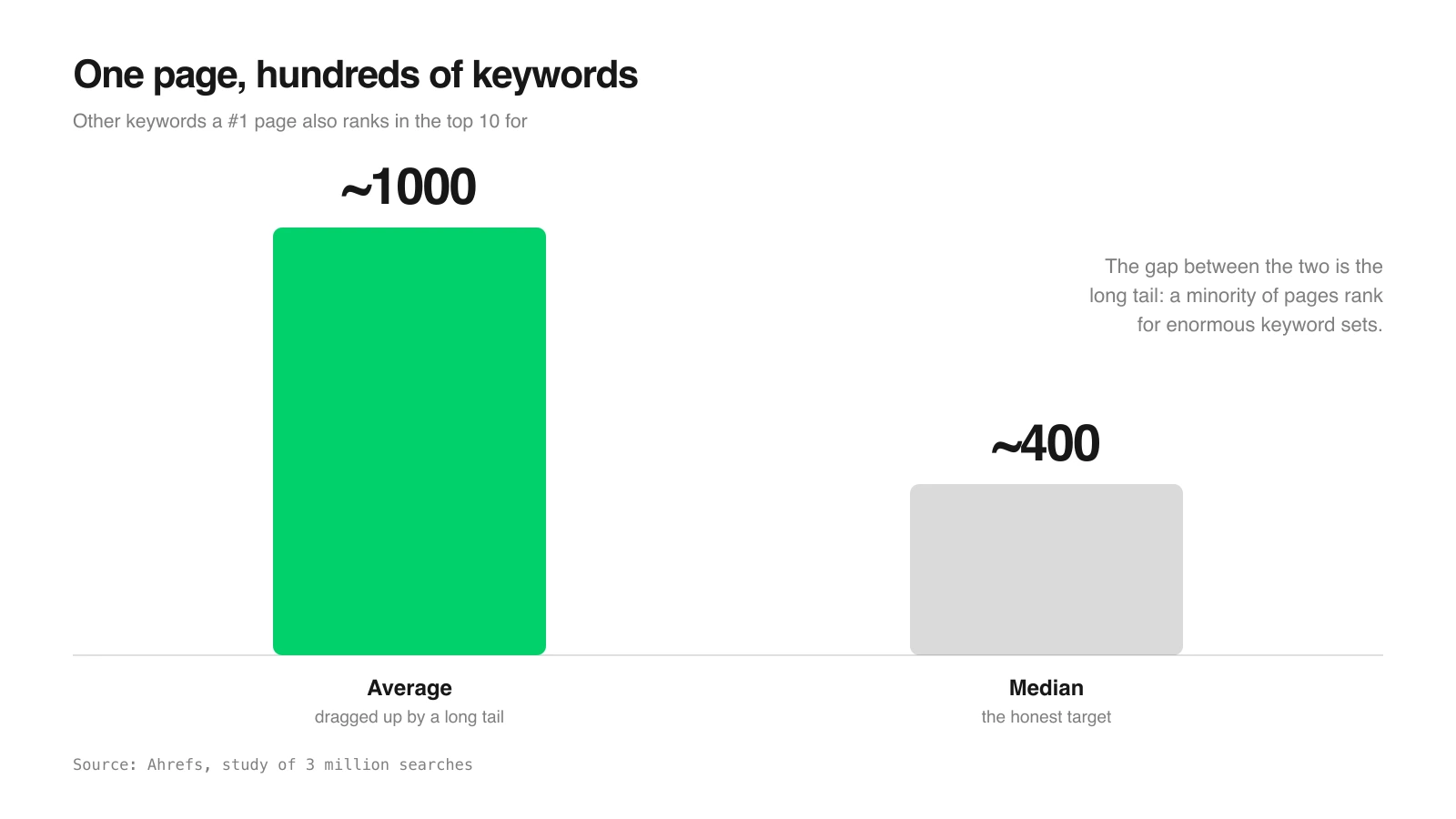
Read that again. The average top-ranking page is not focused on one keyword. It is holding hundreds of them, and nobody sat down and assigned a single one.
The gap between the average and the median is worth a second. A mean of 1,000 against a median of 400 means the distribution has a long tail: a minority of pages rank for enormous keyword sets and drag the average upward. So 400 is the more honest target for a page that does well, and you will not reach it by listing phrases in a brief.
You reach it by covering one question so completely that the page becomes the obvious result for every way a person might phrase it. Every synonym, every typo-adjacent variant, every "how do I" version of the same need. That is where four hundred keywords come from. Not from a spreadsheet.
Which reframes what a keyword list is for. It is not an assignment sheet telling the writer what to include. It is a map of the question, useful before you write and mostly irrelevant after. If you are still ticking terms off it in the final draft, you are optimizing the wrong artifact. That is also why we automate the research and not the writing.
Why one page can hold a thousand keywords
The Ahrefs number sounds impossible until you know the mechanism, and almost nobody writing about this question explains it.
Google does not only rank pages. It ranks passages inside them. The system crawls and indexes the full page as it always did, then applies natural language processing to segment the content into logical sections, following headings and topic shifts. When a query comes in, it can surface the one section that answers it, from inside an article about something broader.
Worth being precise, because this gets misreported constantly: passages are not indexed separately. Google confirmed it does not index passages independently of pages — the page is still the indexed unit. What changed is that ranking became section-aware, so different passages of the same URL can rank for different queries independently.
That is where four hundred keywords come from. Not from a page stuffed with terms, but from a page with twelve genuinely distinct sections, each one the best short answer to a slightly different phrasing.
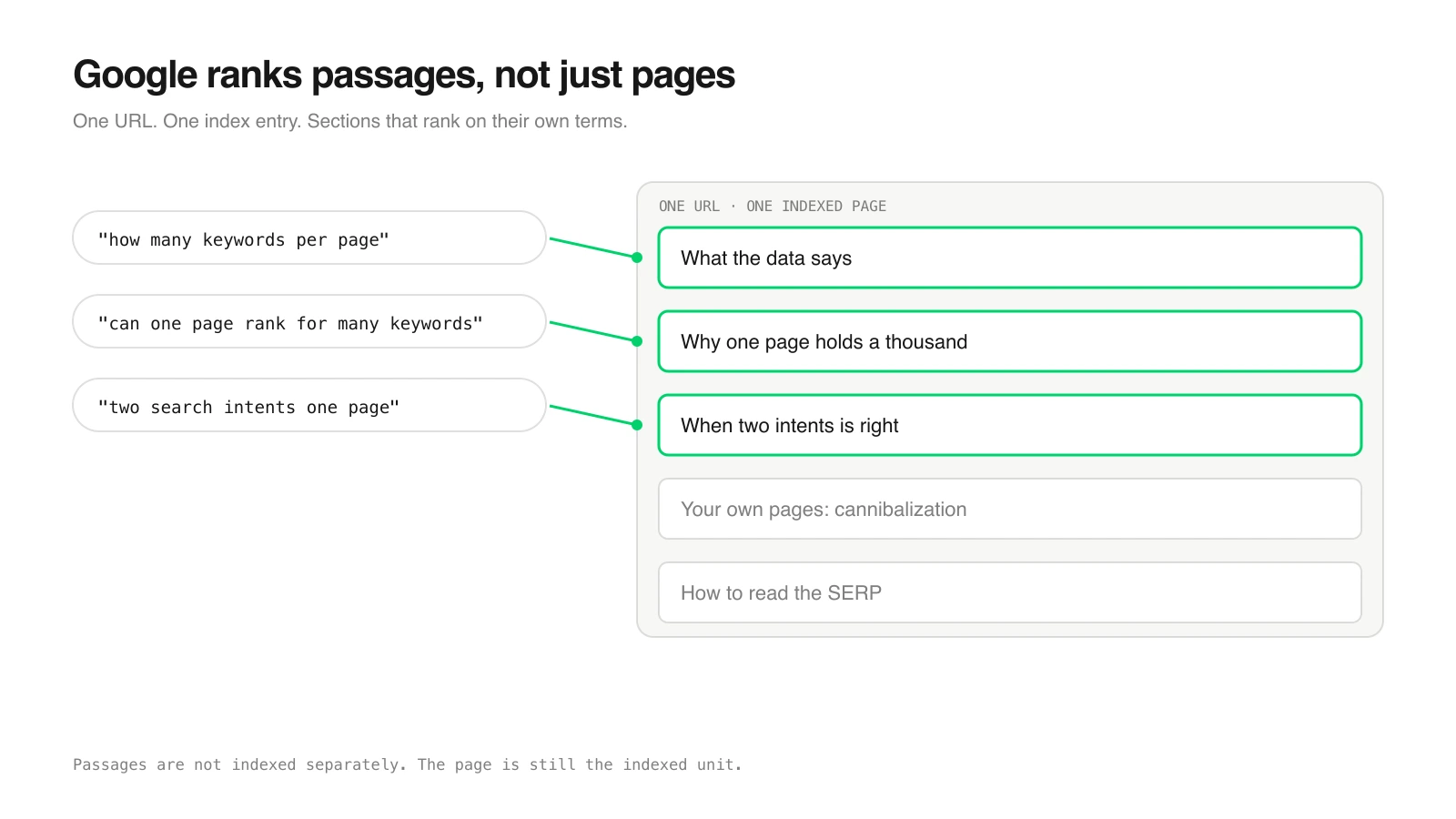
It also explains the mechanism behind the section below on mixed intent. Passages are how a page holds a secondary interpretation without losing its centre: the secondary reading gets its own segment, indexed with the page but ranked on its own terms.
Your subheadings are the seams Google cuts along. Vague headings like "Some things to consider" give the segmenter nothing to work with. A heading that states the question it answers gives it a clean edge. That is the actual reason to write descriptive H2s, and it has nothing to do with keywords.
The page answers a query network, not a keyword
Koray Tuğberk Gübür, who formalised most of the vocabulary the semantic SEO world now uses, describes a query network as a search language containing all possible word distributions, representing terms with different aspects, definitions and themes. That is the unit a page competes for. Not a phrase. A network.
Two more of his terms do the real work here.
Information responsiveness he defines as being responsive to all related and possible search activities in every form of the search query, with all context interpretations. Read that last clause slowly, because it demolishes the advice everyone gives. Not one interpretation. All of them.
Contextual hierarchy is the adjustment of a context's coverage weight, expressed through typography, visuals and how much of the page a sub-section occupies. That is the mechanism people are missing. When a page has to hold more than one thing, you do not refuse the second thing. You weight it.
Which reframes the whole exercise. You are not deciding how many keywords the page can carry. You are deciding which interpretation gets the core of the page and which ones get a section, a paragraph, or nothing.
When two intents on one page is the right answer
I want to correct something the rest of this niche repeats, and that I would have repeated too.
The standard advice is one intent per page, always, no exceptions. It is wrong, and Google's own documentation says so. The Quality Rater Guidelines have a category for queries with multiple meanings, and they sort those meanings into dominant, common and minor interpretations. Google does not treat mixed intent as a mistake to be resolved. It treats it as a property of the query.
Search "keyword research" and watch it happen. Right now the top results split almost evenly: a complete guide, a university explainer and a course on one side, a keyword generator, a free tool, Keyword Planner and a keyword database on the other. Four teaching, five giving you a tool. Google is not confused. It is reporting that people typing those two words want two different things, and it is hedging.
A page targeting that query with one intent only serves half the demand. The winning move is not to pick a side and pretend the other does not exist. It is contextual hierarchy: give the dominant interpretation the core of the page, give the common one a real section with less weight, and drop the minor ones entirely.
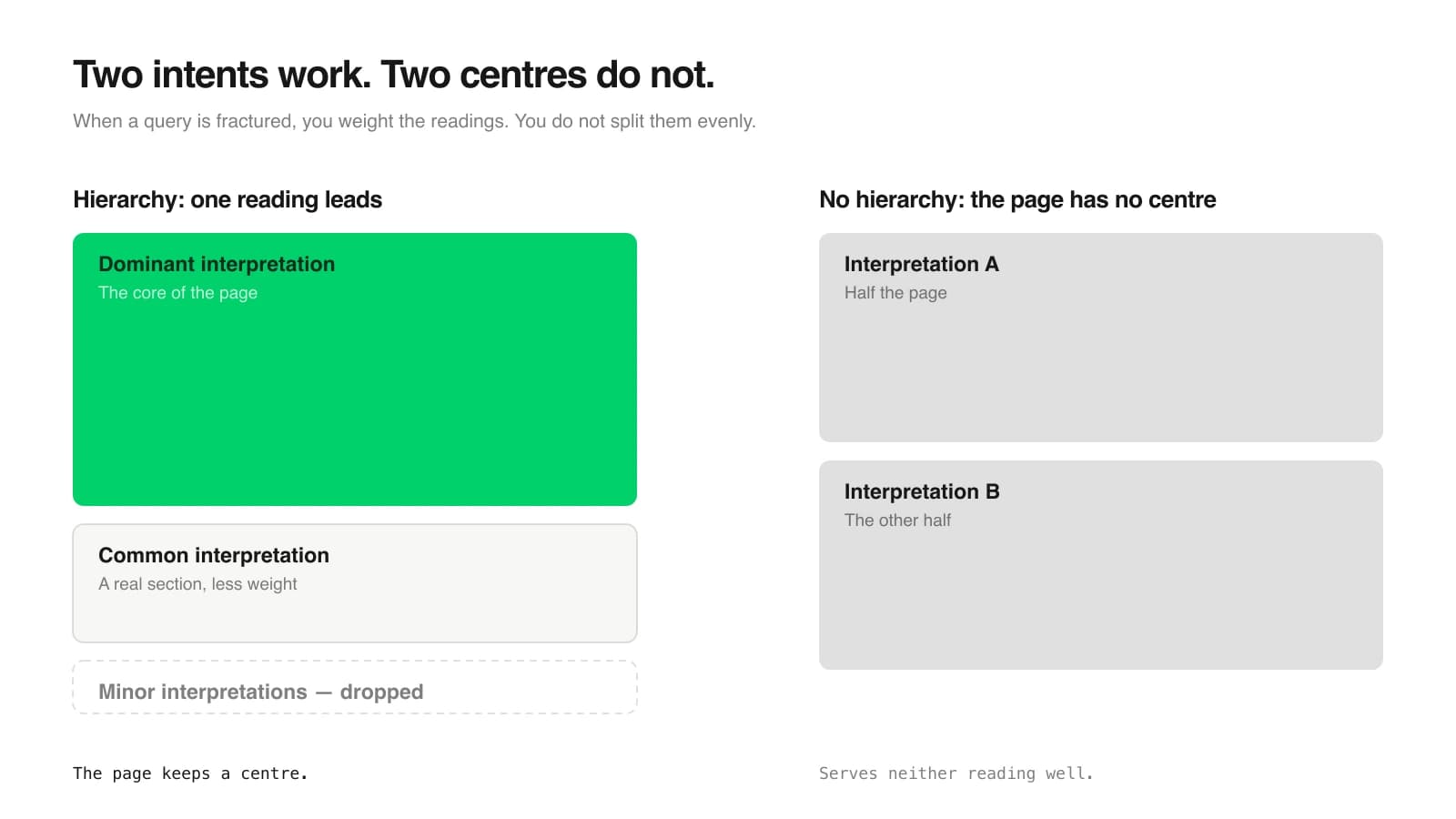
The failure mode is not two intents. It is two intents with equal weight, which produces a page with no centre, and three or more intents, which produces a directory. What breaks a page is the absence of hierarchy, not the presence of a second answer.
"How many keywords is too many" fractures between on-page SEO and Google Ads ad groups. The SEO reading is dominant, so it gets everything from here down. The Ads reading is common, so it got a section near the top and will not come up again. That is the method, applied to itself.
The other limit nobody mentions: your own pages
The most common real-world version of "too many keywords" is not one bloated page. It is one keyword spread across four of them.
Keyword cannibalization happens when several of your own URLs compete for the same query. Google has to choose one, it chooses inconsistently, and every candidate underperforms what a single consolidated page would have achieved. Rankings wobble between URLs. Click-through drops because the wrong page shows for the query. Whatever authority you built gets divided by four.
It is also the failure mode you are most likely to create while trying to avoid the first one. Someone reads that pages should be tightly focused, splits a working article into five thin ones, and manufactures a cannibalization problem out of a page that was doing fine.
The fix, when it happens, is almost always consolidation rather than deletion. Pick the URL with the strongest history, fold the useful parts of the others into it, redirect the rest, and let the surviving page inherit what the group was splitting.
So the count that should worry you is not keywords per page. It is pages per keyword, and there the correct answer really is one.
Notice that this is the same principle as the section above, pointed at the site instead of the page. Within a page, hierarchy decides which interpretation leads. Across a site, hierarchy decides which URL owns a query. Both failures come from refusing to rank things.
How to read the SERP instead of counting keywords
Skip the density calculator. This takes about fifteen minutes and replaces the number you were looking for with something you can actually act on.
Read what the page already holds
Open Search Console and pick a page that ranks. Filter Performance by that URL, open the Queries tab, and look at the list. That is the actual number of keywords the page holds. Not a target you set, a result you earned.
Sort by impressions and read the top fifty
Do they all want the same outcome? If yes, the page is coherent and you can keep expanding it. If you can sort them into two piles that want different things, you just found where to split.
Classify the top ten results by hand
Search your primary keyword in an incognito window. How many results are teaching, how many are selling, how many are a tool? A clean 9-to-1 means one interpretation dominates and the page should be single-minded. A 6-to-4 means the query is fractured, and your page needs a core plus a weighted secondary section. Do not average the two. Rank them.
Check for cannibalization before writing anything
Run site:yourdomain.com "your keyword". If more than one page is a serious candidate, the next piece of work is a merge, not a new URL.
Write the answer first, then check the phrase is present
In the H1, once in the opening paragraph, and in two or three subheadings where it lands without forcing. That is the entire on-page keyword requirement. Everything past it is superstition with a progress bar.
How many keywords is too many before Google penalizes you
Keyword stuffing is a documented violation of Google's spam policies, defined as filling a page with keywords or numbers to manipulate rankings, often appearing in a list or group, unnaturally, or out of context.
Notice what the definition keys on. Not a percentage. Manipulation, and unnaturalness.
Google publishes no quantitative threshold, and most stuffing never reaches the bar for a manual action, which is reserved for serious or repeated cases. It gets handled algorithmically instead: quietly, as a downgrade rather than a dramatic penalty. That is worse in practice, because nothing arrives in Search Console to tell you what went wrong. The page just stops climbing and you never learn why.
If you write for a reader and mention the term where it belongs, you will not come close to the line. That holds when AI drafts the page too, which is why writing an article with AI that ranks starts from the search, not from a term list. The sites that get hit are not the ones that used a phrase seven times instead of five. They are the ones with a list of forty city names in the footer.
Common questions about how many keywords is too many
Is keyword density a ranking factor?
No. Google has stated repeatedly that it has no notion of optimal keyword density. There is nothing to optimize toward, although extreme repetition can trip the stuffing filter.
How many keywords should one page target?
One primary keyword and its variations, which in practice means one intent. Common guidance suggests one primary plus two to four supporting phrases, and that is a useful planning convenience. It is not a limit Google enforces.
Can a single page rank for hundreds of keywords?
Yes, and the good ones do. Ahrefs found the average #1 result also ranks in the top ten for around a thousand additional keywords.
Is 3 percent keyword density too much?
The percentage is the wrong question. Read the paragraph out loud. If the repetition sounds deliberate, it is too much at any percentage, and if it sounds natural, nobody is counting.
Can one page target two search intents?
Yes, when the query itself is fractured. Google's Quality Rater Guidelines classify queries with multiple meanings into dominant, common and minor interpretations. Give the dominant one the core of the page and the common one a weighted section. What fails is two intents with equal weight, or three or more.
What is the actual limit on keywords per page?
There isn't one. The limit is on how many interpretations you can serve without the page losing its centre, and that is a question of structure, not arithmetic.
The reason this question refuses to die
Counting feels like control. A percentage is checkable. You can put it in a report and hand it to a client. "Is this page responsive to the demand behind the query" is a judgment call, and judgment calls are harder to invoice.
But the pages winning right now were not assembled from a keyword list. Somebody read the SERP, worked out what the person typing that query actually came to do, decided which reading of it deserved the centre of the page, and built the thing around that decision.
Stop asking how many keywords is too many. Ask what the person searching this came for, how many ways they are asking it, and which of those readings your page is going to lead with. That judgment is most of what our keyword research service is actually for.