
How to Write an Article with AI That Actually Ranks

Summarize with AI
We write articles with AI every day, and the lesson that took longest to learn is the one the marketing pages never mention: the model is the least important part. Learning how to write an article with AI that actually ranks has almost nothing to do with the generator and almost everything to do with the judgment around it.
Every AI article writer sells the same promise. Type a topic, get an optimized, plagiarism-free article in seconds. That promise is true and almost useless, because generating fluent text was never the hard part. Earning a position against everything already ranking is, and no amount of clicking generate closes that gap on its own.
This guide is about the work that does close it, written from the experience of doing it at scale rather than from a feature list. By the end you will know how to decide whether a query is worth writing for, what real research in front of the writing looks like, where a human has to stay in the loop, what these tools still cannot do, and how to use one without producing pages Google quietly refuses to index.
None of it survives a platform that will not let you ship clean markup, which is a decision made long before the first draft and one we argue out in why the platform your blog sits on decides your ceiling.
One principle holds it together. The model handles language. The research decides relevance. And the decision that comes before both, whether the query rewards a new article at all, decides whether any of it pays off.
Point a writer at a topic with no knowledge of the results and you get confident prose aimed at nothing. Ground it in the live search results and the AI answers first, and the same model produces something that can win.
How we approach it
Inputs
Keyword, intent, market, voice
Qualify
Does the SERP reward an article here?
Study who ranks
Structure, length, the merit-rankers
Map the AI answers
Weigh the facts and entities they cite
Outline you approve
Structure locked before drafting
Draft + schema
Voice, internal links, structured data
Why most AI article writers produce content that cannot rank
The default behavior of a language model is to write something plausible. Ask it for an article on email deliverability and it returns clean, organized, confident text assembled from patterns in its training data. The text reads well and ranks for nothing, because it was never shaped by what the search results are actually rewarding for that query right now. It is an average of everything the model has read, and an average does not outrank the specific pages already winning.
This is the blind-generation problem, and it is the real difference between AI article writers hidden under near-identical feature lists. A tool that writes from a prompt alone has no idea that the pages ranking for your keyword run a certain length, share a comparison table, or cover a cluster of entities your draft never mentions.
It also never asks the question that should come first: whether an article belongs in those results at all. It just writes, because writing feels like progress.
It usually is not. A huge share of low-value pages never earn any traffic, with Ahrefs finding 96.55% of pages get none from Google, and Google does not guarantee indexing in the first place. So the page that took an afternoon to produce does not lose to competitors. It simply never enters the race. That reality is the backdrop for the policy nobody on these tool pages wants to quote.
Using generative AI tools or other similar tools to generate many pages without adding value for users may violate our spam policy on scaled content abuse.
That line, from Google's own documentation, is worth getting right because the fear around it is misplaced. Google does not ban AI content. Its 2023 guidance rewards high-quality content however it is produced, and judges it on experience, expertise, authoritativeness, and trustworthiness. What gets ignored is volume without value, pages spun up to fill a calendar whether a human or a machine made them. Everything below is how we stay on the productive side of that line, starting with the step most people skip entirely.
Phase 1, Decide whether the search results reward an article
This is the phase the marketing pages do not have, and skipping it is why so much AI content fails silently. Before any keyword goes into a writer, we read the results to answer one question: can a new article realistically win here, and is it worth the effort. Writing without knowing whether there is a reward waiting is the single most common waste in content.
Step 1, Qualify the query before you commit to it
Action. Read the live results for the keyword and decide whether they reward an article you can produce, or whether the query belongs to something an article cannot displace.
How. Look at what is actually ranking. When the first page is filled with product pages, tools, or large established hubs, the results are telling you the query rewards a format a blog post will not beat, and writing an article into it aims at a position that does not exist.
When the page is articles, look closer at what kind: a how-to, a comparison, a list. Match it or move on. The format the results already reward is not a suggestion.
Then apply the honest filter most people avoid: ask whether Google would even index the piece you are about to write. If you cannot bring something the ranking pages lack, first-hand experience, original data, an angle none of them took, the likely outcome is a page that is never indexed rather than one that ranks.
A model left alone will happily write two thousand words for a query it can never win, because it has no way to know the reward is not there. Knowing is the job.
There is one legitimate reason to publish into a hard query anyway, and that is building topical authority for your own site. Even then, thin filler is rarely the way to do it.
In our experience the stronger moves are deepening the pages you already have, closing real gaps inside a topic cluster you are actively building, and adding depth where you already rank close to the top. That is the difference between publishing content and running a real content marketing strategy where each article has a job inside the cluster, supports a service page, and earns its place in the index. Publishing weak articles to look like you cover a topic usually adds noise the index discards. Every piece should earn its place either by chasing a reachable reward or by materially strengthening a cluster, not by existing.
Verification. You are ready to write when you can state, before drafting, that this query rewards an article you can realistically win, or that it serves a clear topical-authority gap. If it does neither, the right call is not to write it.
Phase 2, Research before the first sentence
Once a query earns a draft, the quality of that draft is set by what the writer knew before it started. These steps happen fast inside a good setup, but understanding them is the difference between buying a generator and buying the research that makes one useful.
Step 2, Study who ranks, and weight the ones winning on merit
Action. Read the pages already ranking for the keyword, and study hardest the ones that have no business ranking on authority.
How. Start by reading the ranking pages structurally: their length, their structure, what they cover, and the subtopics and entities they share. That shared shape is the floor the query expects.
Calibrate length to it and clear it by a modest margin rather than padding. Length for its own sake is not a strategy, it is filler the review stage will have to cut.
The page worth the most attention is the one ranking without the authority to explain it. When a small, low-authority site holds a top position next to established domains, that is the clearest possible proof that content won the spot, not links and not brand.
That makes it the most replicable result on the page, and the one we study hardest: how it is structured, what it covers, and the angle it took that the bigger pages did not. It is also why studying only the top few results by position misleads you, since those often rank on an authority you cannot borrow.
Studying is not copying, and copying would be the wrong instinct anyway. The merit-ranking page tells you what the query actually rewards; the work is to take that understanding and go deeper, or come at the topic from an angle none of them found.
We believe this beats what most people do, which is imitate the top result. And it certainly beats what a model does alone, which is study nothing and average everyone.
Verification. You know the shape the query rewards, you can name the page winning on merit and why, and you hold an angle that goes past what any of them did rather than restating it.
Step 3, Map what the AI engines cite, and weigh how solid it is
Action. Pull what the AI engines surface for the topic, and treat their claims as evidence to weigh, not truths to repeat.
How. Ranking in classic results is now half the job. The other half is being the source an AI assistant cites when it answers, which is its own discipline and part of the broader shift we cover in SEO in the AI era.
We read what several engines surface for a topic: the facts they assert, the entities they lean on, and the sources they cite. That tells us what a piece has to contain to be considered citable, a higher and more specific bar than comprehensive.
The part almost nobody works on is that not every claim an engine states is solid. Some are well supported, some are weak, and some are plainly rebuttable. Repeating them wholesale is how a piece launders the same shallow consensus everyone else is publishing.
What we do instead is weigh them. Where a widely repeated claim is weak or wrong, we treat that as the opening. Pushing back on it with real experience or a real number is the kind of defensible, contrarian angle that stands out to readers and engines alike, and it is the opposite of averaging the web, which is all a model does on its own.
Writing to be cited is its own craft on top of that: lead with the answer, state claims with numbers and named sources, structure cleanly under question-style headings, and define entities plainly.
A Pew Research Center study found that users click a source inside an AI summary only about 1% of the time, and AI Overviews reached roughly two billion monthly users in 2025, per TechCrunch. The citation itself is the visibility now, which is the reason to be inside the answer rather than hoping for a click out of it.
Verification. You hold the facts and entities the engines treat as essential, and a short list of weak claims you can credibly challenge. The piece will assert what is solid and push back on what is not.
Step 4, Lock intent and the terms the topic requires
Action. Confirm the search intent and gather the entities and related terms the topic demands, grounded in what ranks rather than what the model recalls.
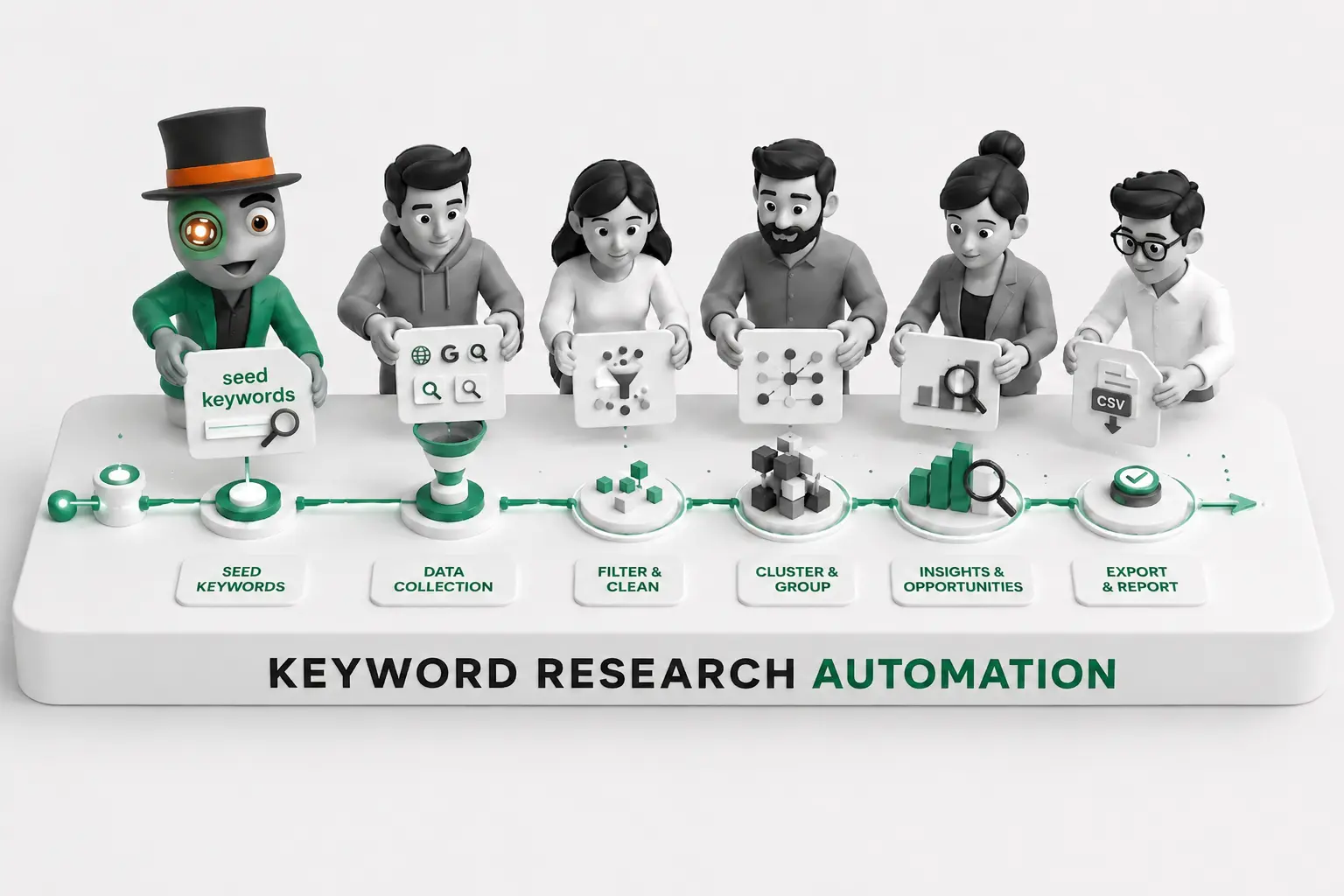
How. Intent decides the whole shape of the piece, and getting it wrong is the most expensive early mistake. A term can look informational and resolve commercial the moment you read the results, so classify it from what actually ranks and let that pick the format. This is the same SERP-first logic behind modern keyword research automation.
Then handle topical completeness. The ranking pages share a vocabulary of entities and related terms that a model left alone will not fully include, since it writes from general patterns and not from this specific set of results.
Pull those terms from what the winners share, mark the ones that belong in headings, and feed them in as requirements rather than hoping they surface.
Verification. The intent label matches what the results show, and you hold a list of required entities and terms with the heading-level ones flagged. That list is the spine the draft has to satisfy.
Phase 3, Generate with control, not on autopilot
Now the model writes, and the temptation is to let it run unattended to the finish, which is where quality leaks out. The discipline here is keeping human judgment in the two places it pays off most and automating everything between them.
Step 5, Approve the outline, the cheapest place to fix structure
Action. Have the writer pause at the outline so a person approves or reshapes it before any body text exists.
How. The outline is the highest-leverage checkpoint in the process. Reordering a section, cutting a weak one, or adding a missing angle costs seconds at the outline stage and a full rewrite once thousands of words sit on top of it.
A serious setup treats this as a hard stop for editorial pieces: it generates the structure from the research and then waits for a sign-off. Use the pause for real, checking that the structure matches the intent you locked, that the sections the ranking pages share are present, and that the order tells a coherent story rather than a pile of headings.
This single gate, placed before the draft instead of after, is most of what keeps an automated workflow from scaling its mistakes.
Verification. Every section maps to something the research justified, the format matches the intent, and you would hand the structure to a writer as a brief without hesitation.
Step 6, Write in a real voice, with your real facts
Action. Apply a defined brand voice and supply the writer your own source material so the draft sounds like you and asserts what is true.
How. Tone settings produce a generic register. A real voice is captured from samples of your actual writing across many dimensions, identity, audience, sentence mechanics, preferred and banned words, even a target reading level expressed as a number.
Held consistently across every section, it keeps the piece from drifting. The value compounds across volume, where the difference is many articles that sound like one brand instead of many that sound like a machine.
The harder problem a voice does not solve is fabrication. Left to its training data, a model will assert plausible figures and invent citations that do not exist.
The defense is to give it your own material, product docs, real data, internal guides, as context it has to draw from, so it writes with your facts instead of its guesses. This is also where stripping the machine tells earns its place, removing the giveaway vocabulary and cadences that mark text as generated.
Verification. The draft reads in your voice across every section, and the specific claims trace to material you provided rather than to the model's imagination.
Step 7, Set structure, schema, and internal links by silo
Action. Configure the on-page elements that make the piece eligible for rich results and connect it to the rest of your site.
How. The structural choices, an FAQ, tables, key takeaways, are not decoration; they map to how the page is read by Google and by AI engines, and FAQ, author, and freshness schema is part of what makes content eligible to be surfaced and cited. Generate that structured data to match the actual content type rather than bolting it on later. Internal linking is the piece most tools ignore: connecting a new article into its topic cluster, with descriptive anchors and a clear reason for each link, is what builds topical authority and keeps the page from publishing as an orphan. Do it by silo, supporting pieces pointing up to their pillar, rather than scattering links by keyword match, which reads as spam to readers and search engines both.
Verification. The schema reflects the page's real content type, and the piece links into a cluster with descriptive anchors instead of sitting disconnected from everything else you publish.
Phase 4, Review, fact-check, and edit at the sentence level
A finished draft is a starting point, not a publishable page. This phase is where first-hand quality is won or lost, and it is the work no model can do for you, because it requires knowing what is true and what your readers actually need.
Step 8, Run the quality pass and verify every claim
Action. Review the draft for accuracy, voice, and the failure modes specific to AI text before anything ships.
How. A first pass can be mechanical: rewriting the cadences and vocabulary that mark text as machine-made, confirming the keyword sits where it should, and checking the structure holds. The human work comes next, and it matters more.
Verify every statistic and every citation, because hallucinated numbers and invented sources are the most common and most damaging AI failure, and confident enough to pass a skim. Check for staleness from the model's training cutoff, since anything recent may be wrong. Watch for topical drift into someone else's framing.
This is also where the weak claims you flagged earlier pay off, as the points where your own experience replaces the consensus the engines repeated.
The title gets the same test as the body. A headline the first screen does not pay is the one failure this whole workflow can still ship, so it is worth knowing exactly where the clickbait line sits and how to measure whether you crossed it.
Edit where it matters at the sentence level rather than regenerating whole sections. Tightening a single paragraph, adding a real data point, or fixing a tone slip without disturbing the rest is how you keep the part the model got right and fix the part it did not.
The numbers back the net gain even with this review included. Surveys of bloggers using AI assistants reported about 2.81 hours per post versus 4.02 without, and HubSpot found only 7% of marketers publish AI text with no edits while 56% revise it significantly. That is the workflow that actually works.
Verification. Every number and source checks out against a real reference, the voice is consistent, and you would put your name on it as the publisher. If a claim cannot be verified, it comes out before publishing.
What an AI article writer still cannot do
The honest section the tool pages leave out, and the one that keeps you from shipping content that reads fine and fails anyway.
A model cannot generate genuine experience. It can summarize what has been written about running a campaign; it cannot have run one. The emphasis Google now places on first-hand experience is a direct response to a web filling with competent text that never touched the real thing.
Original research, a tested result, a number from your own account: those are yours to add, and they are increasingly what separates content that ranks from content that merely exists.
It also cannot decide what is true, hold a relationship with your audience, or make the call that comes before all of it, whether a piece is worth writing at all. It will write whatever you point it at, persuasively, including the wrong thing and the thing that will never be indexed.
The judgment about which queries deserve a page, which claims are defensible, and which draft is good enough to carry your name stays human. An AI article writer is leverage on execution. It is not a substitute for knowing your field.
| Dimension | Blind generator | Research-first approach |
|---|---|---|
| Decides whether to write? | Never, it just writes | Qualifies the query first |
| Starting point | A prompt | The live results and AI answers |
| Length | Guessed or fixed | Calibrated to who ranks |
| Treats AI facts as | Truth to repeat | Claims to weigh and challenge |
| Human checkpoint | Edit the finished draft | Approve the outline first |
| Typical outcome | Fluent, often unindexed | A page that can compete |
Best practices, common pitfalls, and where to start
This is the operational checklist, and it applies to any AI article writer.
Pros
- Qualify the query before you write. Confirm the results reward an article you can win, or that the piece fills a real gap in a cluster you are building.
- Study the page winning on merit, not the top result by position, and find an angle that goes past all of them.
- Weigh what the AI engines assert rather than repeating it, and push back on the weak claims with real experience.
- Approve the outline, not just the draft, and fix structure where it costs seconds instead of hours.
- Verify every statistic and citation by hand, since hallucinated facts do the most damage.
Cons
- Writing for a query without checking whether the results reward an article, then wondering why it never ranks.
- Publishing thin pieces to fill a calendar, the behavior the scaled-content policy targets and the index quietly discards.
- Chasing word count on the belief that longer always wins.
- Laundering the shallow consensus the engines repeat instead of bringing a defensible angle.
- Trusting AI-generated numbers and links without checking them.
If you want to feel the difference in an afternoon, take one keyword you already publish for. First, before writing anything, read its results and decide honestly whether a new article could win or get indexed at all. Then run it through a writer that does no research, prompt and generate, and read that draft against the pages actually ranking. Then do the research first, study the merit-ranker, weigh the AI answers, build an approved outline, and generate again. The gap between the second and third drafts is the whole argument, and you only have to see it once.
Want research-first generation without building the stack?
An AI article writer that reads the live results and the AI engines before it writes a word, then drafts with your voice, internal links, and schema in place.
Frequently asked questions
Should I write an AI article for every keyword?
No, and treating an AI article writer as a reason to publish more is how sites end up with pages Google never indexes. Before writing, read the results and decide whether they reward an article you can realistically win, and whether you can add something the ranking pages lack. If the query is owned by other formats or your piece brings nothing new, the time is better spent deepening content you already have. Volume without value is the thing search engines now discard.
How does an AI article writer actually work?
The good ones run a pipeline rather than a single prompt. They study the results for your keyword to learn the structure and length that rank, read what the AI engines cite and how solid it is, lock the intent and required terms, generate an outline a human approves, then draft in your voice before adding schema and internal links. The model writes the words; the research around it decides whether those words can rank.
Is AI-generated content good for SEO, and will Google penalize it?
Google does not penalize content for being AI-generated. Its published guidance rewards quality however content is produced and judges it on experience, expertise, authoritativeness, and trustworthiness. What it ignores or penalizes is scaled, low-value content made to manipulate rankings, whether a human or a machine wrote it. One well-researched, genuinely useful article is fine; a stream of thin pages is the thing that gets buried.
Can an AI article writer write a full SEO article on its own?
It can produce a complete, well-structured draft on its own. It cannot reliably publish a piece that ranks without a human qualifying the query, verifying the facts, and adding the first-hand experience search engines now reward. The realistic split is the model doing the heavy lifting on a research-grounded draft, and a person handling the judgment, accuracy, and experience signals a model cannot fake.
What is the difference between writing for SEO and writing for AI engines?
SEO writing optimizes to rank a page in the classic results through structure, depth, internal links, and intent match. Answer engine optimization optimizes to be the source an AI assistant cites, by leading with the answer, stating claims with numbers and named sources, using clean question-style headings, and adding FAQ schema. A modern approach builds for both at once, because being cited inside an AI summary is increasingly where the visibility lives even when the click does not follow.
How long does an AI article writer take to produce a draft?
The drafting itself is seconds to a couple of minutes. The research in front of it and the human review after it are where the real time goes, and should. Surveys back the net gain, with bloggers using AI assistants reporting about 2.81 hours per post versus 4.02 without, a meaningful drop, though far from the inflated minutes-not-hours claims that ignore the review the work actually requires.
Are AI article writers plagiarism-free?
The text is generated rather than copied, so it is original in the literal sense, but originality of words is not the same as accuracy or value. The real risks are fabricated statistics and invented citations that read as fact, which is why verifying every claim against a real source is non-negotiable before publishing. Treat the draft as a confident first pass that needs fact-checking, not as finished truth.