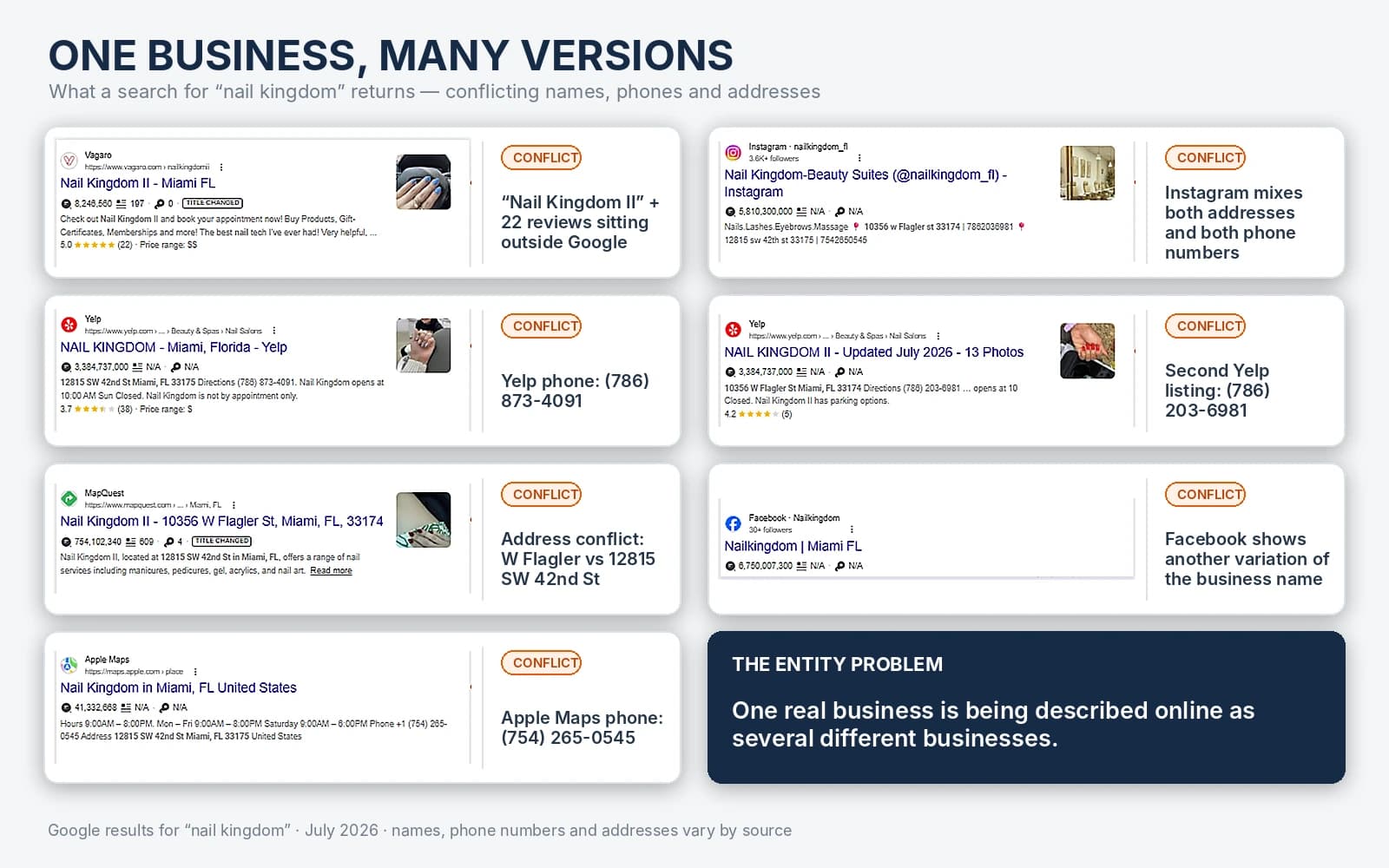

What Is NAP in Local SEO, and Why Does Consistency Matter?

Summarize with AI

I have worked through a cleanup after a business changed its name in Google Business Profile while its other listings kept outdated details. Correcting the profile was only one part of the work. My team still had to claim listings, request edits and contact directory owners.
For business owners and marketers managing a local presence in the United States, the practical question is whether those sources identify the same business and help someone reach it. Here is how I approach that question.
What each part of NAP represents
These are the three fields I use as the reference for each location:
| Field | What it identifies | What matters |
|---|---|---|
| Name | The business's public identity | Customers should recognize the business they know. |
| Address | Its actual location | Public directions should lead to a location that receives customers. Service-area businesses need different handling. |
| Phone | A way to contact the business | Calls should reach the intended business or branch. |
Opening hours, categories and the website address matter too, but sit outside those three fields. You may also see NAPW, which adds the website.
Your business category answers another question: what kind of business you operate. If that is unclear, our guide to choosing a Google Business Profile category walks through that decision separately.
Where your NAP appears
Business details can appear in several places:
- Your contact page and individual location pages.
- Your Google Business Profile and other map listings.
- Social profiles with business contact details.
- Relevant business directories, professional associations and review platforms.
- Older announcements or profiles that still describe your previous location.
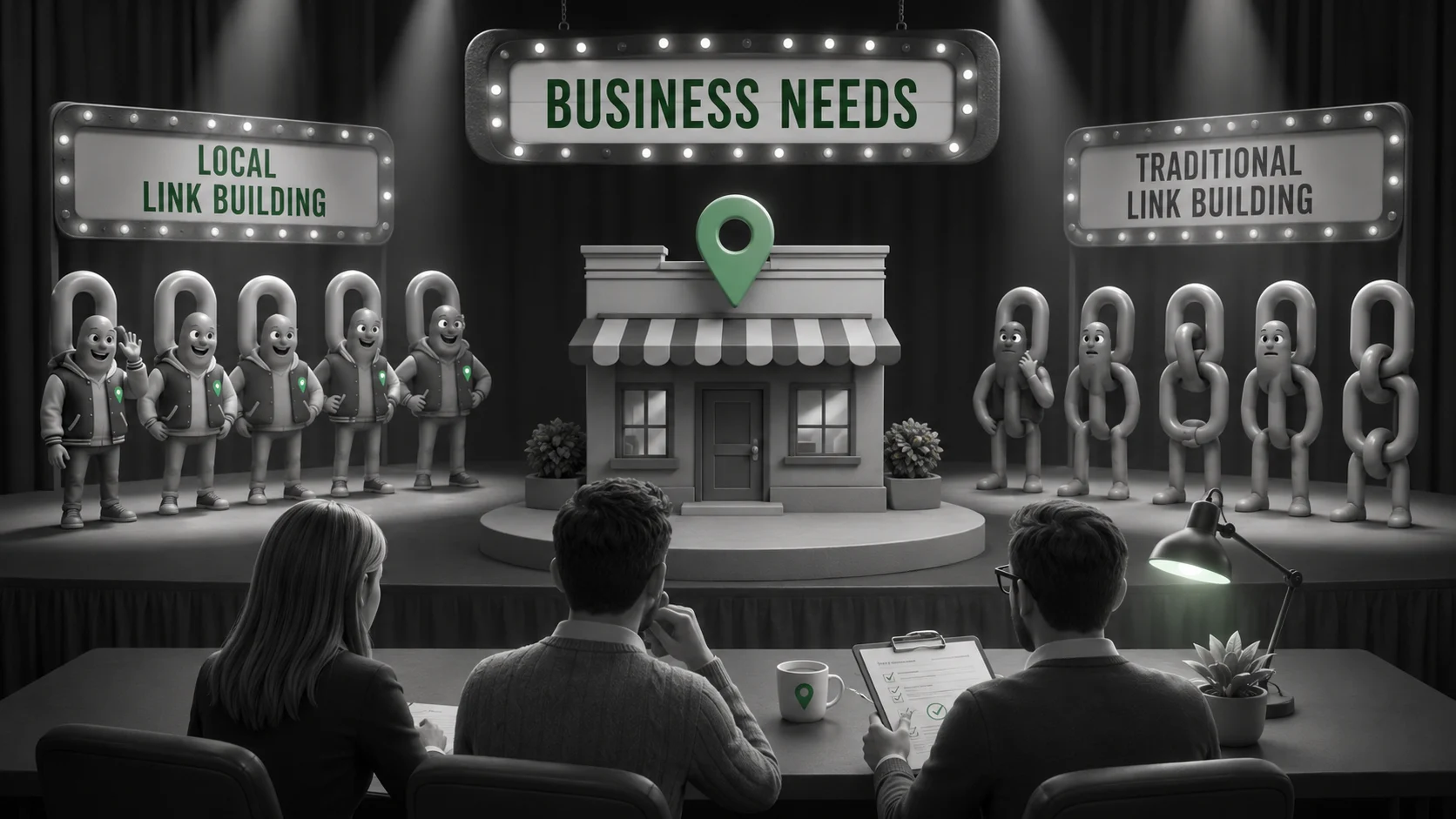
A mention of your business details on another website is commonly called a local citation. It does not have to include a clickable link to be a mention of your business. For the distinction between citations and links, see our guide to local SEO versus traditional link building.
Correcting your website or Google Business Profile does not automatically correct every other listing. That distinction became particularly clear in the campaign below.
A name change that left the other listings behind
One business we worked with had recently changed its name in Google Business Profile. We knew that change could have left other listings outdated, but we needed to understand the extent of the problem.
The clearest picture came from an audit we ran in tamerMaps, our own platform for local SEO work. Across the citations reviewed, the NAP details were inconsistent except on listings that updated directly from GBP. The business's new identity had not carried through its wider online presence.
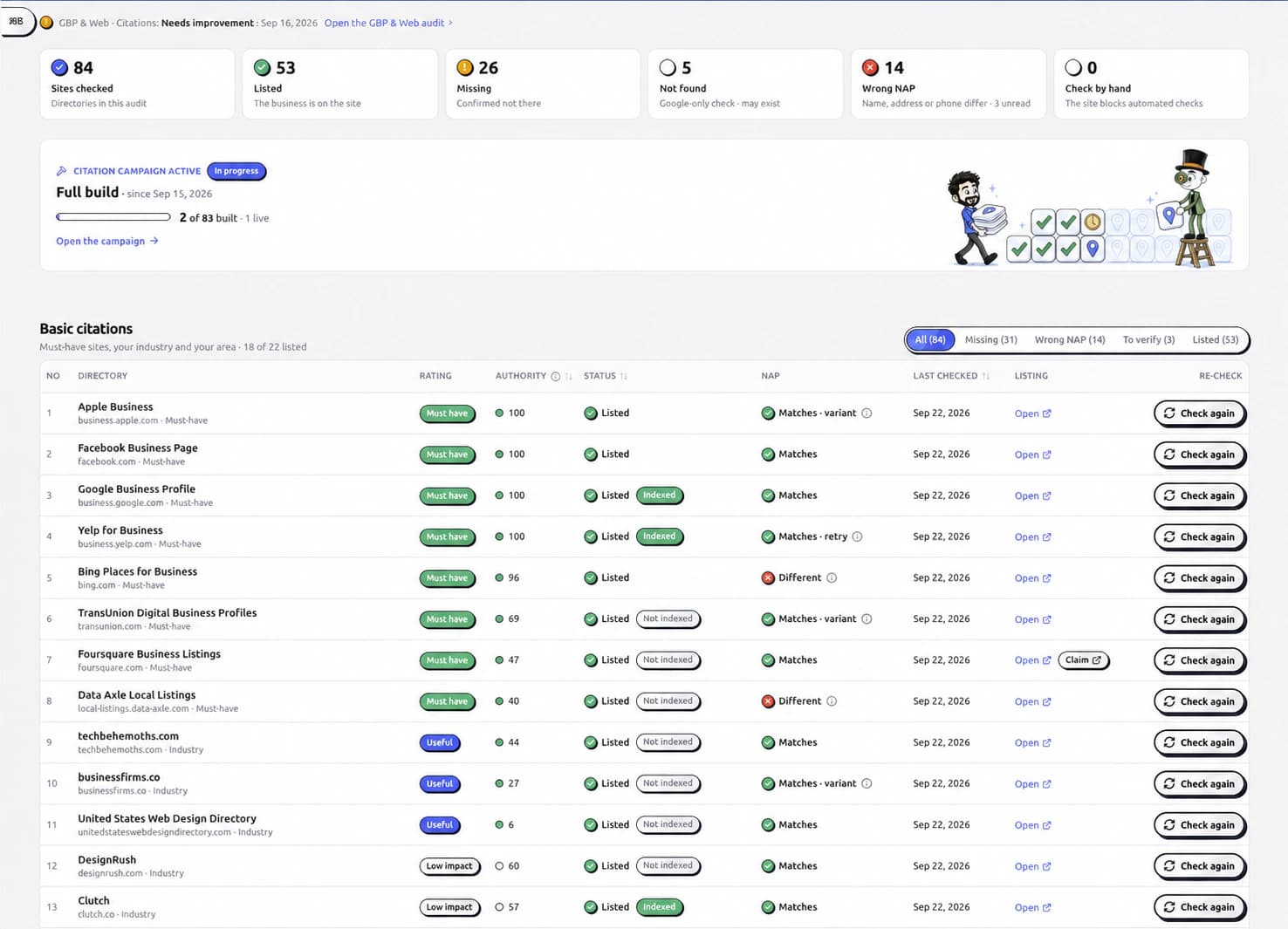
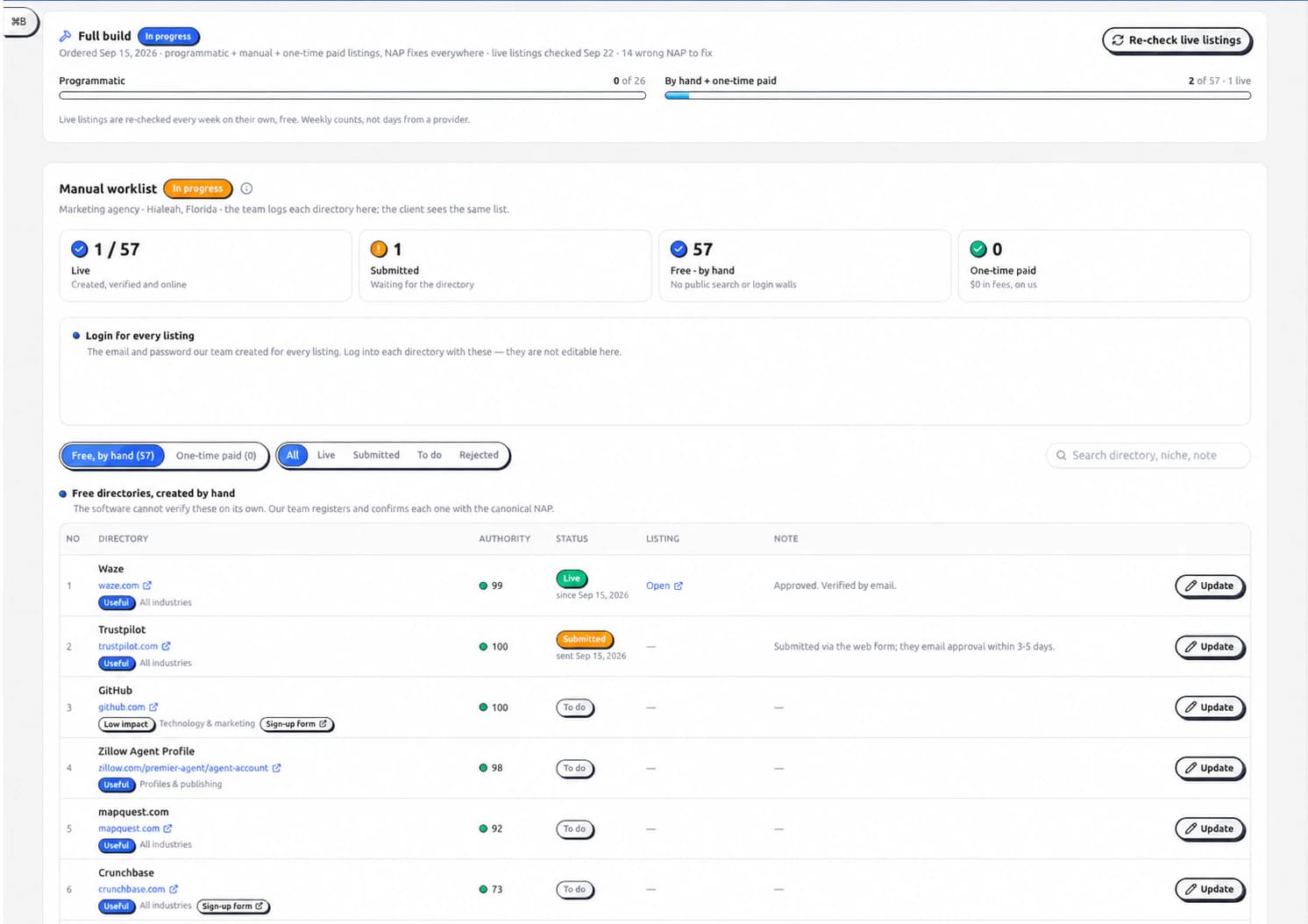
We launched a campaign to update and improve those records. Some profiles had to be claimed before we could edit them. Where a site offered no way to make the change ourselves, we sent emails requesting corrections. It took sustained work across individual platforms.
During that period, we had observed local rankings at least roughly 15 positions below their usual level. About 3–6 weeks after the cleanup, rankings became more consistent. Returning to the previous level took around three months, alongside additional local SEO work.
Those are approximate observations from one campaign, not a controlled test. I cannot separate the effect of the NAP corrections from the other work, and I would not use that timeline as a promise to another business. What the case does show is the maintenance problem: changing a name in one place can leave many other records needing attention.
Why NAP consistency matters
Customers need one reliable answer
Someone choosing a business may compare its website, map listing and reviews before booking. If those sources disagree about the address, the customer has to decide which to trust. If the number is disconnected, there may be no second attempt.
These are practical failures you can identify without estimating their effect on rankings: a wrong destination, an unanswered call or uncertainty about whether the business is still open.
Google uses more than the information you submit
Google explains that business information comes from sources including websites, licensed data and user contributions. Your Business Profile is part of that picture, rather than the only input. See how Google sources business information.
That is a reason to keep the underlying facts accurate across the places you control. It is not evidence that every directory has equal influence or that buying a large number of listings will produce a specific ranking improvement.
Local mentions, prominence, and the role of NAP
Google identifies relevance, distance, and prominence as the main factors in local rankings. It defines prominence as how well-known a business is and names links from other websites and reviews among its signals. Google's local-ranking guidance.
In my strategy, mentions from relevant local sources are part of building that presence: a merchants' association, a neighborhood publication, or a specialized directory for the area can place the business within its community. I value that hyperlocal context when deciding where a business should be represented. Accumulating generic listings does not necessarily offer the same value.
This is where NAP consistency comes in: those mentions need to identify the same business and the correct location. If they retain former names, outdated phone numbers, or another branch's address, the information supporting that presence is contradictory. Keeping the details consistent lets local references tell a recognizable story about who the business is and where it operates.
This connection between local mentions, identity, and prominence is my practical interpretation for guiding SEO work. Google does not publish a specific weight for unlinked hyperlocal citations or a rule that more consistent mentions mean better rankings. The geographic context of a mention also does not change the physical distance to the searcher. That is why I combine relevant citations and accurate data with the rest of the local SEO work.
AI search and brand mentions
An Ahrefs study of 75,000 brands found stronger correlations between branded web mentions and AI visibility than between several link metrics and AI visibility. It did not test whether correcting local NAP improves recommendations; correlation cannot establish that effect.
Google still recommends established SEO practices and current Business Profile information for its AI search features. My practical takeaway is to maintain accurate brand information. Neither source establishes that links have stopped mattering or that NAP has become a stronger ranking factor.
Which differences deserve attention first?
I use customer impact as the starting point. This table explains my priorities; it is not a list of Google's ranking weights.
| Difference | Suggested priority | Reason |
|---|---|---|
| A phone number no longer reaches the business | High | A customer cannot complete the call. |
| A listing shows the address you left | High | A visitor can travel to the wrong place. |
| One branch displays another branch's details | High | The customer reaches the wrong location. |
| An obsolete business name remains on an active listing | High when it obscures the current identity | A rebrand can leave customers unsure whether they found the right business. |
| “Street” versus “St.” for the same address | Lower, after checking the full address | The abbreviation alone does not describe a different destination. |
| Spaces or parentheses around the same phone digits | Lower | Formatting alone does not change the number being called. |
For example, “100 Example Avenue, Suite 2” and “100 Example Ave., Ste. 2” describe the same fictional destination. Changing the suite to 12 would change the destination. Standardizing the writing helps maintenance, but I give the incorrect suite priority over the abbreviation.
Low-authority citations
I would not dismiss a listing solely because an SEO tool gives its domain a low authority score. My working criteria also include its relevance to the business's industry or locality, whether customers encounter it, and whether its error sends them to the wrong place.
A relevant local association can deserve attention before a generic directory with a higher score. If a minor listing is easy to correct, I favor correcting it. If it takes substantial effort, I weigh that effort against more consequential errors. This is a prioritization judgment, not a claim that every citation affects rankings equally.
Three situations where a blanket rule fails
Your public name differs from your legal company name
Google's guidelines base the profile name on how the business is represented in the real world. Do not add search terms or an unused legal suffix merely to satisfy a generic NAP checklist. Business representation guidelines.
Your address is public—or your business travels to customers
A real storefront that receives customers can show its address under Google's eligibility rules. A service-area business that only travels to customers should hide its address on GBP. The same business guidelines distinguish these models; Google's address instructions explain how to hide it.
I favor a visible address when it is a genuine place for customers to visit. A desire for visibility does not justify displaying a private or unstaffed location as a storefront. Other directories have their own options and rules; consistency must respect how the business actually operates.
You have more than one location
Consistency applies to the facts for each branch. Two genuine locations should have different addresses; making every listing repeat headquarters' details defeats the purpose. Keep a separate reference record for each branch. Our local SEO guide for multiple locations covers the broader workflow.
How we manage NAP corrections
We use our own tools in tamer Studio, including tamerMaps, for local SEO work. tamerMaps supports NAP audits and a step-by-step correction workflow. Clients can also hire our team to manage the work. Individual platforms still determine how a profile can be claimed, verified or edited.
Our campaign setup includes a dedicated email account and the credentials needed to manage listings. We use the business's own phone number for verification, and the client handles phone confirmations when a platform requires them. Access and cooperation matter: a list of errors alone does not give us permission to edit an external profile.
The work then involves claiming profiles, making available edits and requesting corrections where direct editing is unavailable. The rebrand case required all three. An update request and a corrected public listing are different stages, so the published record is what needs checking before an issue can be considered resolved.
On the website, I also recommend checking the displayed phone number against the call button's destination. Correct text can still sit above an outdated link. For storefronts, the address and map link should lead to the intended location.
Structured data is another representation of those facts. Google's LocalBusiness documentation describes business details that can be supplied in markup, and its structured-data policies require alignment with visible content. Adding markup to a website does not edit its external directory listings.
Where NAP syndication fits
NAP syndication means distributing business details to other platforms, often through a provider or integration. Consistency describes the accuracy and agreement you want; syndication is one way to distribute the data.
In our rebrand case, listings that updated directly from GBP were the exception to the inconsistencies we found. That illustrates the value of connected data sources, without making every listing part of the same network. Sending outdated details through a distribution system can also spread the error.
Common questions
Is NAP the same as a local citation?
NAP is the set of business details. A citation is a mention of business information on another site; it may include all or only some of those details.
Must every listing use exactly the same punctuation?
A consistent house style helps your team. Prioritize accurate facts and a usable address and number over cosmetic differences. A changed digit is a different problem from parentheses around the same digits.
Is a different call-tracking number always a NAP error?
Different digits alone do not explain the setup. The questions are who controls the number, which business receives the calls and whether the configuration follows the platform's rules. Google's business guidelines require a phone number under the business's direct control. I would review a tracking setup before labeling the number incorrect.
Will fixing NAP put my business in Google's local pack?
There is no guaranteed result. Accurate details address one part of your local presence; they do not remove the effects of distance, relevance or other ranking considerations.
Should I create a new profile when I find a wrong address?
Start by checking access to the existing profile and the appropriate correction process. An inaccurate field is not, by itself, a reason to create another listing for the same business.
Keeping the business recognizable and reachable
The hardest part of our rebrand cleanup was carrying the correct information across listings with different owners, access requirements and editing processes. That is the practical work behind NAP consistency.
Our local SEO services include help connecting that work with the business's wider local search presence.