
Local SEO vs Traditional SEO Link Building: What Changes and What Your Business Needs

Summarize with AI
For twenty years SEO treated backlinks as votes. AI is revealing they were always evidence too.
Six months of link building. Forty new referring domains. The report came back green: authority climbing, every link relevant, every link clean.
Then you searched for your own service, in your own city, from your own phone. The same spot on the map. Not one.
So one of three things is true. The links did not work. Someone sold you smoke. Or link building died and nobody sent the memo.
None of them is true.
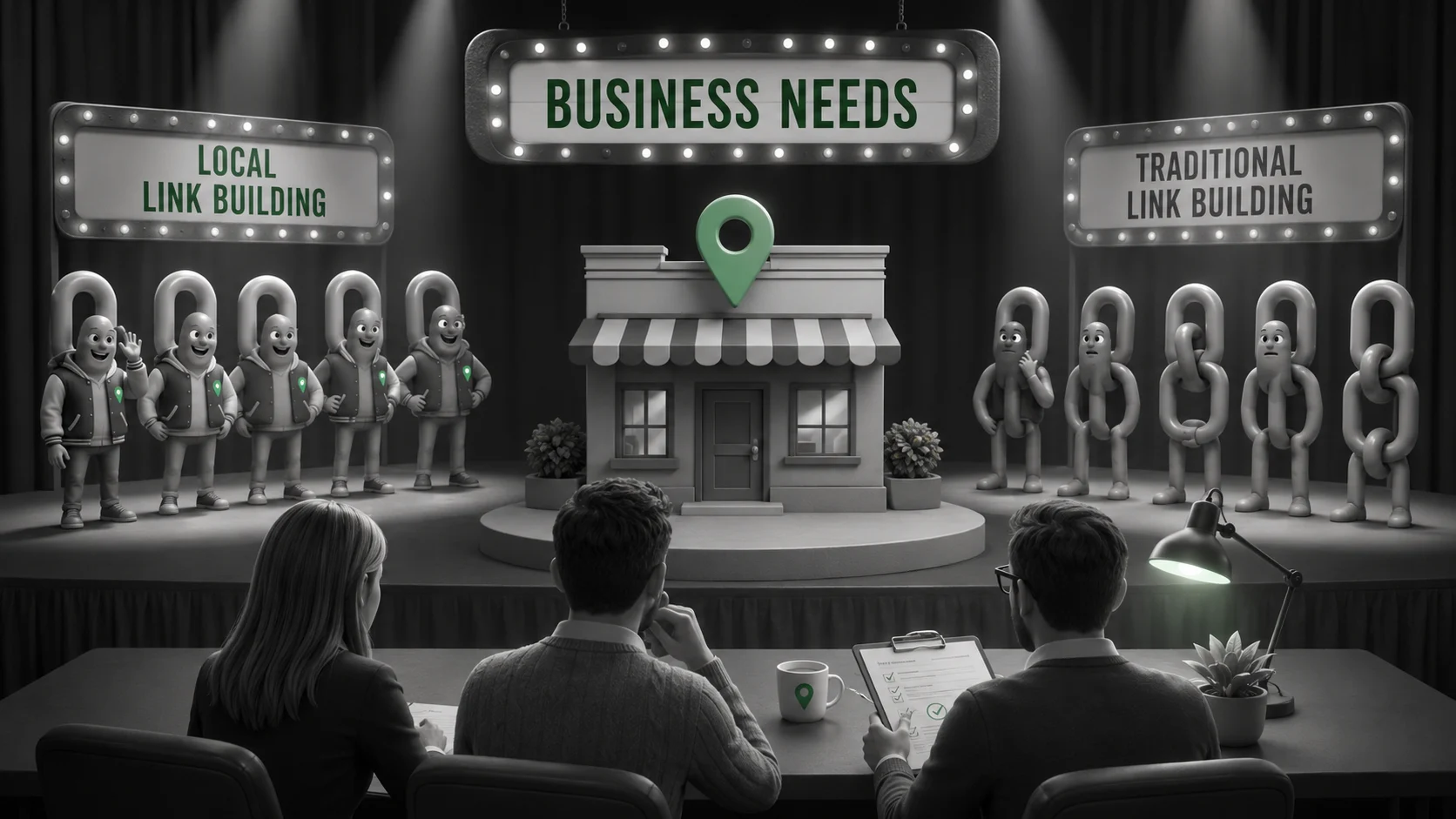
You were reading the wrong scoreboard. Local SEO vs traditional SEO link building was never a choice between two strategies. It is one link carrying two distinct signals, and you were only ever shown the scoreboard for one.
While the map sat still, a service page nobody in that meeting thought to open was climbing. Fifteen spots, maybe more. You may have won. You just do not know it yet.
And nothing died, either. Artificial intelligence did not kill link building. It changed what counts as a good link, and dragged that definition toward something local search has understood for years.
You never choose between local and traditional link building. Every backlink carries two signals, and you decide, link by link, which one is worth buying on that opportunity. How much you spend in total depends on one thing, and it is not your industry: whether your customers find you on the map or on the page.
| Local link building | Traditional link building | |
|---|---|---|
| Best for | Businesses found on a map: plumbers, restaurants, clinics, anything urgent or nearby | Businesses researched before they are called: law firms, surgeons, agencies, software, ecommerce |
| What ranks | The business | The page |
| Signal it buys | Corroboration: you exist, here, doing this | Authority: PageRank toward a URL |
| How you prospect | Geographic and industry relevance | Referring domains and topical authority |
| Directory listings | The foundation | Almost worthless |
| Nofollow links | Still testifying | Cast no vote |
| Unlinked mention | Already an asset | A lost conversion |
| Where the link points | Wherever you ask | Money pages are the hardest to earn |
| Who you ask | A partner, a supplier, a body you already belong to | A stranger. Ahrefs: five links from a hundred outreach emails and you can be proud of yourself |
| In 2026 | Its evidence base is what AI search reads | Its criteria now ask for the same evidence |
One link, two signals
A plumbing company in Houston sponsors a youth soccer league. Two hundred dollars, a banner on the fence, and the league's site adds them to its sponsors page.
Show that link to a traditional link builder and the verdict lands in four seconds. No authority. No traffic. Marked nofollow. Buried in a footer. Junk.
Show it to a local search specialist and they take it without blinking.
Both are right. They are holding the same object and reading two different signals off it, and each is blind to the one the other cannot see.
Which decides how two businesses you already know should spend their money. The plumber. And a personal injury firm across town. Both local, both single-location, both dropped into the same box by every article that ranks on this topic. That advice is going to be wrong for one of them.
The two-signal model: what a backlink actually carries
Here is the model. It describes what a link contains, not what ranking systems do with it. What they do with it, nobody outside Google knows.
Every backlink carries two signals. They travel together. They are read separately. Almost nobody prices both.
The first signal is Authority. It answers a question about a page: why should I trust this document? It is the signal PageRank was built to read. It feeds organic rankings, and now it feeds the sources an AI Overview decides to cite.
The second signal is Corroboration. It answers a question about a business: how do I know this is real, that it is where it says, that it does what it says? It feeds the map, the Knowledge Graph, and the confidence a language model has when it puts your name in an answer.
Two signals. One object. And they do not obey the same physics.
Authority transfers. It behaves like a quantity: it is conserved and it is divided. A page that links to a thousand gives each one a thousandth. Block the transfer with a nofollow and you have blocked the signal.
Corroboration is declared. A witness spends nothing by testifying, so there is no dilution: that same page can vouch for a thousand businesses and vouch for each one in full. But it does not stack like authority. It is built from independent statements, not repeated ones.
Read that last sentence twice, because everything strange about local link building falls out of it. Read it as observed behavior, though. There is no published physics of the backlink.
Two warnings before you use it, and both matter.
The signals do not split cleanly by surface. Corroboration reaches organic too: a business Google does not understand is a business that cannot rank with confidence anywhere. Authority reaches the map too, weakly, by a long route we will trace later. What changes is not which signal arrives. It is which one gets weighed.
And the second: this is not a local model that also works elsewhere. Local is not the topic. It is the laboratory, the one place the second signal has ever had a visible scoreboard. The map pack is a corroboration meter. Everywhere else that same signal has worked in the dark, which is why local SEOs learned to read it first.
What the model predicts: four things local SEO knew and never explained
Four things about local link building have been true for years, and nobody has ever explained why.
A nofollow link still works. Halfway. The attribute blocks a transfer. It does not stop a statement. BrightLocal says it: since 2019 Google treats it as a hint, not an order. It is still a page with your name, your address, and your category, and Google still reads that page.
A mention with no link at all works too. It is a statement with no transfer attached, and corroboration never needed an <a href>. Whitespark's 2026 survey lists unlinked brand mentions as a factor in their own right, and Semrush says the same about AI systems: the mention signals authority, with a link or without one. A sentence with your name in it did not need a hyperlink to get there, and it does not need one to be read.
Domain Authority does not predict local value. It measures the ability to transfer. It says nothing about credibility as a witness. BrightLocal is blunt: most local links worth having score poorly on proxy metrics. Joy Hawkins arrived from the other side, buying links priced by Domain Authority and finding high scores on domains with dead traffic. Domain Authority is a Moz metric. Domain Rating is Ahrefs'. Neither exists inside Google, and prospecting by either is optimizing for a model of a model.
And a hundred cloned directory listings are worth almost nothing, while a handful of real ones are the foundation. This is where the two disciplines have their loudest public fight. Ahrefs, a company that sells a backlink index, says in its own guide that directory submissions have little to no value in Google's eyes. Local SEO treats those same listings as the first thing you do.
Inside a model where the link is one thing, they cannot both be right. Inside a model where it is two, there is no conflict. For a national software company, a directory listing is a transfer from a source with nothing to give. Correct: skip it. For a plumber, that same listing is a statement confirming a name, an address, and a category. It is not a weak vote. It is a valid assertion of a fact.
But the clones are still worthless, and now you can say why. Corroboration accumulates through independent statements, and a hundred clones of the same record are one witness photocopied a hundred times. A link from a Miami trade association carries a geography, a category, an institution the town already trusts, and often a human who clicks. The hundred clones carry one fingerprint.
And listings came back in 2026, though not for the link. In Whitespark's survey, the most important citation factor is now presence on curated "best of" lists. Not directory volume. The lists a machine reads when it has to name three businesses and cannot afford to be wrong.
Which explains the two mistakes this whole article exists to correct. The traditional link builder looks at the chamber listing, finds no authority to pass, and throws it away. They have discarded the corroboration. The local SEO looks at a national trade publication, finds no city name, and shrugs. They have discarded the authority. Both were holding the same object. Both were reading one signal.
Where the two signals get weighed: the map and organic results
Now take the model to Google's documentation. And before you read a word, notice something almost nobody has seen: Google rewrote that page.
Today's live version says local results are based mainly on relevance, distance, and popularity. And then it titles the third section Prominence. Two words for the same factor, on the same page. The language is in transition and Google has not finished the job.
And of that factor, this is all that survives: prominence is how well-known a business is, and this factor is also based on things like how many web pages link to your business and how many reviews you have. Read it slowly. How many. Not how strong. Not how authoritative.
That is the sentence the model needs, and it is still there. But there was another one, and what Google deleted matters more than what it kept. For years the same page said prominence drew on information from across the web, "like links, articles, and directories." And it said this: your position in web results is also a factor, so SEO best practices also apply to local SEO.
That sentence is gone.
It was the only public statement Google ever made connecting your organic ranking to your local ranking, and the industry built a decade of practice on top of it. Almost everything you will read about local SEO still cites it as current. It is not.
Google does not explain its edits, and it did not explain this one. What is left standing is this: links count toward how well-known Google thinks a business is. A count. So no, there are not two sealed engines. It is one web, read twice, by systems that weigh what they find there differently.
Organic weighs authority. That is PageRank, doing what it has done since 1998: a vote whose value depends on the voter. The map weighs corroboration, and then makes it fight for a spot against proximity, against category, against how recent the last review is.
Which is why this happened. In 2024, Sterling Sky ran a test: a strong, topically relevant link to a page that ranked poorly. The organic result jumped to the top three. The map pack moved one position.
That is not a broken link. It is a link loaded with authority and nearly empty of corroboration, landing on a surface that mostly wants the other signal. A national trade blog says nothing about where you are.
Darren Shaw's annual survey asks forty-seven working local SEOs, and scores the map pack and local organic separately. Everyone who has read the 2026 edition agrees on the direction: links weigh more on the page than on the map. In the same report, the chart of link signals over time reads, in Miriam Ellis' words, like a staircase descending into a dark basement. The only staircase going up in that chart is reviews.
You will not pull a percentage out of here. Everyone who has summarized that report cites the weights differently, the report itself is behind a page that will not render, and this article is about to tell you to distrust any benchmark you cannot check yourself.
Now the objection, because burying it would be cheap. Whitespark argues that because most small businesses have almost no links, getting a handful of good local links can make a real difference in low-competition markets. That is not a contradiction. A weak signal still moves a weak field. If your three competitors have nothing, almost anything wins, and it stops being true the moment one of them decides to compete.
And the authority signal does reach the map. The route the industry always draws is this: the link builds authority for your site, that authority reaches the page your business listing points to, and the strength of that page feeds prominence. Nobody has ever proven that chain, and this year it lost the single line of documentation that ever backed it. It is a chain, not a cable, and a chain loses strength at every link.
You will read the opposite everywhere, usually like this: a link from your chamber of commerce weighs more in the map pack than a high-authority guest post. Take the chamber link. Take it every time. But not for that reason. It corroborates a business, and it can push a service page in organic, which is where almost all the money is. Sell someone local links promising the map will move, and you have sold them the one job links are worst at.
The overlap is where most of the budget burns
Everything so far has been about differences. Now the part that stops you overcorrecting, because these two share three things, and all three are where money disappears.
Both are useless without a page to rank. The most expensive mistake is identical in both: buying the links first and deciding where to point them afterward. You choose the service, the city, the page that carries that intent, and the internal links that feed it. Then you build. In reverse, it is a budget with no destination.
Both punish irrelevance. More links is not better. More bad links is noise, risk, and money you will not see again.
And both run on transactions. Guest posts are paid for. Niche edits are paid for. Sponsorships are paid for. Chamber memberships are paid for. Premium directory profiles are paid for. Google's spam policy explicitly names the exchange of goods or services for links, and yet nobody in the world marks their chamber membership as sponsored.
Joy Hawkins asks the uncomfortable question without anesthesia. Sponsoring a youth league, or paying for an enhanced profile in a local directory, are things most SEOs actively recommend. So how exactly is that not buying a link?
Neither of these two disciplines is pure organic, and whoever sells you that story is selling you something else. What separates a clean link from a dirty one was never whether money changed hands. It is whether the thing you paid for was real.
And one last honesty, because this article is about links and has been writing as if links were all of corroboration. They are not. Google assembles its understanding of a business from profiles, directories, articles, official sites, and structured data. Organization and LocalBusiness markup exists precisely so you can declare what you are without waiting for someone else to say it. The backlink is the most versatile carrier of that set, because it is the only one that moves both signals at once. It is not the only one. A business with impeccable links and an incoherent entity has built a very expensive contradiction.
Stop pointing every link at the home page
Which leaves the cheapest mistake on this page, and the one almost everyone makes.
The soccer league links you wherever you ask. So does the chamber, the supplier, the trade association, the local paper. None of them will object that your page is too commercial, because they are not linking a page. They are listing a business.
That is a freedom traditional link building does not have. Ahrefs is blunt: the pages you most need to rank are the hardest to link, because editors would rather link something informative than something that sells. So the traditional link builder builds a linkable asset, earns it links, and pushes the authority toward the money page through internal links. A detour, with loss on every turn.
The plumber never needs the detour. Ask for /plumbing/houston/ instead of the home page, and the same link now corroborates the business and pushes the exact page that closes the sale. Same sponsorship. Same two hundred dollars. Twice the return. Almost everyone gives that second half away. Every time.
A note on anchor text. A sponsors page links to a business by its name, so leave it. If thirty sponsorship pages all say plumber in Houston, you have optimized nothing. You have built a pattern, and patterns are what get looked at.
The question that decides your budget: map or page?
You now know how to spend a link. You still do not know how many to buy, and the answer is not the same for the two businesses this article opened with. Same city. Same category on paper. And they need almost opposite strategies, because the question that matters is not what kind of business you are. It is this:
Does your demand live on the map, or on the page?
A pipe bursts at eleven at night. Nobody researches. They open Google Maps and call whoever is closest and answers. That ranking runs on proximity, category, and review pace. Forty beautiful local links will barely move it.
The firm lives on the other side of that line. Nobody picks a personal injury lawyer by tapping the nearest pin. They research. They read. They compare. That happens in organic results and increasingly inside AI Overviews, and both run on the machine that weighs links.
This split is not mine. Joy Hawkins draws it directly in the same piece as the test: a firm that lives on organic traffic should invest in links, and a locksmith whose leads come through the business listing is better served by almost anything else. Send them both the same invoice and you have over-served one and starved the other.
How many links you need, and why nobody can tell you
People search for the 80/20 rule of SEO expecting a percentage. It does not exist, and whoever gives you a clean split between local and traditional link building made it up at their desk.
Distrust any link-volume benchmark just the same. The numbers still circulating are old, most predate Google Business Profile being called that, and nobody has measured again. Ahrefs observed, in a guide originally published in 2021, that you rarely find a local business on page one with more than 150 referring domains. It is a ceiling, and it is old, and nothing more.
The real number is not in a study. It is in your market, and you can count it this afternoon. Search your money keyword. Take the three businesses in the map pack. Drop their domains into any backlink tool and count their referring domains. That is your target, and it is the only figure that is true today, in your city, in your category.
| Where your demand lives | What to do with links | Where the rest of the money goes |
|---|---|---|
| The map | Very little. Match the businesses in your pack, and stop. | Primary category, hours, photos, review pace |
| Both | Match your pack, then keep going for the organic half. | Split it |
| The page and AI answers | No ceiling. Whatever organic competition demands. | Content, proprietary data, digital PR |
The plumber who gets a handful of real local links has already done more than most of their competitors, and the map will barely register it. Every dollar after that belongs to their listing. Telling them to split 70/30 between two kinds of link is answering a question they should never have asked. The firm is fighting other firms with real budgets in organic. No ceiling, no shortcut.
Whatever the count says, build in this order. Take first every link that carries both signals. The trade outlet published in your city. The supplier headquartered forty minutes away. The industry association with a chapter in your county. These carry both signals at once, so they never force a choice. Most companies have more of these available than they think, and almost nobody claims them.
Then split what is left. If your demand is on the map, keep collecting local witnesses until they run out, which happens faster than you expect, and stop. If your demand is on the page, go build topical authority and do not stop. That is the ratio. It was never a percentage.
And it is not decided once, in January, in a meeting. That decision is made link by link, on three inputs: the intent of the query, the geography it carries, and the surface where the demand is captured.
2026: AI is why traditional link building now looks like local SEO
Which is where the model stops being a lens and starts being a forecast.
Semrush published its updated criteria for a quality backlink this year. The old ones, they said, have been replaced: high domain authority score, follow link, exact-match anchor. Out. The new list: Relevance. Trust. Context, meaning the mention explains what you do and why you matter. Co-citation proximity, meaning you appear next to brands the machine already recognizes. Persistence. And retrievability, meaning the mention sits somewhere a language model can pull it from.
Read it again with the model in hand. Not one of those six criteria measures authority. Every single one counts something instead of weighing it.
| Semrush 2026 criterion | What it actually is |
|---|---|
| Relevance | Evidence by category |
| Trust | Evidence by institution |
| Context | Evidence in a sentence |
| Co-citation proximity | Evidence by the company you keep |
| Persistence | Evidence that survives |
| Retrievability | Evidence a machine can actually reach |
Relevance and Trust are authority, obviously. Nobody deleted authority. But look at what they now ask you to produce to prove it: real editorial standards, a real audience, little spam footprint, and a mention on a site a machine can reach. None of that is a number you can buy. It is testimony. And testimony is how corroboration has always worked.
Semrush did not remove authority from the list. It removed the number, and put the witnesses in its place.
The headline everyone wrote this year was that artificial intelligence is changing link building. It is true and it is shallow. Here is the deep version: artificial intelligence is forcing search to care about corroboration as much as it has always cared about authority.
A language model cannot fake it. When it is asked who the best plumber in Houston is, it cannot rank documents and cross its fingers. It has to name a business. And to name a business it has to believe it exists. That is not a question about authority. It never was. It is the question local search has been asking from the start, and now it is being asked of the whole web.
A warning, because this is the point where it would be easy to overreach. Nobody in local SEO ever published a six-point list, and Semrush was not writing about local SEO. Putting the two lists side by side is an editorial act. But it is a reading that is hard to un-see. Traditional link building is not evolving into something unrecognizable. It is being handed a second signal it never learned to price, by machines that need that signal more than the first.
Run your own numbers before you spend anything
Which leaves one thing to do, and it takes about ten minutes. You do not need someone else's case study. You need your own.
Open your Google Business Profile performance report and set it to the last ninety days. Add up calls, direction requests, and messages. That is your map demand. Links will barely touch it.
Now open Search Console or your analytics. Find the organic sessions that landed on your service pages without going through the listing, and count how many turned into a real contact: a form, a tracked call, a booking. That is your page demand. Links move it hard.
Put the two totals side by side. If the first crushes the second, you are the plumber. Fix the listing, chase reviews, keep the citations clean, and treat link building as maintenance, not growth. If the second is what holds the business up, you are the firm. Links are not an extra. They are the lever, and every one of them should point at a page that closes. If the two are close, you have the hardest job on this list, and the honest answer is that you fund both.
Most businesses have never done this. They buy the package their industry is supposed to buy, and then wonder why the results feel arbitrary. Ten minutes. Then spend.
For twenty years we built links to persuade an algorithm about a page. The next decade is about building evidence to persuade a machine about a business. The backlink never changed. Only the question it is asked did.
Want to know whether your demand lives on the map or on the page before you spend a dollar on links? Get in touch and we run the numbers on your account with you.
Frequently asked questions
How long does local link building take to work?
Split the question, because the two surfaces run on different clocks. A follow link to a service page can move organic in weeks, and your rank tracker will show it. The map is slower, smaller, and responds mostly to things that are not links. Give organic ninety days before you judge it. Do not put a deadline on the map.
What is the difference between a local citation and a backlink?
A backlink is a link. A citation is a mention of your name, address, and phone, with a link or without one. Every local backlink that carries your address is also a citation; not every citation is a backlink. Traditional link building only counts the first. Local search counts both, which is why the two disciplines talk past each other.
Do links from outside my city help my local ranking?
For one of the two signals, yes. A national trade publication passes real authority and will push your service pages in organic. What it cannot do is confirm that you operate in Houston, because it says nothing about Houston. An out-of-town link is half a link. Take it anyway when the authority is real.
If I have multiple locations, does each one need its own links?
Hundreds, no. But each location page needs enough evidence to justify existing, and a dropdown in your menu is not evidence. Build authority to the parent page, pass it down with internal links, and then earn a handful of genuinely local links per market. A location page no local site has ever mentioned is a page Google has no reason to believe in.
Can a business with no public address build local links?
Yes, and it matters more, not less. A service-area business hides its address on its Google listing, removing one of the strongest corroboration signals it has. Everything else has to carry more: the county trade body, the manufacturer's dealer page, the local press. When you cannot show the address, the witnesses are all you have left.
Can I get penalized for local link building?
Less than the anxiety suggests, and the real danger is somewhere else. Your website and your Google Business Profile are separate assets, judged by separate systems. Bad links cost you organic rankings, which recover. A suspended listing costs you the entire map, and link building does not touch that risk. Be careful with your links. Be paranoid about your listing.
Do social profiles and directory accounts count as links?
They count, but not as authority. Ahrefs is right that you can create them yourself, which is exactly why they pass almost nothing. What they do is confirm a business exists and hold a consistent name, address, and phone. That is corroboration. Claim a few dozen, then stop, and go do something a competitor cannot copy in an afternoon.
Sources referenced
This article draws on the public work of BrightLocal (nofollow link treatment and proxy metrics), Whitespark (2026 local citation factors survey), Semrush (2026 quality backlink criteria and signals for AI systems), Ahrefs (link building and directory guides), Joy Hawkins and Sterling Sky (link tests on map vs organic), and Darren Shaw's annual local ranking factors survey (Whitespark), with commentary from Miriam Ellis. The Google Business Profile documentation cited is the official "how local results are ranked" help page.