
Local SEO for Multiple Locations: A Step-by-Step Playbook

Summarize with AI
Local SEO for multiple locations rarely starts at zero. You start with half-built profiles, listings you don't remember creating, and something broken you haven't noticed yet. So this playbook starts by auditing what already exists: eight steps, checked against what Google documents and, where Google is silent, against current research. Treat them as a default sequence, not a rigid order; an urgent fix jumps the queue.
We'll run every step against a real business: Nail Kingdom, a nail salon with two locations in Miami that once ranked near the top of its market, then stopped investing and lost the presence. And the ground keeps moving. In BrightLocal's Local Consumer Review Survey 2026, the share of consumers using AI tools for local business recommendations jumped from 6% in 2025 to 45% in 2026.
Audit
Check each location’s Google profiles, website, and grid rankings before changing anything.
Prioritize
Rank the fixes by impact, starting with data accuracy.
Fix your data
Make each location one consistent entity: name, address, phone, and categories.
Claim and verify
Claim every Google Business Profile, verify it, and connect each one to its own location page.
Build a dedicated location page
One page per branch, with real location-specific content.
Build citations
Work the tier-one directories and data aggregators; ignore the auto-generated junk.
Earn reviews per location
Not brand-wide, and respond to them.
Measure by location
Use a grid or heat map, never a single brand-wide average.
The order matters most at the start. Fix the foundation before you build.
How Google Ranks Local Businesses (the Foundation for Local SEO Across Multiple Locations)
Before the steps, the foundation everything rests on, straight from Google's documentation.
Google publicly identifies three primary factors for local ranking: relevance, distance, and prominence, or popularity. (Google's help page uses "popularity" when it lists the three, while still titling and explaining that section as "Prominence." The documentation uses both words; treat them as the same idea rather than a formal rename.) Relevance is how well your profile matches what someone searches. Distance is how far you are from the searcher. The third one is how well-known your business is, and it's the one worth understanding properly. Google states it's based partly on the number of websites linking to you and the number of reviews you have, and that more reviews and positive ratings can improve your local ranking. If you want the longer version of how those links get read, we take it apart in local SEO vs traditional link building.
Google also says, in its own words, that there is no way to request or pay for a better local ranking. Keep that line in mind every time someone sells you a shortcut.
Those three are the frame: relevance, distance, prominence. Google says local results are based primarily on them, which isn't the same as publishing the full formula or promising every tactic slots neatly into three boxes. Still, it's the right test to hold each step against. When a tactic can't tie back to relevance, distance, or prominence, that's a signal it was invented somewhere other than Google.
Step 1: Audit What You Already Have
Start here, before you build or change anything. You cannot fix what you haven't measured, and in multi-location the damage is usually hiding in plain sight.
Go back to the salon. You can run the same check on any business in a few minutes.
Audit the Profiles
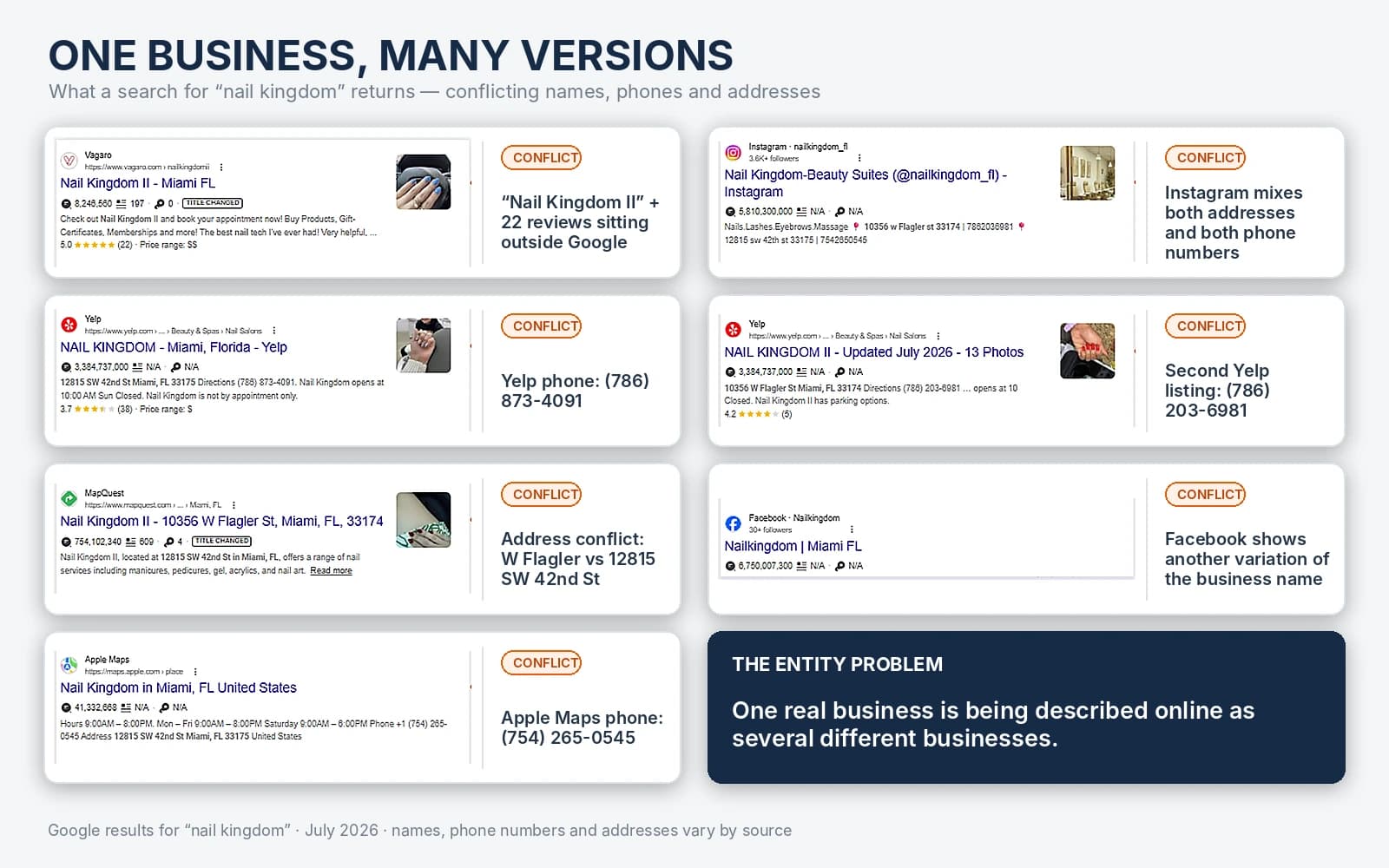
What a public audit surfaces:
| What we found | What it reveals |
|---|---|
| The two locations use different names across profiles: the base brand on one, a suite-branded variant on another, a neighborhood tag on a third | Inconsistent name across sources, against Google’s own guideline |
| Both locations’ addresses and phone numbers cross-listed in a single social bio | The two profiles bleed into each other, confusing which data belongs to which location |
| The same street address shows up tied to several different businesses across directories and records | Google has to figure out which business the address actually belongs to |
| Third-party sites auto-generating “booking” pages for the address under invented names | Nobody claimed the space online, so directories filled the vacuum |
| Review counts split across platforms and profiles | Reputation is fragmented, not concentrated where customers look |
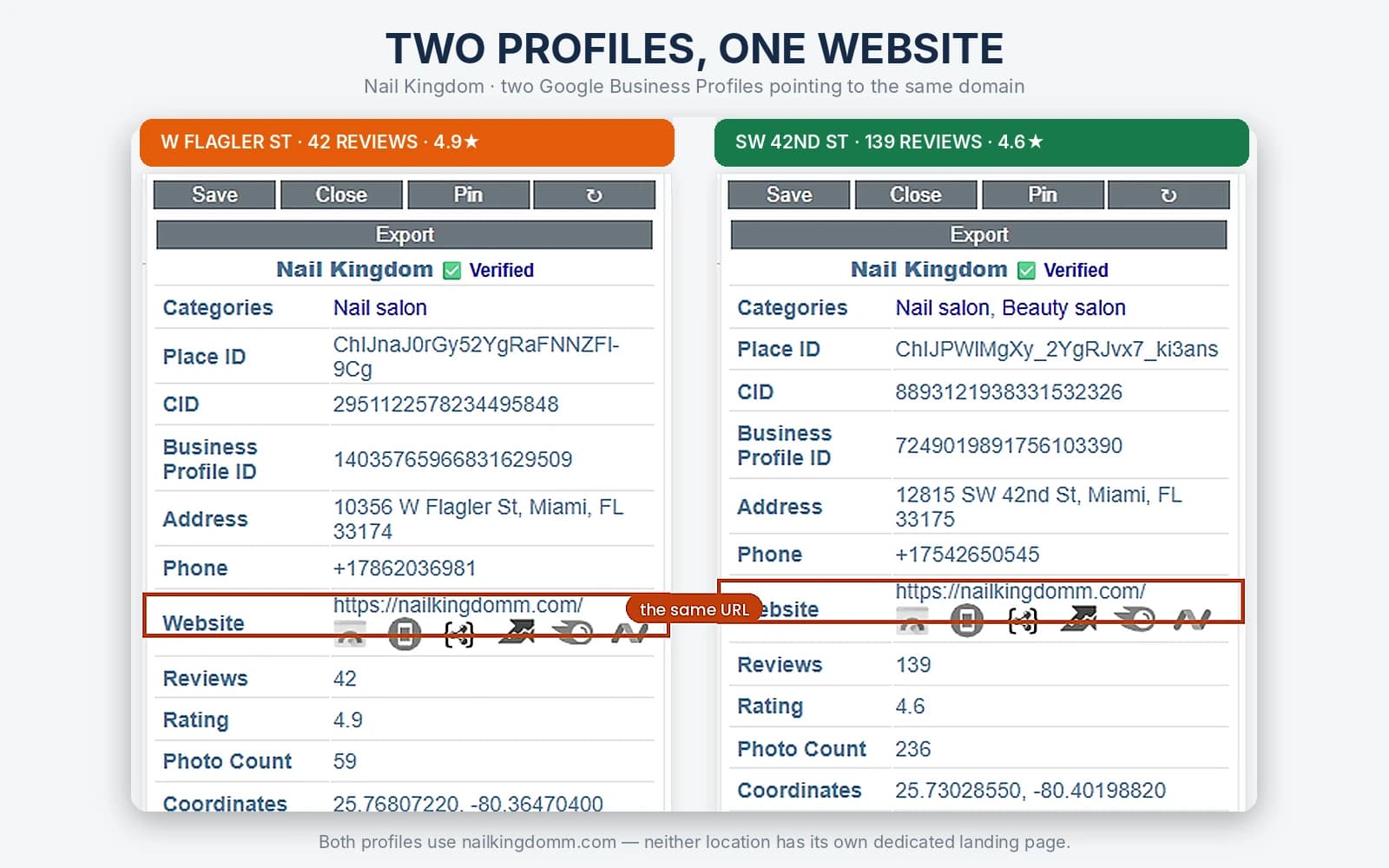
| The domain that once hosted their site now sits parked, with profiles pointing to a homepage or nowhere | They had a real website and lost it, so each location has no home base to rank |
| The grid scan showed the location with more reviews was the less visible one | Star count was hiding a ranking problem, not proving strength (more on this in Step 8) |
Notice that none of these are opinions. They're verifiable facts, sitting out in the open across Google, Yelp, Apple Maps, and a couple of directory sites.
And that's the point: you audit everywhere, not just Google. A location's data problem almost never sits inside one profile: it sits in the disagreement between sources. This salon's two locations had their addresses and phone numbers cross-listed in a single Instagram bio, so the data for one bled into the other. One address showed up across directories and public records tied to several businesses, and third-party sites had spun up booking pages for it under names that weren't even the salon's. Whatever the reason, Google is left to sort out which business each address belongs to. If you only check the Google Business Profile, you never see any of it, because the problem is that the sources don't agree with each other.
How to run your own audit. For each location, check four things across every place the business appears (your website, Google Business Profile, Yelp, Apple Maps, Bing, and the major directories):
- The business name. Does it match everywhere, or does one listing carry an extra word?
- The name, address, and phone. Do all sources agree, down to the actual number, not just the formatting?
- Claimed and verified status. Is each profile claimed and verified, on every platform?
- Review and photo count. Per location, side by side.
Audit the Website
Then audit the website itself, because the profiles are only half the picture. For each location, check four things:
- A dedicated page. Is there one for that branch, or does everything point to the homepage (or worse, to a dead or parked domain)?
- Where the profile points. Does the Google profile link to that location's page, or to the homepage?
- NAP match. Does the page carry the same name, address, and phone as the profile?
- Index status. Is it indexed, with real content on it, or is it a placeholder?
You're not fixing any of this yet, that's Steps 4 and 5. Right now you're just writing down what's broken. A business with clean profiles but no location pages behind them is likely giving up organic reach, conversion, and the corroboration a real page provides, even if it still appears on Maps.
A business that once had a real website and let the domain lapse has a bigger problem than any listing. A parked domain is a lost asset and a poor experience. A profile pointing at a dead URL gives Google nothing to corroborate, while a competitor's working site does. Losing the site is the same story as losing the rankings: upkeep stopped and the asset went with it.
Run the Baseline Grid Scan
Then add the piece that turns a ranking into a map: a grid scan. A tool like Local Falcon shows your ranking as a map instead of a single number, because your ranking shifts from block to block. A location can rank first on its own street and vanish two miles away, and with two locations close together, a grid is the only way to see where each one actually wins and where they overlap.
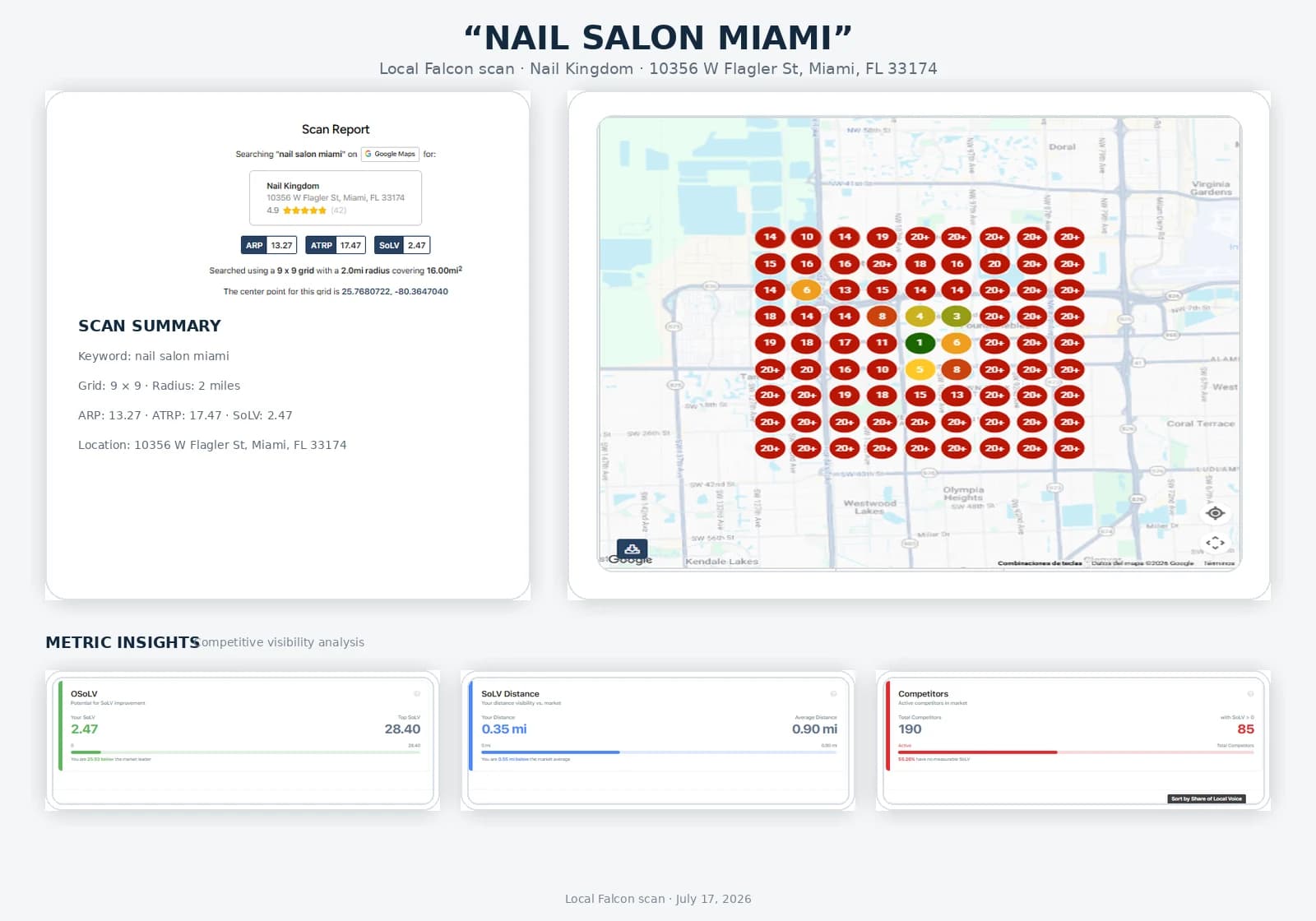
For a first pass, run one scan per location on a handful of keywords. The radius doesn't come with a fixed number: adjust it until most of the grid comes back green or yellow, and tighten it when the edges are all red. For this Miami salon, in a dense urban market, we started around 1.5 to 2 miles; a different category, density, or catchment area may call for a different starting radius. Then note each location's Share of Local Voice, that's your baseline, the "before" you'll measure against once the fixes are in. Record the specifics too (date, keyword, grid size, radius, center point) so the scan is repeatable. The full step-by-step, including Place ID lookups, grid and radius by business type, and reading the heat map, is covered in the measurement and AI-visibility guide in this series.
Save this as your baseline. Note the SoLV score (Share of Local Voice, how often you land in the top three across the grid) for each location and keyword. That's your "before." When you finish fixing data, profiles, and pages, you re-run the identical scan and compare. That comparison documents whether visibility changed after the work, instead of asking anyone to take it on faith. It's evidence of movement, not proof of cause, so annotate what you changed and read several scans rather than a single pair.
The audit was run in July 2026 against public data only (Google Business Profiles, Yelp, a booking platform, state business records) with no account access. The grid scans used Local Falcon on Google Maps, one scan per location, for the keywords "best nail salon," "nail salon near me," and "nail salon miami," on a 9x9 grid at roughly a 2-mile radius centered on each storefront. SoLV is reported per location per keyword. The scans are published with the business named, using its public profile data and our own Local Falcon scans. Limitations worth stating plainly: these are single-day snapshots, SoLV is one diagnostic among several, and a two-location salon is one case, not a controlled study. It illustrates the method; it doesn't prove a universal rule.
How you know Step 1 is done: you have a written list, per location, of every name mismatch, every crossed or contradictory piece of NAP data, every unclaimed or duplicate profile, and a grid snapshot of where each location ranks right now. That snapshot is your "before." You can't reconstruct it later, so capture it now.
Step 2: Prioritize Before You Touch Anything
Now you're looking at a list of everything that's broken. The instinct is to start with whatever feels productive. That instinct is how budgets get wasted on the wrong work.
Score each fix instead. The method is called ICE: Impact times Confidence times Ease, each rated 1 to 10, multiplied out. It comes from growth hacking, where Sean Ellis (who coined the term "growth hacking") popularized it as a way to decide which experiment to run first; it works just as well for ranking local SEO fixes. One thing to be honest about up front: these numbers come from your judgment; nothing measures them with an instrument. You're estimating how much a fix will move the needle (impact), how sure you are it'll work (confidence), and how hard it is to do (ease). Two people scoring the same list might land a point or two apart. That's fine. The value isn't false precision; it's that scoring forces you to compare fixes against each other instead of doing whatever feels urgent.
Here's the audit's real findings, scored with that in mind:
| Task | Impact | Confidence | Ease | Score |
|---|---|---|---|---|
| Fix the cross-listed names and NAP so each location is one clean entity | 10 | 9 | 6 | 540 |
| Rebuild a real website with a page per location | 9 | 8 | 4 | 288 |
| Bring the weaker location’s reviews up to the ranking floor | 8 | 7 | 5 | 280 |
| Reclaim or clean up the directory listings under wrong names | 6 | 6 | 5 | 180 |
| Publish weekly Google Posts | 3 | 4 | 8 | 96 |
Where do those numbers come from? Your judgment, informed by what Google emphasizes. Take the entity cleanup at the top. We scored it highest because Google explicitly makes complete, accurate, trusted business data the foundation of local ranking, and because the audit showed contradictions hitting both locations, so its impact and confidence are genuinely high. That's a defensible call, not a published Google priority ranking, and that distinction matters. The rest is reasoning you can follow and disagree with. The website rebuild has high impact but low ease, because it's real work, so it scores below the entity fix even though both are critical. Reviews score high but not top, because there's a ceiling on how much they move ranking (Step 7 covers why). Posts score low on impact because a controlled Sterling Sky test (three profiles, back in 2021) found no measurable ranking effect. That's useful evidence, though limited, and not proof they never matter. They score high on ease because they're trivial to publish, which is worth keeping in perspective: easy to do isn't the same as high impact.
The order that falls out: fix the tangled entity, rebuild the site, fix the weak location's reviews, clean the directories, and only then bother with Posts. Doing Posts before the entity is fixed is polishing a doorknob on a house with no foundation. If you'd scored it differently, fine, but now you're arguing about a defensible list instead of guessing.
This is where scale changes the answer. With two locations, most of your list can be fixed by hand in an afternoon. With 50, you need a system. With 500, you need infrastructure. The priority order stays the same; only the tooling to execute it changes. Don't buy an enterprise platform to manage two profiles, and don't try to run 500 by hand.
How you know Step 2 is done: every item from your audit has an ICE score, and you have a ranked list. You attack it top down.
Step 3: Fix Your Data Foundation
Data comes first because it's the prerequisite for everything else. If Google doesn't trust that your business is real and located where you say, most of what you do downstream is built on sand. This is the entire "data" pillar in one step: name, categories, address, and one clean profile per location.
One distinction to hold onto, because getting it backwards is the classic multi-location mistake: some of this has to be identical across every location, and some of it has to be specific to each one.
Identical across all locations: the business name (every branch, same country, same name) and the primary category (shared when branches run the same business).
Specific to each location: the street address (one profile per location, no duplicates), the local phone number that rings at that branch, and the map pin, sitting on your door rather than the building next to it.
Secondary categories: they should match the services each branch actually offers, so they may be identical across locations or differ where the services genuinely differ. Never vary them just to chase different keywords.
Name
Every location of the same business, in the same country, uses the same name. Google's example is literal: all Home Depot stores are "The Home Depot," not "The Home Depot at Springfield." Our salon breaks this: across its profiles the two locations show up under the base brand on one, a suite-branded variant on another, and a neighborhood tag on a third, so the same business reads as several. The only exceptions are genuine sub-brands applied consistently, or a location that really does use a different name on its sign and paperwork.
This isn't a minor detail. Stuffing a keyword into the name works. Sterling Sky ran the test: adding "salad bar" to a restaurant's name moved it from unranked into the top five almost immediately. It also violates Google's guidelines and is reportable by competitors. So when a rival outranks you with a keyword-packed name, you now know two things: why it's happening, and that auditing and reporting it is real, doable work.
Categories
This is a guideline worth getting exactly right. Google says to use as few categories as possible, and gives a one-line test: pick categories that complete "this business IS a," not "this business HAS a." Google already includes the broad parents automatically. Choose "Golf Resort" and Google implicitly covers "Resort Hotel," "Hotel," and "Golf Course." Adding them by hand does nothing.
Meanwhile, on the same results page where you find Google's guideline, Semrush recommends adding as many categories as you think describe your business, and salon guides list several primary categories to choose from. One of these sources is Google. The others are guessing. Follow Google. If you're not sure which primary category actually fits each location, we walk through how to choose it in how to choose your Google Business Profile category.
Address
A virtual office isn't eligible. Coworking counts only if your staff works there, greets customers there during stated hours, and the space carries permanent signage. One profile per location, no duplicates, and duplicates are what block verification later, so clear them now.
There's a messier version of the address problem, and our salon has it: an address that public records and directories tie to several businesses at once. When Google sees the same street address linked to a nail salon, an electronics store, and a couple of directory-invented names, it has to decide which business actually lives there. You can't always control who else claims your address, but you can make your own signals airtight: the address on your profile, your site, and your core citations should match exactly and consistently, so Google has one clear, well-supported answer even when the address is noisy. Confirm the profile's pin actually sits on your door, not on the building next to it.
How you know Step 3 is done: identical name across all locations of the same business, a shared primary category with secondary categories that match each branch's actual services, an address and pin that meet the rules and match across your profile, site, and core citations, and zero duplicate profiles.
Step 4: Claim, Verify, and Connect Every Google Business Profile
With clean data ready, get every location claimed and verified. Verification tells Google you're authorized to represent the business, which makes the profile far more likely to show. If a location is verified and still missing from the map, work through why a Google Business Profile stops showing up before you assume the data is the problem.
If you have 10 or more locations of the same business, you can request bulk verification. One detail worth knowing before you apply: duplicate, suspended, or disabled profiles don't count toward the 10. And an agency managing several separate businesses in one account can't bulk verify at all. That tool is for one business with many locations, not a portfolio.
Connect each profile to its own location page, not the homepage. This is the link between this step and the next one. Each branch's profile should point to that branch's own page, so Google ties the listing to the right local content. If the site doesn't exist yet, as with our salon that lost its website, this is where Step 4 and Step 5 interlock: you rebuild the location pages first, then come back and point each verified profile at the page that matches it. A profile aimed at a dead homepage or a parked domain is a wasted signal.
Then plan for the real operating cost. The bulk spreadsheet covers structured data (names, addresses, phones, hours, categories, descriptions) and, for businesses with 10 or more locations, photos via image URLs. Beyond the spreadsheet, the Business Profile APIs let you manage Posts, media, and services at scale, though that takes development work and API access. What stays stubbornly manual, or needs third-party software sitting on the API, is the ongoing per-location content: fresh photos of each specific space, location-specific Posts, Q&A. (Google's own capabilities shift here; the Q&A API, for one, was discontinued on November 3, 2025.) The limitation is operational, keeping dozens of locations individually current takes real hours, not that the tools can't bulk-load at all. That workload is the true cost of multi-location, and no dashboard erases it.
On phone numbers: Google recommends a local number over a central one "whenever possible." That's a recommendation, not a mandate, no matter how many guides list a unique local number as a hard requirement.
How you know Step 4 is done: every location verified, each profile pointing to its matching page, and its own hours, phone, and details in place.
Step 5: Build Location Pages (and Specialty Subpages) That Earn Their URL
Every location needs a page, but not every page deserves to exist. This is where thin content actually gets made, and where most of the myths live.
URL Structure
Subfolders are usually the simpler choice for multi-location sites, but be honest about why. Google's John Mueller has said plainly that Google has no inherent ranking preference between subfolders and subdomains; it treats them the same for indexing and ranking. The case for subfolders is practical: easier management, cleaner internal linking, one property to track in Search Console, and less technical overhead than standing up separate subdomains. Pick based on those realities. A genuinely independent franchise brand may have real reasons to go its own way.
The Page Earns Its URL
The idea that each page earns its URL is BrightLocal's, from their guide on location pages: each page needs to earn its URL, and a page mostly copied from another city page with the address swapped out just bloats the site with low-value duplicate content. BrightLocal suggests aiming for more than half the page to be location-specific. Treat that as a production heuristic from BrightLocal, a useful target to write against, not a Google threshold and not a shield against filtering.
To put the principle to work before you publish, ask four questions of each page:
- Does it have information specific to that location?
- Does it help someone choose between nearby options?
- Would it be useful even if Google didn't exist?
- Does it have enough local substance to avoid being a template with the city swapped out?
Four yeses, and the page earns an indexable URL. If any answer is no, the page isn't ready to exist yet: strengthen the locator or the regional page before you open another URL.
To fill those pages at scale without writing each one from scratch, use a fixed-and-variable model. Roughly half the page is fixed: brand standards, guarantees, process, the things that are true everywhere. The other half is variable, pulled from real data for each location: its actual reviews, live hours, staff names, local FAQs, real photos of that space. The variable half comes from real data, not from rewriting the same paragraph with a new city name. That difference is what separates a page that ranks from a template that gets filtered.
The Duplicate-Content Myth
Filtered is the right word, because the biggest myth here is the duplicate content penalty. Google has said since 2008 that ordinary duplication isn't grounds for action against a site unless the intent is to deceive and manipulate rankings. What actually happens is milder: Google normally picks one representative version, consolidates signals, filters the near-duplicates out of results, and spends less crawling attention on pages that add little unique value. Google rarely penalizes duplication: it sets the pages aside, which in practice costs you the same. (The exception is genuine manipulation, doorway pages spun up only to catch keywords, which Google does act on.) Either way the fix is the same: differentiation, not damage control. And the "500-word minimum" and "60% unique" thresholds you'll see quoted aren't Google's, and there's no public evidence they exist as stated rules.
Specialty Subpages
A single location page can rank for many related searches at once; one title and one H1 don't limit it to a single keyword. What a single page struggles to do is serve genuinely different intents equally well, "nail salon Miami" (choosing a place) and "acrylic nails Miami" (a specific service someone already wants) pull in different directions. That's when a dedicated subpage earns its place. Create one for a service when it has distinct search intent, enough real demand, and enough location-specific substance to justify its own URL, not mechanically for every item on the menu:
/locations/miami-westchester/
/locations/miami-westchester/acrylic-nails/
/locations/miami-westchester/pedicure/
/locations/miami-westchester/gel-x/
A nail salon like this one has a lot of distinct services that each carry their own search demand: pedicures, acrylics, gel, dip powder, polygel, waxing, and more. Each is a different search with its own intent, and each could be a subpage that ranks on its own. The twist in this case: that full service catalog does exist, in detail and with prices. It just lives on a third-party booking platform and a scattering of directories, not on the salon's own site, because the salon has no site. So when someone searches for one of those services, the booking platform shows up and captures the click, while the business that actually does the work stays invisible. Someone filled that vacuum, and it wasn't the salon. This step is how you take it back: put the services on pages you own and control.
IHOP shows the structure when a business does have the pages. Each restaurant location page sits at its own URL and branches into service subpages, like a dedicated takeout page for that exact address (restaurants.ihop.com/.../detroit/.../takeout). Each subpage targets its own search intent.
One requirement is decisive: the location page must link to each subpage. A page reachable only through a sitemap can still be discovered and indexed, but without internal links it gets less context, less priority, and weaker integration into the site, the "orphaned page" problem BrightLocal warns about, and the reason Google advises against isolated structures.
How you know Step 5 is done: every page passes the four questions, uses a subfolder structure, and links to its specialty subpages.
Step 6: Build Citations That Actually Matter
Citations are where budgets go to die. The advice to match your competitor's listing count, whatever it is, is the most expensive bad idea in the field, and it comes from people who bill by the listing.
Sort citations into three tiers. Tier one is core: Google, Apple Maps, Bing Places, and the main data aggregators. You own these directly and audit them regularly, because they feed hundreds of smaller directories downstream. Fix the aggregator and the correction propagates on its own. Tier two is vertical and large local directories relevant to your industry, updated a couple of times a year. Tier three is the low-value layer: auto-generated generic directories with negligible traffic. Deprioritize them completely. Don't spend a dollar or an hour there.
BrightLocal's own citation course teaches auditors to expand a client's citation footprint by benchmarking against competitors' citation counts. The logic sounds reasonable: they have more listings than you, so go get more. The problem is what "more" turns out to be. Chase a competitor's total and most of what you build lands in tier three, the auto-generated directories Google already ignores. You'd be paying to build listings that don't move the scoreboard.
While you're here, kill the NAP myth, carefully, because this one has a real half and a false half. The false half: that Google uses identical formatting, "St." versus "Street," "Ste 200" versus "#200," as a ranking factor, and that any variation sinks you. It doesn't. Google's own John Mueller has said listings aren't hurt when one reads "Ave" and another "Avenue," because Google normalizes common abbreviations and minor format differences on its own. Google resolves entities; it understands those are the same address. The true half: contradictory facts do matter. A different phone number, a different street address, a name that changes across profiles: those aren't formatting quirks, they leave Google unable to tell whether it's even the same business. Our salon had exactly that: phone numbers and addresses cross-listed and the name inconsistent across profiles. That's the real problem, and a period versus a comma is not. Spend your effort making the facts agree, not making the punctuation match.
How you know Step 6 is done: tier one is accurate and consistent, real contradictions are resolved, and tier three is left alone.
Step 7: Generate and Respond to Reviews, Per Location
Reviews are the most honest signal a local business has, which is exactly why they can't be faked. Handle them per location, and understand where their power actually ends.
Start with what the audit surfaced: the two locations carry very different review counts, one around 139, the other around 42, plus scattered counts on booking sites and directories. Some of those directory listings aren't even under the salon's real name, so reviews left there never reach the profiles customers actually check. Consolidating the entity so reviews accrue to one clean profile per location comes first; chasing new reviews into a split identity just spreads them thinner.
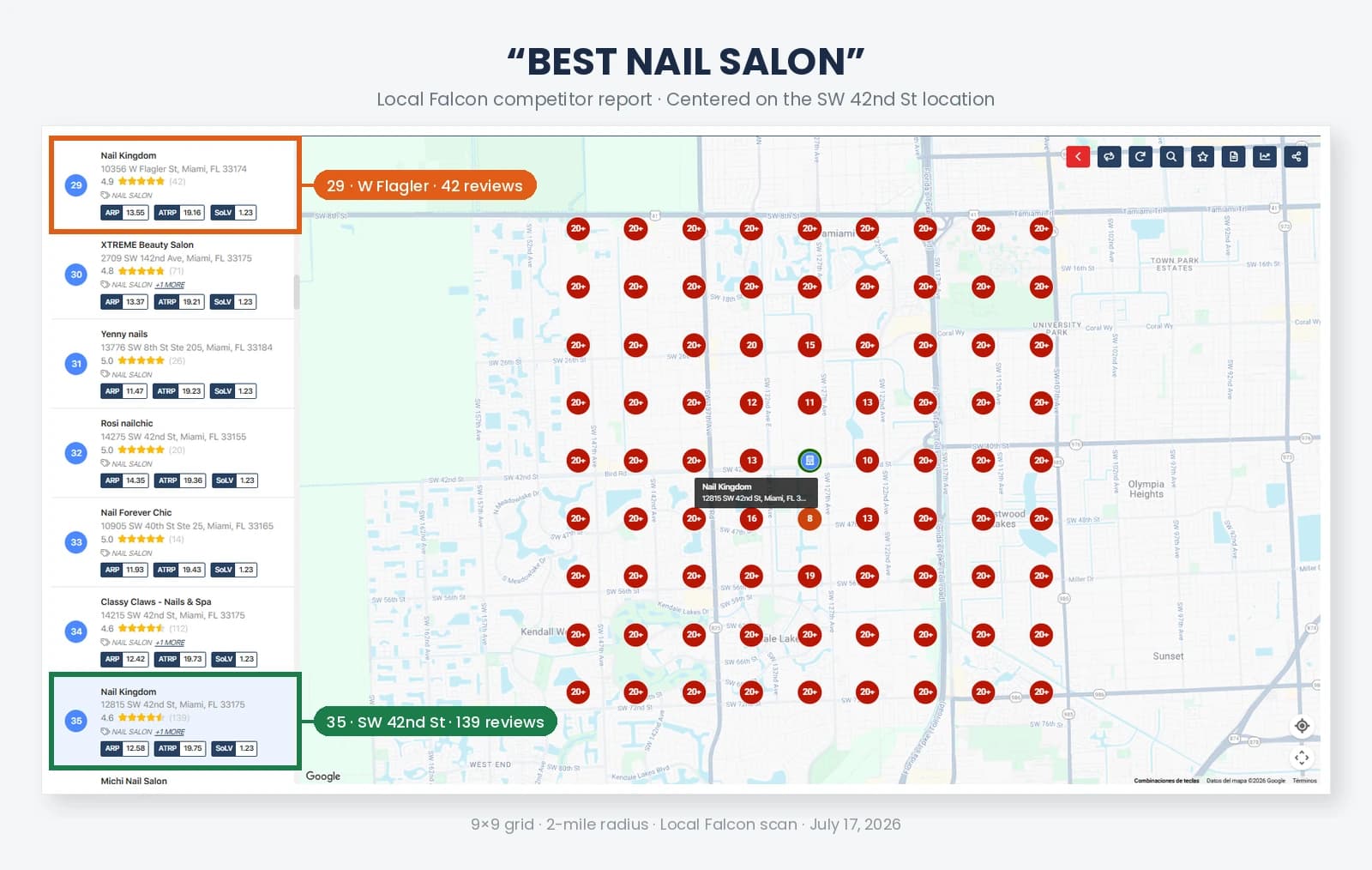
Once the profiles are clean, volume still isn't a blank check, though this is where you should hold two things at once. Google's own documentation says more reviews and positive ratings can improve local ranking. Alongside that, Sterling Sky's testing suggests an observable lift around the tenth review in the cases they ran, followed by diminishing returns, in one case study with three cases they compared businesses with around nine reviews and found them ranking similarly despite the differences. Read together: getting a starved location up to a baseline is urgent, high-impact work, while a location well past it, like the one with 139, is unlikely to climb much by doubling its count. Treat the ~10 figure as a third-party observation, not a Google-confirmed threshold, and remember review impact also shifts with recency, rating, relevance, and competition. Past the baseline, more reviews still earn conversions and richer text for AI to read, which matters, but that's a different goal from chasing rank.
The competitor report makes that ceiling concrete. In the grid centered on the SW 42nd Street location, Nail Kingdom sat at position 35, behind salons with 14, 20, and 26 reviews. Every business in that stretch shared a Share of Local Voice of 1.23, which is one grid point out of 81. A review count six times larger did not buy a better position.
That reframes the whole system. Prioritize the locations sitting below a healthy baseline and just maintain the rest. Spreading the effort equally wastes it.
Generate Cleanly
Reviews go to the specific location's profile, from the customer who was actually there, requested right after the service with a direct link to that location's profile. There are three red lines Google draws that this industry crosses daily. The first is incentivizing reviews with discounts or gifts. The second is gating: routing happy customers to Google and unhappy ones to a private form first. The third is scripting keyword-stuffed reviews, with no confirmed evidence that those keywords move rankings and against Google's rules, which want genuine experiences. Encourage honest, open-ended reviews instead, and customers naturally use the words real searchers type.
Respond Consistently
Replies are public, they show you're paying attention, and they help you recover trust after a bad experience, that alone is worth doing. Your response text is visible and can add natural context about the service and area. Just don't oversell it: Google doesn't confirm that keywords in your replies, your response rate, or your response speed are ranking factors, and it actually advises responding where useful rather than mechanically to every single review with a canned line. Reply because it's good business and good reputation management, not because it's a lever on the algorithm. A location with 200 reviews and no replies still looks abandoned to a human deciding where to go.
The AI Layer (2026)
There's a 2026 layer that changes what all of this is worth. With the share of consumers using AI tools for local recommendations jumping from 6% in 2025 to 45% in 2026 (BrightLocal), the text of your reviews became a discovery asset on top of a ranking one. This part is confirmed: Google analyzes the text of reviews, generates summaries and themes from what customers actually wrote, and leans on recent reviews to do it. So if your reviews rarely mention your specific services, those summaries won't surface the things you want to be known for. The strategic inference that follows, reasonable but not proven, is that detailed reviews naming the real service and neighborhood give AI systems more usable material than generic "great service" one-liners, which is why encouraging specificity is worth doing. Where we'd stop short: there's no evidence that responding to a review makes an AI more likely to recommend or cite you. Respond for the human reasons above, and treat the AI-visibility upside of rich review text as a strong bet, not a documented fact.
How you know Step 7 is done: a per-location review flow is running, locations under about 10 reviews are prioritized, and every review gets a reply.
Step 8: Measure by Location, Not by Average
You measure last, because now you have something built to measure. And the way most reports measure multi-location is broken by design.
Rio SEO's 2026 local search report, drawn from more than 239,000 US business locations over January to December 2025, shows how far apart verticals move in the same year. Retail total views fell 5.3% while healthcare views rose 7.7%. Restaurants saw the sharpest drop, total views down 31.7% and Maps views down 40.1%. That's aggregate industry data, not a prediction for any single salon, but it makes the point: a single national average blurs opposite realities into one meaningless number. The same thing happens inside your own brand: the average of your 20 locations hides the one that's sinking. Report only the average and you never see it.
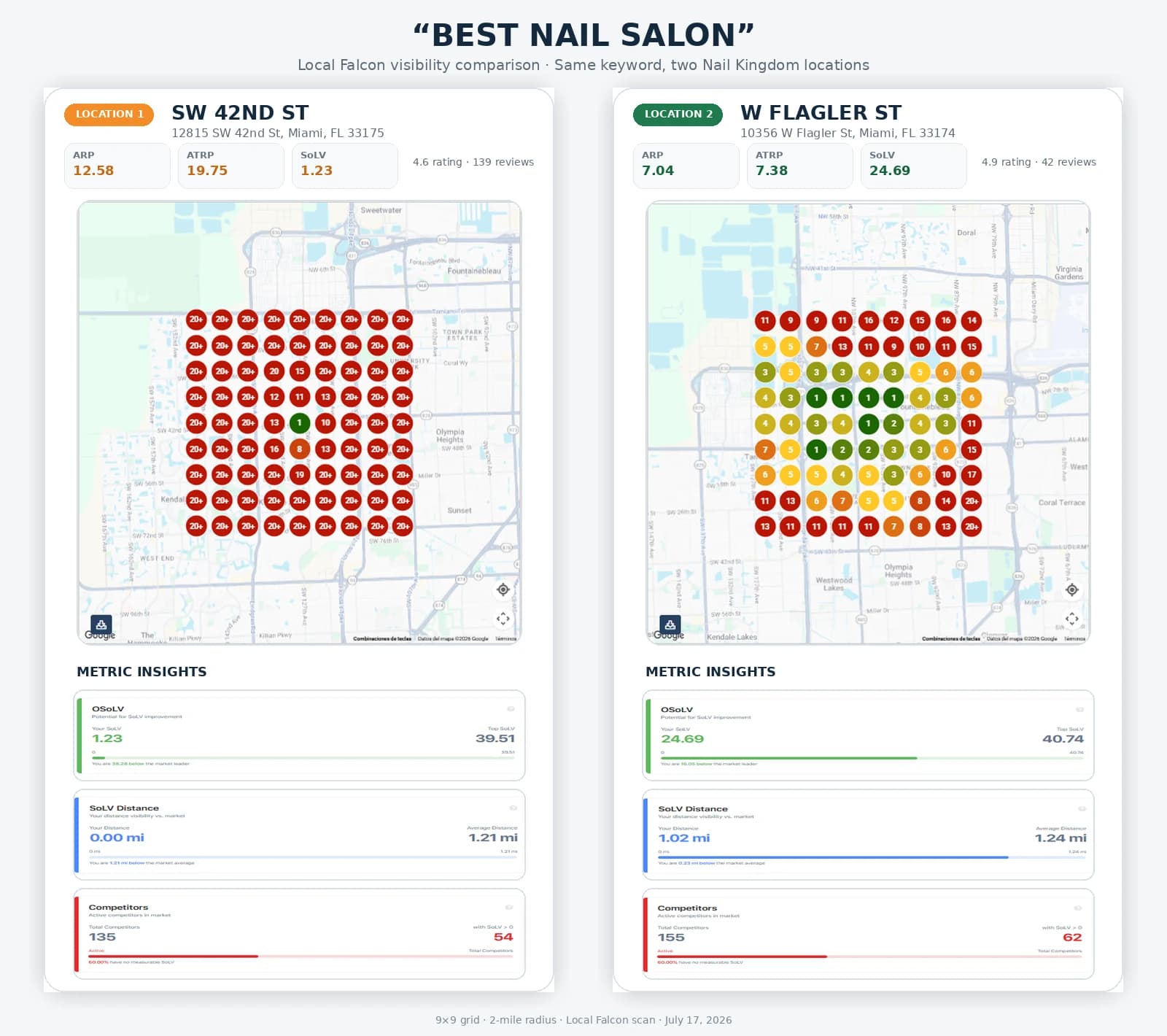
So measure per location, on a grid. Share of Local Voice, Local Falcon's measure of how often you appear in the top three across a map grid, is one of the most useful diagnostics for comparing geographic visibility between locations, and a heat map shows it at a glance. It isn't the whole truth, though, read it alongside leads, appointments, revenue, conversion rate, and profile engagement. What it captures that a plain rank number can't: your location can be first on its own block and absent two miles out. One number hides that; a grid shows it.
Our salon shows why this matters, and the numbers are worth sitting with. We ran grid scans on both locations, same day, for three keywords. The location with more reviews (around 139) ranked worse than the one with fewer (around 42) across every keyword we tested. For "best nail salon," the W Flagler location scored a Share of Local Voice of 24.69 while the SW 42nd Street location scored 1.23. For "nail salon near me," the search that drives the most walk-in intent, both locations scored under 4 and only appeared within roughly a third of a mile of their own door. If you had looked only at the star rating and review count, you'd have called the 139-review location the healthy one. The grid showed it was nearly invisible the moment a searcher stepped off its block. That gap, between what the aggregate says and what the map shows, is the entire reason to measure this way.
The grid also tells you where the searcher was standing, which is almost always on a phone a few blocks away. That is a separate discipline from ranking, and we broke down mobile behavior across locations and what to fix first in its own guide.
Track four levels per location, not one. Visibility: local pack, Maps, organic, grid coverage. Engagement: calls, direction requests, clicks, form fills. Reputation: volume, velocity, rating, response rate. Business: qualified leads, appointments, revenue, cost per acquisition. A brand-level roll-up buries the weak location every time.
This matters more now because, as Rio SEO argues, the path to purchase has collapsed. They describe the old path as search, check the website, compare, call, visit, and the new one as search, decide, visit: when AI Overviews and the local pack answer on the results page, the middle steps disappear. In that reading, your profile isn't just a listing; it's source data feeding AI Overviews and Maps, so even when a consumer never opens it, the systems deciding what to recommend are reading it. It's an interpretation, but a well-grounded one, and it lines up with the AI-discovery shift the review data already showed.
How you know Step 8 is done: you're tracking Share of Local Voice per location, and your reporting can drill down to a single location instead of stopping at the brand average.
Where This Leaves You
A business with two locations can walk these eight steps in a few weeks. With twenty, the work becomes a system: the same sequence, more tooling to run it. What doesn't change with scale is the order, fixing the data before chasing reviews, or the habit of checking each move against what Google actually documents. That habit is what separates the work that moves visibility from the work that's merely easy to bill.
There's one layer no guide covers, and it's where a lot of this gets decided in our market. When two locations sit a few miles apart in the same metro, "one city per page" stops working, because both are the same city. The differentiator drops to the neighborhood. And the language layer is real: in Miami-Dade, about 75% of residents speak a language other than English at home, and in neighborhoods like Hialeah (92.6%) and Tamiami (91.7%) it's the overwhelming majority (US Census QuickFacts). That doesn't automatically mean every resident wants a Spanish page or can't read English, but it does make language-specific demand research and bilingual content testing strategically important here. It's central to the market, and it gets its full treatment, alongside location-page structure, in the location pages and architecture guide in this series.
Ads bring the click only while you pay for them; when the budget stops, the visibility stops. Local SEO works differently: the visibility you build keeps working after the spend slows, but only if you maintain it. That salon is the proof either way. It reached the top of its market once, and the grid today shows what happened when the upkeep stopped.
Want to see where your locations actually stand?
We run the audit, show you the grid per location, and tell you in what order to fix what is costing you visibility right now.
Frequently Asked Questions About Local SEO for Multiple Locations
Do I need a separate website for each location?
No. Each location needs its own page with location-specific content (address, hours, reviews, and real photos of that branch), but all under one domain. A single page listing several cities competes poorly for each local search. What you don't need is a separate website per location.
Can I use the same phone number for all my locations?
Google recommends a local number per location "whenever possible," not a central one. It's a recommendation, not a hard requirement. A local number reinforces the signal that the branch really operates in that area, so use it when you can.
How many reviews does each location need?
There's no magic number from Google. Sterling Sky's testing suggests an observable lift around the tenth review, with diminishing returns after. Prioritize getting locations with very few reviews up to that baseline; a location that already has many gains little ranking by doubling its count, though it still gains conversions.
What is a grid scan and Share of Local Voice?
A grid scan measures your ranking at many points across a map, not just one, and draws it as a heat map. Share of Local Voice (SoLV) is Local Falcon's metric summarizing how often you land in the top three across that grid. Together they show where you're visible and where you disappear.
How long does multi-location local SEO take to show results?
It depends on your starting point and each market's competition, so no serious agency promises a date. Data and profile fixes can move things in weeks; building reviews, pages, and local authority takes months. The honest way to know is to measure a baseline with a grid scan and compare against it.
Does a virtual office work for a Google Business Profile?
No. A virtual office isn't eligible. Coworking counts only if your staff works there, greets customers during stated hours, and the space has permanent signage. Google can suspend profiles with addresses that don't meet these rules.
Related guides in this series
Four deeper companion pieces build on the steps above:
- Google Business Profiles at scale: claiming and verifying at volume, bulk workflows, the API, suspension recovery, and per-location review generation, response systems, and reputation recovery.
- Location pages and multi-location architecture: site structure, specialty subpages, handling nearby locations in the same metro, and the bilingual neighborhood layer specific to a market like Miami-Dade.
- Citations and local authority: the tier model, how data aggregators actually work, what they cost, and where NAP consistency matters (and where it doesn't).
- Measurement and AI visibility: the full Local Falcon grid-scan walkthrough, Share of Local Voice, and how to track whether AI tools recommend your locations.