
7 Benefits of Hiring a Digital Marketing Agency in 2026, and When Not To

Summarize with AI
Half of the small businesses in the United States have nobody working on marketing. Not a bad hire, not a part-timer. Nobody. That is the finding of the LocaliQ 2026 Small Business Marketing Trends Report, and the same survey found that 60% of owners spend between one and ten hours a week on it themselves.
So the benefits of hiring a digital marketing agency are not abstract for those owners. They are the hours they get back and the decisions they stop guessing. But I run an agency in Hialeah, and I am going to start with the part the other articles skip: an agency is not the right answer for every business. Sometimes a freelancer is. Sometimes your cousin who is good with Instagram is. This article covers the seven real benefits, what they cost against hiring in-house in Miami, and the four signs that tell me a business is ready. Or not.
Quick answer: hiring a digital marketing agency pays off when your customer acquisition depends on more than one channel and you no longer have the time to run and measure them yourself. It costs less than a single in-house marketing hire in most U.S. cities, it comes with tools you would never buy for one business, and, if the agency is any good, it will tell you what not to do. If you need one channel and have a small budget, a freelancer with a narrow scope is usually the better call.
Published September 2026. Last updated September 10, 2026.
When hiring a digital marketing agency makes sense, and when it does not
Here is the rule I use before I take on a client, and I say it to people who then decide not to hire us.
If a business needs one way of getting customers, one channel, one job, it does not need an agency. A freelancer can do it. A person in-house can do it. Somebody who knows Google Ads and nothing else will run your Google Ads fine.
The picture changes when a business wants to cover several ways of getting customers at once: social media, SEO, the website, email, Google Business Profile. Those are not five tasks. Each one is its own world with its own workload, and they feed each other. The ads send people to the website. The website either converts them or wastes the click. The email brings them back. Reviews change what the ads cost. One person cannot carry that, not because they are bad, but because there is not enough of them. That is when an agency with people already spread across those jobs is not just nicer. It is the only setup that does not fall over.
Budget matters too, and I will put a number on it. Under about $1,500 a month, look for a freelancer. Just be careful about one thing at that price: do not ask that person to do everything. Give them one channel and a clear scope, and you will get something good. Ask for six channels and you will get six things done badly, and it will not be their fault.
One more honest note. AI has changed this decision. A freelancer with the right tools, or a small agency like mine, can now move faster and do more with fewer people than was possible three years ago. That is a fact, not marketing. It means the line between freelancer, agency and in-house has more room in it than it used to. The rule above still holds; the budget where each option starts to make sense has shifted down.
The four signs a business is ready for an agency
These are the signs I look for. All four, not one of them.
- The offer already works. The business sells. The goal is to make customer acquisition consistent, not to find out whether anyone wants the product.
- The problem spans several areas. The ads bring visits, but the website does not convert, and nobody measures what ends in a sale. That is three problems wearing one trench coat.
- The owner has become the bottleneck. No time to manage freelancers, review campaigns, or decide what comes next. Marketing happens when the owner has a free evening, which is never.
- The business can sustain the investment and handle the demand. Fees, ad spend and tools fit the budget without depending on next month's results to pay this month's bills. And if the phone rings twice as much, someone answers it.
I do not use a universal revenue threshold, and I would distrust anyone who does. Margin per customer, capacity to serve more sales, and how complex the work is matter more than turnover. Two businesses billing the same amount can need completely different solutions.
The 7 benefits of hiring a digital marketing agency, explained with numbers
Every article ranking for this question lists roughly the same five or eight benefits with no numbers attached. I am keeping the ones that are true, adding the figures, and telling you which ones agencies oversell.
1. One team runs the channels that feed each other
This is the whole reason agencies exist, and it is the benefit that gets flattened into "access to a full team of experts" in every listicle. The point is not the head count. The point is that the person doing your SEO sits next to the person building your landing page, and both of them see the same ad data.
When those jobs are split between a freelancer, a web developer and a nephew, each one optimizes their piece and nobody owns the hand-offs. The hand-offs are where the money leaks.
Real example. For Pa' Comer Cuban Pizza, the ads were only half the work. The campaign delivered 1,428 order clicks in a single month, with cold-audience clicks at 56 cents each, and that only happened because the landing experience, the offer and the audience targeting were adjusted together, week by week, by the same team. Split that across three vendors and you get three invoices and one argument.
Best for: any business trying to grow through more than one channel at the same time.
2. You stop being the marketing director of five freelancers
Agencies love the phrase "multidisciplinary team." Here is what it means for a small business owner in plain words: you do not have to coordinate the ads person, the web person, the social person, the email person and the person who does reports. Someone connects the ads, the website, the message and the measurement, and that someone is responsible for the result.
Remember the LocaliQ number from the intro: 50% of small businesses have no employee dedicated to marketing. In practice that means the owner is the marketing department, on top of being the operations department and, some nights, the cleaning department. Handing the coordination to an agency does not add another thing to manage. It removes five.
Best for: owners who are currently the bottleneck, which is most of the owners I meet.
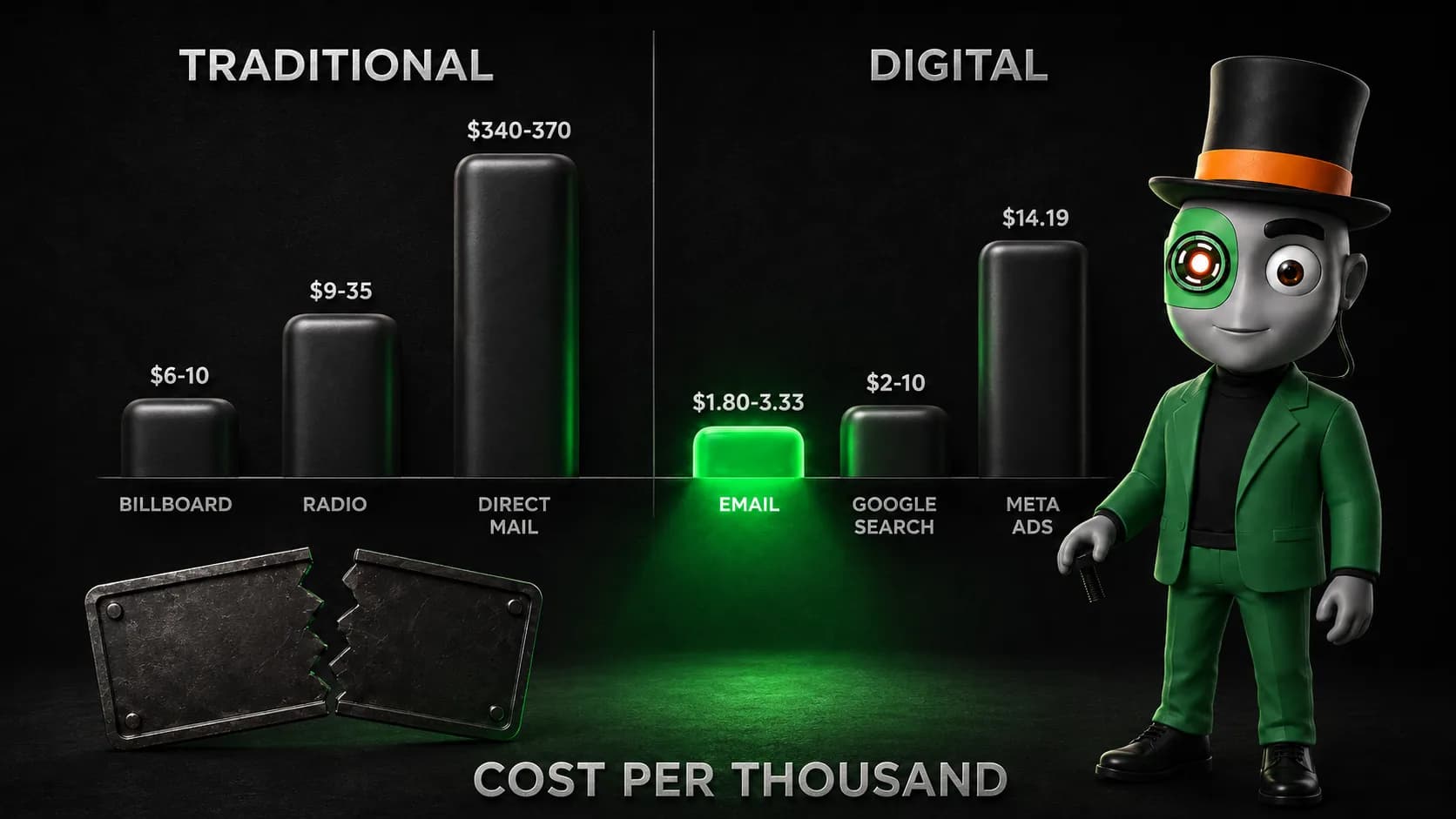
3. It usually costs less than one in-house hire
Everyone says agencies are cheaper than in-house. Almost nobody shows the math for their city. Here is Miami's.
According to the U.S. Bureau of Labor Statistics (May 2025 data for the Miami-Fort Lauderdale-West Palm Beach metro), the median marketing manager earns $135,870 a year, and the median marketing specialist earns $78,990. Benefits add another 30% on top of wages across private industry, per the BLS Employer Costs for Employee Compensation release for June 2026.
On the agency side, an Ahrefs survey of 439 providers put the average monthly retainer at $3,209 for agencies and $1,348 for freelancers, with the most common bracket sitting between $501 and $1,000.
The reason the gap is that wide is structural, not a discount. With an agency you pay for a service. With an employee you pay for hours, whether or not there is work that week, plus recruiting, onboarding, software seats and the months it takes a new hire to learn your business. The full table is further down.
Best for: businesses that would otherwise be hiring their first marketing employee.
4. You find out what is actually bringing customers
This is the benefit I think is most real and worst explained. Agencies describe it as "data-driven strategies" or "detailed reporting." A report is not the benefit. The benefit is being able to tell you this:
"This ad generates a lot of inquiries but few sales. This other one brings fewer people, but they buy. We are going to move the budget and check where the first group is dropping off."
That sentence is the difference between deciding with evidence and deciding by feel. Measurement is never perfect, and anyone who says theirs is should be walked out. But going from "I think Instagram works" to "Instagram brings the visits and Google brings the sales" changes where the next dollar goes.
If you want to see what this looks like in practice before hiring anyone, my article on how to track brand presence in AI search shows the manual version of the same discipline.
Best for: any business currently spending money on marketing without knowing which part of it is working.
That is exactly what the free Miami digital marketing plan is built to answer. It is a real plan, not a sales call with extra steps.
5. Tools you would never buy for one business
Agency software is a real cost advantage, and this one is easy to quantify. Semrush's plans run from $139 to $549 a month, and Ahrefs from $129 to $449, based on their pricing pages as of September 2026. Add call tracking, a rank tracker, a reporting platform, AI visibility tools and design software, and a serious single-business stack lands between $500 and $1,000 a month before anyone has done any work.
An agency spreads those seats across every client, so the cost per business drops to a fraction. More important than the money: someone on the team already knows how to read the tool. A Semrush subscription you do not open is a $139 monthly donation.
Best for: anyone who has been paying for marketing software they log into twice a year.
6. Speed and capacity that one person cannot match
An agency's people are already spread across the work, so the website does not wait for the ads to finish, and the SEO does not wait for the website. That parallel capacity is why Live Love Beauty Salon got a new website built from scratch and its Google Business Profile rebuilt in the first month, and why Piñeiro English School saw monthly leads grow 294% with an 8.2x return on Google Ads spend: the search work and the ads work ran at the same time, not one after the other.
AI has widened this gap further. The repetitive parts of research, drafting, reporting and campaign setup are faster now for everyone who uses the tools well, which means a small team can carry a workload that needed twice the people in 2023. The judgment about what to do with that speed is still human, and it is still the expensive part.
Best for: businesses that need results inside a season, not inside a fiscal year.
7. Someone who tells you "you do not need this yet"
The most valuable thing an agency can say is no. No, you do not need TikTok. No, that rebrand can wait. No, five posts a week on four platforms is not an obligation.
"You need to be on every platform" is one of the most convenient lies in this industry, because it lets an agency sell more services without justifying what each one adds. A small business does not need to be everywhere. It needs enough customers, at a cost that leaves margin, without overwhelming its own operation. If Google Maps, a good website and referrals get it there, that is the plan.
The same goes for "nobody knows your business better than you." You know your trade and your operation. That does not mean you know how a customer searches for you, what they understand about your offer, or why they pick the competitor. An agency worth paying will question you, not just execute your ideas. And I have stopped caring about "we are a 360 agency." That describes what someone sells, not how well they decide. An agency shows more judgment when it says "this is not necessary yet" than when it proposes hiring everything.
Best for: owners who have already been sold a package they did not need. You know who you are.
Benefits of hiring a digital marketing agency vs. a freelancer or an in-house hire: the cost table
The numbers below use the BLS Miami metro figures for wages, the 30% benefits load from the BLS ECEC release, and the Ahrefs retainer survey. Tool costs use current Semrush and Ahrefs list prices as a floor. Your numbers will differ; the shape of the comparison will not.
| In-house marketing manager (Miami) | In-house marketing specialist (Miami) | Freelancer | Agency | |
|---|---|---|---|---|
| Median annual cost, wages only | $135,870 | $78,990 | $1,348/month average retainer | $3,209/month average retainer |
| With benefits (+30%) | about $176,600 | about $102,700 | not applicable | not applicable |
| Monthly equivalent | about $14,700 | about $8,550 | $500 to $2,000 most common | $501 to $1,000 most common bracket; multi-channel programs more |
| Tools you still pay for | $500 to $1,000+ on top | $500 to $1,000+ on top | usually theirs, for their channel | included in the fee |
| Channels covered | as many as one person can carry | one or two | one, done well | several, coordinated |
| Who coordinates | you | you | you | the agency |
| What happens when they leave | you start over | you start over | you find another freelancer | the team stays |
Two things the table does not say, because tables cannot. First, a great in-house hire who owns the whole picture is worth every dollar; the problem is that at $135,000 you are hiring one person to be five, and the good ones know it. Second, the cheapest column is not the best one. A $700 freelancer running your one channel well beats a $3,000 agency running five channels you did not need.
If you want the full breakdown of what specific services cost in this market, I have written it up for SEO in Miami and for web design in Miami.
When not to hire a digital marketing agency
The LocaliQ report has a number that agencies do not like to quote: only 34% of small businesses work with a marketing partner or agency, down from 60% the year before. Some of that is budget. Some of it is businesses that hired an agency they were not ready for, and left. So here is my list of when to wait.
- You need one channel. One job, one specialist. A freelancer or an in-house hire will do it better and cheaper than a team built for five.
- Your budget is under about $1,500 a month. Hire a freelancer with a narrow, written scope. Ask them to do everything and you will pay for a little of each and get none of it.
- Your offer is not proven yet. If you are still finding out whether people want the product, marketing spend just accelerates the answer, and the answer might be no. Fix the offer first.
- You cannot handle more demand. If a 40% jump in calls would break your operation, buy the operation fix first. Ads that fill a phone nobody answers are a gift to your competitor.
- You are hiring to be told you are right. An agency that only executes your ideas is an expensive pair of hands. If you do not want to be questioned, you do not want an agency yet.
None of these are permanent. Most of the businesses I have told to wait came back within a year, ready.
Is AI replacing digital marketing agencies?
Google asks this question right under the search results, so I will answer it straight.
AI is inside every serious agency already. HubSpot's 2026 State of Marketing report found that 80% of marketers use AI for content creation, and 61% believe marketing is going through its biggest disruption in twenty years. In my own shop, the research, the first drafts, the reporting and a lot of the campaign setup are faster than they were, and I have said so above: a small team does what needed twice the people three years ago.
What AI does not do is decide what your business should do next, coordinate five channels so they feed each other, take responsibility when a campaign misses, or understand why a customer in Hialeah picks the shop across the street. It also does not know what to do when the numbers disagree with each other, which is most weeks.
So the honest answer: AI has not replaced agencies, it has replaced the parts of agency work that were never the valuable part. The businesses that get hurt are the ones paying agency prices for AI output nobody reviewed. If your agency's proposal reads like it was generated in one prompt, it probably was.
Frequently asked questions
Is hiring a marketing agency worth it?
Yes, when your customer acquisition depends on several channels working together and you no longer have the time to run and measure them yourself. No, when you need one channel, your offer is unproven, or the fees would depend on next month's results. The four readiness signs above are the test I use before taking a client.
How much does it cost to hire a digital marketing agency?
An Ahrefs survey of 439 providers found an average agency retainer of $3,209 a month, with the most common bracket between $501 and $1,000. Single-channel programs for small businesses tend to start around $1,000 to $1,500 a month; multi-channel programs covering SEO plus paid media start higher. Compare that with a median Miami marketing manager at $135,870 a year plus 30% benefits.
What is the 70/20/10 rule in digital marketing?
It is a budget split popularized by Coca-Cola's Content 2020 strategy: 70% of the budget goes to proven, low-risk work, 20% to improving what already works, and 10% to experiments that might fail. Small businesses rarely need to formalize it, but the idea holds: most of the money on what is known to work, a little on trying something new.
Freelancer vs. agency vs. in-house: how do I decide?
Count the channels and check the budget. One channel and under about $1,500 a month: a freelancer with a narrow scope. One channel and steady volume: possibly an in-house hire. Several channels that need to feed each other: an agency. And in 2026, with AI making small teams faster, the budget where each option makes sense has moved down, so revisit the math yearly.
What does a digital marketing agency actually do?
It plans and runs the channels that bring you customers (search, website, ads, social, email, Google Business Profile), measures which ones produce sales rather than visits, and coordinates all of it so you do not have to. The good ones also tell you what to skip. If you want to see the full menu, our digital marketing services page lists each one and who it is for.
The one question to answer before you hire anyone
Forget the seven benefits for a second and answer this: how many ways do you need to bring in customers, and can you run them yourself?
If the answer is one, and yes, hire a freelancer and give them a clear job. If the answer is several, and no, that is the moment the benefits of hiring a marketing agency stop being a listicle and become your Tuesday. One team, one person responsible, numbers you can read, and somebody willing to tell you what to leave out.
If you are in Miami or Hialeah and want the honest version of that answer for your own business, start with the free Miami digital marketing plan. If the plan says you are not ready for an agency, it will say so. That is the point of it.