
How Pa' Comer's Pizzas Started Selling Themselves Online: 1,428 Orders in the First Month
Pa' Comer sells Cuban pizza into a super wide, loyal market, with a few thousand active followers on social. Our job here was to make that demand show up through ads too, with order, and without costing an arm and a leg. In the first month the account started producing orders like a business, at a cost per click anyone would sign off on.
 Elizabeth BorgesOwner, Pa' Comer Cuban Pizza
March and April optimized different events, so each month fills different axes. All numbers are real, read from Meta.
- Industry
- Food / Pizza
- Location
- Hialeah & Westchester
- Services
- Meta Ads
- Timeline
- March → April
- Order Clicks
- 1,428/mo
- Reach
- 57K+
The Challenge
Pa' Comer is one of those clients you rarely see: built with an infrastructure designed so everything runs and, of course, brings in money. It's a solid family business: two locations, a huge community, sales that hold up on their own thanks to the product and to the people who keep coming back, and on top of that, an owner who goes out of her way to make everything perfect. That's the best possible scenario and, at the same time, the most interesting challenge: how to scale something that already works without breaking it.
The Campaign Objective, the Most Important Lever
In Meta, the campaign objective is the variable that matters most: it defines which action the algorithm pushes toward and who sees the ad. Follower growth was running under Traffic, optimized to clicks. That's where anyone lands by intuition, but the platform pays off better when you aim at the right event.
Key Outcomes
1,428 order clicks in one month (1,009 cold + 419 remarketing)
57K+ people reached in the month
263 new followers at just 15¢ each
From $1.37-$1.47 per lead to 56¢ per order click
Want a Structure Like This for Your Business?
If your business already sells and you want advertising to grow with order and numbers in plain sight, we build the system that makes it possible. The same in a pizzeria as in a clinic or a store.
Book Your Free AuditFree consultation • Custom strategy • Clear next steps
The Challenge: Scaling a Business That Already Works
Pa' Comer is a solid family business: two locations, a huge community, sales that hold up on their own thanks to the product and to the people who keep coming back. It's highly profitable and keeps selling strong even without advertising. A business that already makes money and wants to grow in an orderly way needs advertising to stop being a loose effort and mesh with the system that runs the place and already delivers results on its own.
When we reviewed the account we found movement, but messy: Instagram posts chasing followers on one side and Uber Eats campaigns running on the other. Each did its own thing, with no structure tying them together and no way to measure what was actually bringing in the sales. Working, it was working: with a good pizza in the mix, it's hard for anything not to work. But in a business that already sells, putting that in order is what multiplies the result.
In Meta, the campaign objective is the variable that matters most: it defines which action the algorithm pushes toward and who sees the ad. Follower growth was running under Traffic, optimized to clicks (where anyone lands by intuition; but the platform pays off better when you aim at the right event. The order campaigns were running under Leads. When the goal is to sell, you optimize straight toward the purchase, so the system chases transactions and not loose contacts. And what matters most for growth: keep the pixel receiving clean signal from every order. With that information, Meta learns to recognize and go find more people who actually buy) and that's what turns a good month into something that repeats.
“We've seen really good results, more reach and real growth in our business.”, Elizabeth Borges, Owner
Our Strategy: Speed With Structure
You don't shut off the engine on a business that's already selling to inspect it. You tune it while it runs. So we went for speed with structure: capitalize on what was already working and, at the same time, build the professional foundation that was missing underneath.
The work was organized into four moves, from the most immediate to the most structural:
Isolate what already worked
From the history we pulled three ads that were already winning, with accumulated conversion signal. Starting from creatives Meta already knows how to deliver shortens the learning phase and lowers cost from day one. Why reinvent penicillin?
Fix the objective architecture
We moved the followers campaign to Engagement (follow event) and the order campaigns to Sales (purchase event). And yes, the change showed right away: more followers and more sales with less spend.
Reduce friction and feed the pixel
We cleaned up the purchase process so the pixel received clean events. The clearer the system eats, the better it learns to go find the people who are actually going to buy.
Build a complete funnel
Three campaigns with clear roles: calls for the highest-intent demand; cold audience (TOFU) to capture new customers, leaning on the high repeat rate; and remarketing to re-engage those who already visited the site or follow the profile. Later we added a followers campaign under Engagement that performed exceptionally well.
The product and sales were already strong. What we added was the structure that turns that spend into measurable orders, ready to scale. The entire objective restructure and funnel build was executed by Juan Pablo Caballero, our Meta Ads specialist.
The Research Behind the Message
In Hialeah and Westchester, "advertising in Spanish" isn't enough. The exact language of the ad changes how much it costs to bring in each customer in Miami. We proved it with tamer Marketing's own study, with real budget, designed to pull valuable insight about the Hialeah market before applying it to this account.
And now a pause: let's take a minute on where this comes from, because we're not the type to talk just to talk. "Advertising in Spanish in Miami" sounds like obvious advice, but almost nobody stops to check whether language really changes the cost of bringing in a customer, how much it changes it, and in which neighborhoods it changes most. Most people assume it and move on, but tamer Marketing is tamer Marketing and assumes nothing. So this wouldn't be a hunch with a budget, we built a controlled experiment: 24 cells, a single real variable, and clean measurement, cell by cell, over 105 days. We wrote the same ad in three registers, each penned from scratch by a native speaker: pure Spanish, pure English, and Spanglish, without translating one original into the other two languages, because a literal translation shows and performs differently. We took those ads to eight Miami-Dade ZIP codes chosen for their distinct acculturation profiles: from Hialeah and Little Havana, of strong first-generation Cuban roots, to Brickell, Aventura, Doral, Coral Gables, Pinecrest, and Miami Beach, with more bicultural or English-speaking populations. Same offer, same design, same budget, same dates, and same audiences: the only thing that changed across the 24 cells was the language of the message, so any difference in cost per customer was attributable to language and nothing else.
In first-generation Cuban ZIPs, Hialeah among them, Spanish and Spanglish performed up to 4.5× better than English, with the same offer and the same budget. What really changed how we work was the pattern behind it: in Miami, acculturation matters more than country of origin for predicting which ad people respond to. Spanglish turned out to be a bridge in bicultural areas, because it reflects how people actually talk in the street; and in first-generation neighborhoods, real Spanish, with its local accent, was unbeatable. Pa' Comer lives right at the heart of those areas: Hialeah and Westchester, pure first-generation Cuban. So when we built their ads we didn't guess the tone or translate from English: we already knew, with data, which register converts, and we speak to Hialeah the way Hialeah speaks, in Cuban, with its cadence, its words, and its humor. It's no coincidence we went from leads at $1.37-$1.47 each to order clicks at 56¢: part of that efficiency is born right there, in speaking to each customer in the exact language in which they decide to buy. That message work is led by Sheyla Rivero.
The Before and After
Everything looks nice in a deck; the real account is the one that doesn't lie. Here are the two snapshots. March, done on the fly: ads set up each on its own; Instagram posts brought cheap clicks that stayed clicks, and the Uber Eats lead campaigns paid $1.37 and $1.47 per contact. It wasn't "badly done": a setup with no structure has nothing to grab onto to chase the sale. April, with the professional funnel running: the account started producing in an orderly way, with 1,428 order clicks, 41 calls, and 263 profile visits, and a reach that topped 57 thousand people.
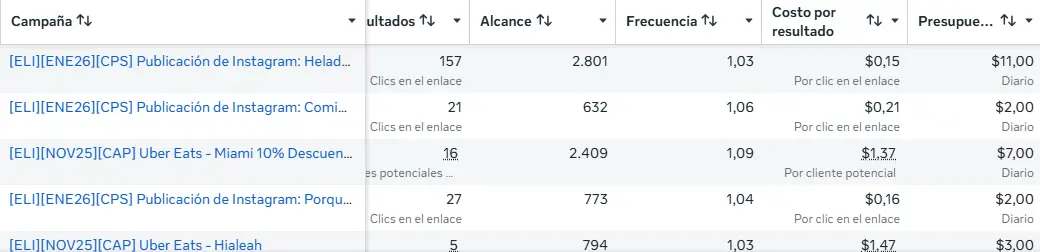
Before · March (done on the fly)
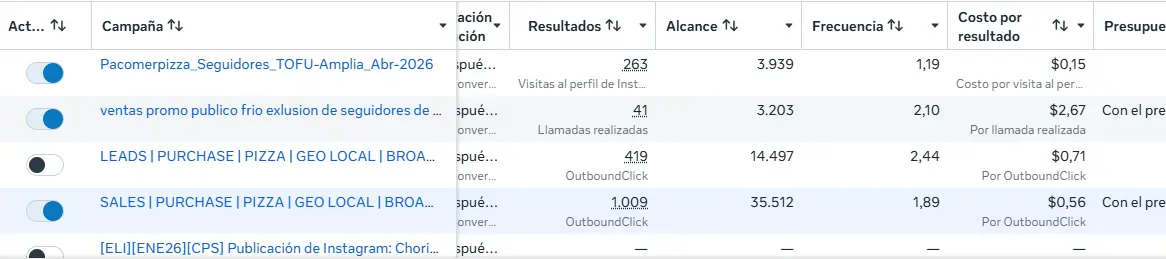
After · April (professional funnel)
| Metric | Before (March) | After (April) |
|---|---|---|
| Account structure | Loose ads, on the fly | Professional funnel |
| Followers objective | Traffic (clicks) | Engagement |
| Orders objective | Leads | Sales (purchase) |
| Cost per contact | $1.37-$1.47 / lead | $0.56 / order click |
| Order clicks / mo | No data | 1,428 |
| Calls / mo | No data | 41 ($2.67 ea.) |
| Profile visits / mo | No data | 263 ($0.15 ea.) |
| Monthly reach | No data | 57,000+ |
Results: From Clicks to Orders
A single month. That was enough to change the nature of the account. The cold audience became the engine with 1,009 clicks at $0.56 and frequency 1.89 under control; remarketing added 419 at $0.71, calls 41 at $2.67, and followers 263 at just $0.15.
Which Campaign Carries the Funnel
Order clicks per campaign with April's professional funnel
What These Numbers Mean for the Business
From clicks to orders
The account stopped buying cheap clicks and started buying orders. Every dollar chases the event that pays the bills.
Profitable advertising
At 56¢ per order click, ads stopped being a test expense and became a predictable way to bring in customers.
A funnel full for tomorrow
With 57K reach and followers at 15¢, it sells more today and, along the way, fills the top of the funnel to keep selling next month.
The account improves on its own
The pixel now receives clean signal, so each month the system gets sharper about who to show the ads to.
What's Next? Scaling on Data
A funnel up and running is just the start. From here the work is scaling and expanding, and every step is decided with the data in hand.
Open new audience fronts
Continuous creative production to reach audiences we haven't touched yet. Each new angle lets the algorithm explore different cold segments and reduces dependence on a single audience, which protects performance when an ad gets saturated.
Mature the demand that already exists
Reinforce remarketing on warm audiences: people who visited the site, engaged, or follow the profile but haven't bought yet. That already-qualified traffic converts at a lower cost than the cold audience.
Fine day-to-day optimization
Since most purchases concentrate between ages 18 and 45, we narrow delivery toward that audience, and widen the selling radius to twelve kilometers. We run systematic A/B tests and monitor ROAS, frequency, CPM, and 3-second-plus video plays, to anticipate when an ad wears out and when it's worth scaling on what already works.
The Structure That Turns Spend Into a System
“You can tell they know what they're doing and that they genuinely care about helping you grow. Highly recommended.”
Elizabeth Borges
Owner, Pa' Comer Cuban Pizza