
Traditional vs Digital Marketing Cost: What $5,000 Actually Buys in 2026

Summarize with AI
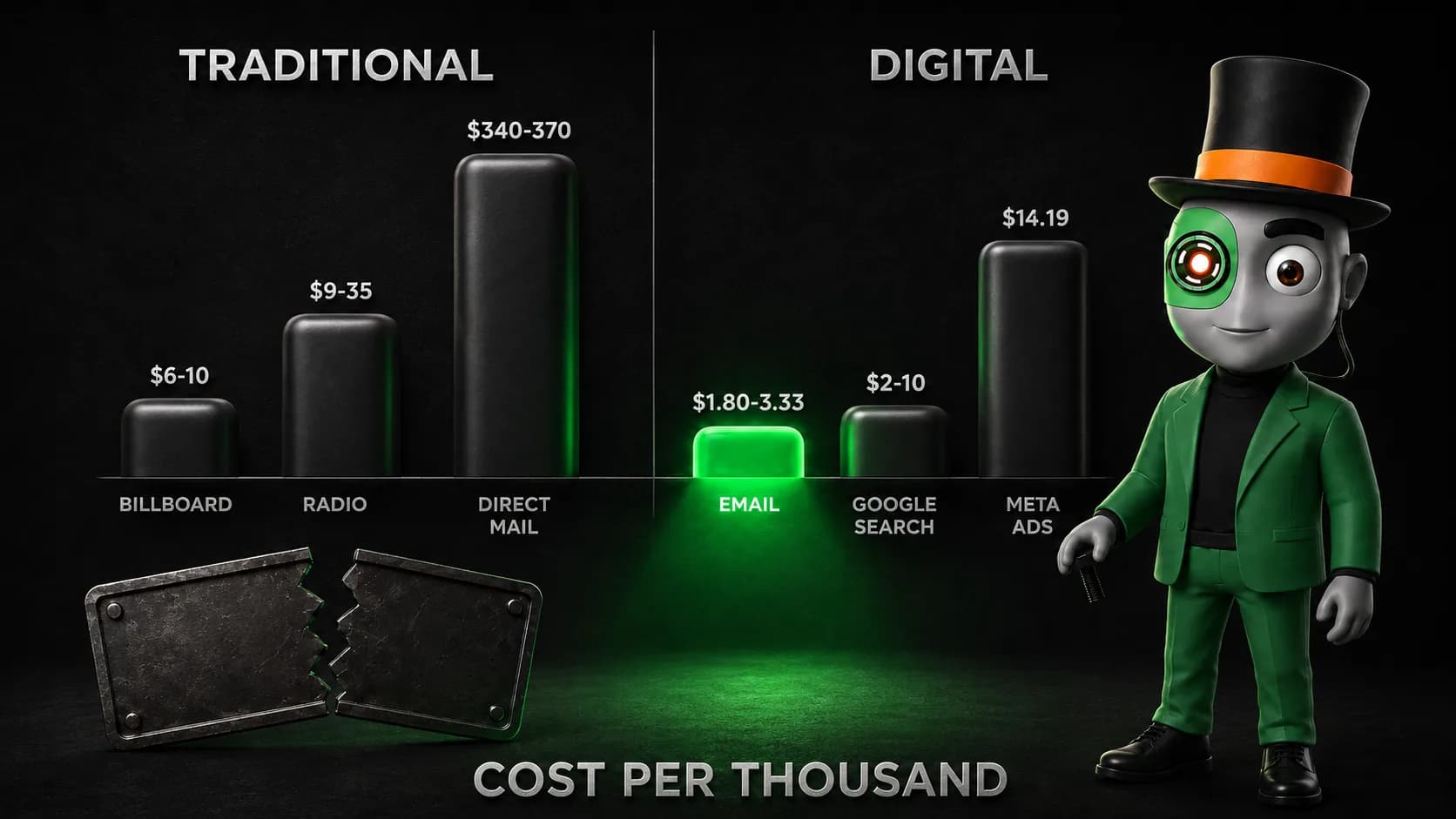
Digital is also no longer automatically cheaper. A standard billboard runs $6 to $10 per thousand impressions in most markets, which puts it below the average Meta ad at $14.19. And the three sources that publish a Meta CPM with a disclosed sample disagree with each other by a factor of three, which tells you something about how solid any of these numbers are.
What $5,000 actually buys
This is the comparison that answers the question. Same money into every channel, and how far the published data lets you follow it.
| Channel | Reach | Engagement | Leads |
|---|---|---|---|
| Google Search | 13,886 impressions | 922 clicks | 75 |
| Meta Ads | 352,361 impressions | 2,604 clicks | 180 |
| 1.5M to 2.8M sends | 31,000 to 58,000 clicks | no published benchmark | |
| Direct mail (EDDM) | 13,500 to 14,700 pieces | 4,900 to 5,300 read | no published benchmark |
| Billboard | 500,000 to 833,000 impressions | no click exists | no published benchmark |
| Radio | 143,000 to 556,000 impressions | no click exists | no published benchmark |
Sources, in order: WordStream 2026 (13,474 US campaigns) · Superads 2026 and WordStream 2025 (726 campaigns) · published ESP pricing and MailerLite benchmarks (3.6 million campaigns) · USPS Notice 123 effective 12 July 2026 and the USPS Household Mail Survey FY2025 · AdQuick 2026 · published rates across the 15 largest US radio markets.
Four of the six channels run out of data before they reach a lead. That is not a research failure. It is the finding.
Two things in that table deserve a second look.
Email is the cheapest channel and the hardest to actually use. At $1.80 to $3.33 per thousand sends, spending $5,000 means sending between one and a half and nearly three million emails. The constraint is not the budget. It is that almost nobody has a list that size, which is why the cheapest CPM in marketing is unreachable for most businesses.
Direct mail is the only traditional channel where somebody measured what happens after delivery. The USPS runs an annual survey where roughly 5,000 households keep a one-week mail diary, with fieldwork by NORC at the University of Chicago. It found that 51% of advertising mail gets read, 39% is discarded unread, and among people who are not already customers the read rate drops to 36%. There is no equivalent measurement for billboards or radio anywhere.
Why cost per thousand is the wrong number
The CPM table below is useful for exactly one thing: killing the assumption that digital is inherently cheap. It is a bad basis for a budget.
| Channel | Cost per thousand | Source |
|---|---|---|
| $1.80 to $3.33 | Published ESP pricing, 2026 | |
| Billboard, standard | $6 to $10 | AdQuick, 2026 |
| Radio | $9 to $35 | 15 largest US markets, 2025 |
| Meta Ads | $14.19 | Ryze, 2026 |
| Google Search | $2 to $10 | WordStream, 2026 |
| Direct mail | $340 to $370 | USPS and published printer rates, 2026 |
One note on the Meta figure, because it is the clearest small example of the problem this article is about. Three sources with disclosed samples publish three different numbers for the same thing: $8.19 (Gupta Media, 2025, geography not stated), $14.19 (Ryze, 2026), and $23.42 as a US median (Superads, July 2025 to July 2026, drawn from $3 billion in ad spend). A factor of three, for one platform, in one year. This article uses $14.19 throughout because it sits inside that range, and you should know the range exists.
An impression on a billboard is somebody driving past with their eyes mostly on the road. An impression on Google Search is somebody who typed what they want into a box thirty seconds ago. Calling both of those a thousand impressions and comparing the price is like comparing the cost per pound of gravel and flour.
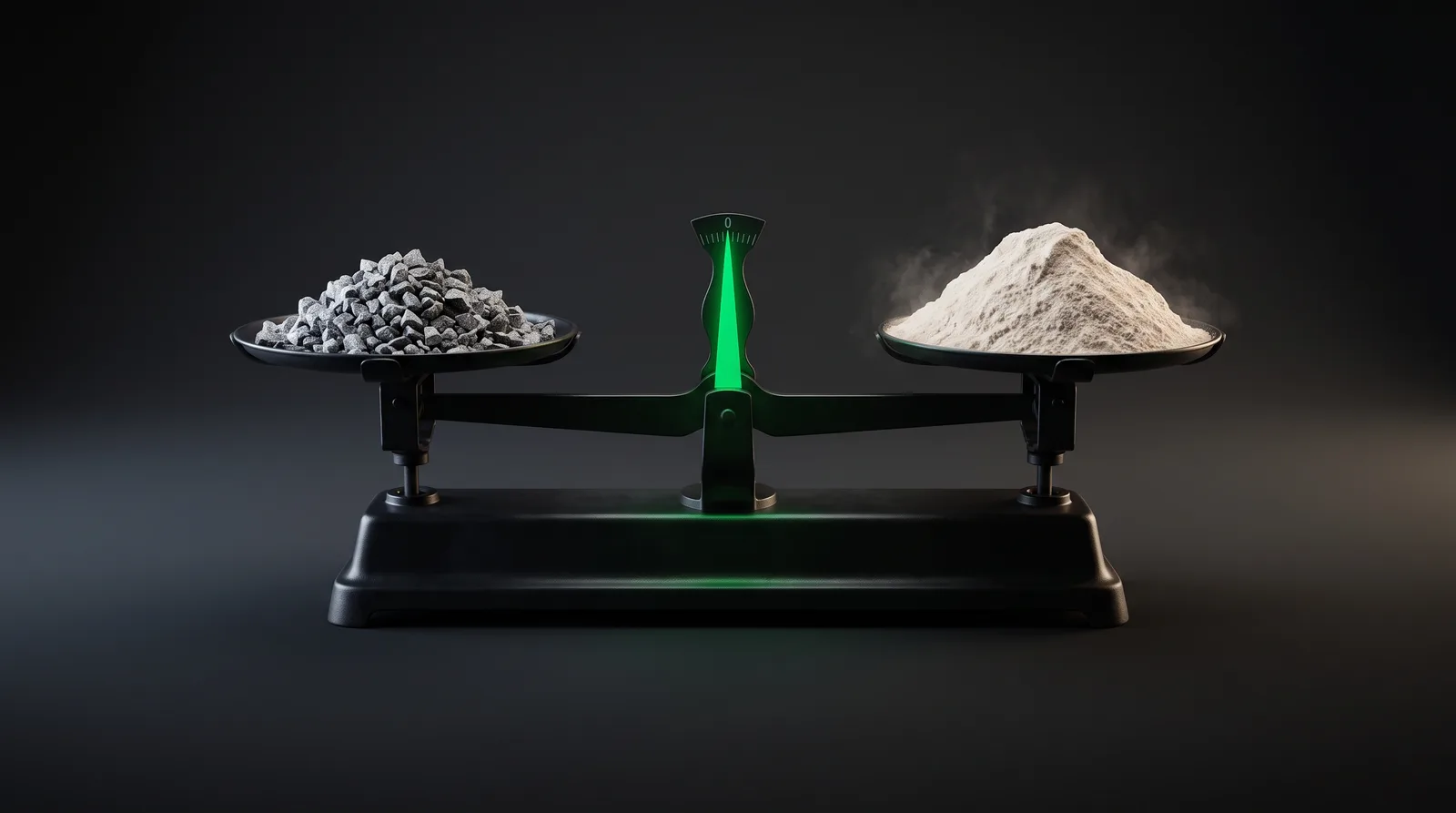
There is a second problem, and it is worse. The units are not even the same event. The industry body that measures outdoor advertising defines an impression as the number of times people passing a display are likely to notice it, calculated as a traffic count multiplied by a visibility coefficient that is not published. Meta counts an impression the first time an ad is on screen, and states in its own documentation that a video does not need to start playing for the impression to count. A piece of direct mail counts when it lands in a letterbox, whether or not anyone picks it up.
Six numbers on one axis, six different definitions of what got counted.
The number that decides budgets is cost per qualified lead. Google Ads averages $66.69 per lead across industries in 2026, with legal services at $131.63 and automotive repair at $29.96. Direct mail, at ten to a hundred times the CPM of everything else in that table, can still beat that in a tight local radius with a good list, because a mailer landing in 3,000 houses in your service area is not competing with the entire internet for attention.
Rank channels by what a customer costs, not by what a thousand pairs of eyes cost. If you want a defensible starting figure for your own numbers, our ROI calculator will get you there.
Where each channel still wins
Traditional wins on uncontested attention. A billboard has no competing tab, no auction bidding your message down the page, and no ad blocker. For brand recall in a defined geography that is worth paying for, and at $6 to $10 CPM it is now cheaper than the social feed.
Digital wins on intent. Google Search costs more per impression than a billboard and it is worth it, because somebody searching "emergency plumber" has already decided to buy. You are paying a premium to skip the entire awareness stage. That is the logic behind our paid media service and behind how we allocate a first budget for a local business.
Digital wins on the ability to stop. This is the part that rarely makes it into comparison articles. A billboard contract is a sunk cost from the day you sign it. A Google Ads campaign that is not working can be paused on a Tuesday afternoon. When you are wrong, and you will be wrong sometimes, digital is the only one of the two that lets you stop paying for the mistake.
And traditional has no answer to active demand at all. There is no offline channel that catches somebody who has already decided to buy and is looking for a supplier right now. The Yellow Pages used to be that channel. Nothing replaced it.
The measurement gap that changes the math
There is a reason the cost comparison keeps getting made badly, and it has nothing to do with the prices.
Most businesses can tell you what they spent on Google Ads last month to the cent, and cannot tell you within 40% what their billboard did. So digital gets judged on its real cost per lead and traditional gets judged on a feeling. Then somebody writes an article concluding that digital is cheaper, when what they actually measured was that digital is measurable.
The published data has the same bias. Search arrives with a cost per lead attached because the platform counts conversions by default. Outdoor advertising does not, so nobody has ever published one.
You can close that gap on your own account. Give every offline channel its own tracking: a dedicated phone number per billboard, a unique landing page or vanity URL per mailer, a promo code per radio spot. Then tag every digital campaign properly so the two sets of numbers are comparable in the first place. Our guide to tracking campaigns with UTM parameters covers the digital half, and the offline half is three phone numbers and a spreadsheet.
None of those methods is as clean as a pixel firing on a thank-you page. A promo code only captures people who remember to use it. A tracking number misses anyone who visits the website instead of calling. That is the honest position, and an imprecise measurement you understand still beats a channel you never evaluated at all.
Until you do this, you are not comparing traditional and digital marketing costs. You are comparing one channel's real numbers to another channel's vibes.
Adjacent claim, same trap: we measured whether Google Ads helps SEO on a real account precisely because the answer everybody repeats had never been checked against data either.
How to actually split a budget
For a local service business spending under $10,000 a month, the split we keep landing on looks like this.
Cover the intent first. Whatever it costs to show up when somebody searches for what you sell, in your city, pay it. That is search, organic and paid. If you are not there, everything else you spend is feeding a competitor's phone. Our SEO service in Hialeah exists for exactly that half of the split.
Then buy reach, if the geography is tight. Billboards and direct mail work in a five mile radius and get expensive fast outside it. At current CPMs a well-placed board is defensible again.
Never buy either without a way to count it. A channel you cannot measure is a channel you cannot cut, and a channel you cannot cut will keep taking money long after it stops working.
The order matters more than the percentages. Businesses that get this wrong almost always bought reach before they bought intent, and then concluded that marketing does not work. We go deeper on the allocation question in our guide to paid media strategy.
Common questions
Is digital marketing cheaper than traditional marketing?
Not automatically, not in 2026. On cost per thousand impressions a standard billboard at $6 to $10 now sits below paid social. Digital is still far cheaper than direct mail, and it wins decisively on measurability and on the ability to stop spending mid-campaign.
Which channel gives the best return on investment?
Nobody can tell you, and anyone who does is guessing. Return on investment requires leads, close rate and average sale value, and none of the three is published per channel by any source. What you can know is which channels let you measure it yourself, and that is a short list.
What is a good CPM?
It depends entirely on intent. Paying $10 CPM for people actively searching for your service is excellent. Paying $10 CPM for drivers passing a sign is fine for brand recall and useless for this week's bookings. Compare CPM only within the same intent level, and compare cost per lead across them.
How much should a small business spend on marketing?
The common benchmark is 7% to 10% of revenue, but the number that matters more is what you can measure. A business spending 5% with clean attribution will outperform one spending 12% that cannot tell which half works. Our ROI calculator will get you to a defensible starting figure.
Does traditional marketing still work?
Yes, in a tight geography, with tracking attached, and after your search presence is covered. Outdoor advertising got relatively cheaper while social got more expensive, which is the opposite of what most marketing advice still assumes.
What to do with this
Your budget is decided by which channels you can measure, far more than by whether they are traditional or digital. Every channel in the table above can work, and every one of them can quietly waste money for a year if nobody attached a number to it.
Same budget, six channels, and the difference is not what you get. It is how far you can see.
If you are about to commit a 2026 budget and you cannot say what a customer costs you on each channel you are already running, that is the thing to fix first. We will map your current channels, put tracking on the ones missing it, and tell you which ones are earning their place.
Bring your last three months of spend
We start with the channels you cannot currently measure, because those are the ones quietly deciding your budget.
Written by J Raydel Sanchez, Founder and CEO of tamer Marketing, a digital marketing agency in Hialeah, Florida. Figures current as of August 2026; sources named inline.