
Paid Media Strategy for Miami Businesses: How to Invest Without Wasting Money

Summarize with AI

A few days ago someone stopped us after a meeting and asked, in literally sixty seconds, whether they should use Google Ads or Meta or TikTok, how much budget to put behind it, how to know if it was working, and what counts as a good ROAS.
One minute. Four questions. Each one with its own conversation underneath.
This guide is exactly what we'd have said in that conversation if we'd had an hour instead of sixty seconds. When paid media makes sense, when it doesn't. How each platform does a different job. How much you actually need to invest in Miami to compete. And why most businesses in this market spend months running ads without knowing whether their campaigns are working.
Let's start from the beginning.
Miami is already expensive. So is its advertising.
Before we talk about platforms or budgets, there's something specific about this market you need to understand because it changes the math significantly.
Paid media has gotten considerably more expensive in recent years. Average Google Search CPC in the U.S. nearly doubled, from $2.69 in 2018 to $5.26 in 2025, according to the Google Ads Benchmarks 2025 report from WordStream, based on 16,446 campaigns. The same budget buys roughly half the clicks it used to.
Meta costs have also climbed. U.S. CPMs averaged $8.19 in 2025, up from approximately $7.19 in 2018, according to the Social Media CPM Tracker from Gupta Media. Not a dramatic jump, but a steady, cumulative one, and it has now gone far enough that the old assumption is worth rechecking: here is how traditional and digital channels compare on cost at 2026 rates.
| Metric | 2018 | 2025 | Change |
|---|---|---|---|
| Average Google Search CPC (U.S.) | $2.69 | $5.26 | +96% |
| Average Meta CPM (Facebook + Instagram) | $7.19 | $8.19 | +14% |
| Buying power of the same budget | 100% | ~50% | -50% |
Miami amplifies all of this. The city concentrates some of the most expensive ad categories in the country: legal services, aesthetic medicine, luxury real estate, home services, finance, all bidding into the same auctions, in the same city, at the same time. Auctions get more competitive every quarter.
The difference is not the budget. It's the business behind the ads, and its capacity to deliver on what the ads promise.
The strategic question nobody asks before they spend
Most agencies will tell you to start running ads today. They get paid when you spend. We work differently. If a client isn't ready to invest in paid media yet, we don't sell them a campaign. We help them build what's missing first. Our job is to grow the business, not charge them to spend on something that won't work.
Paid media is one channel inside your wider digital marketing plan, and on its own it does one thing: it brings traffic. What happens after the click depends entirely on what you had built before you started the campaign.
Send that traffic to a page with a clear offer and a conversion process that works, and you get leads. Send it to a homepage with five menu options and no obvious next step, and you get bounces. If the ad is a click-to-call and nobody answers the phone, the opportunity is lost on the spot. If someone fills out a Meta or Google form and nobody contacts them while it's hot, that lead cools off before anyone touches it.

Ads accelerate what's already happening in your business. If the customers who find you organically convert, ads bring more of them faster. If nothing is converting, ads deliver that same experience to a larger audience at a higher cost.
That's why before launching any campaign, we review three things.
All three need to be in place. If they're not, we don't launch.
| What we check | Offer clarity | Working funnel | Tracking done right |
|---|---|---|---|
| What we validate | A stranger understands in 5 seconds what you do, who it is for, and why pick you. Visual hierarchy, problem-focused copy, and a CTA proportional to traffic temperature. | The full journey: lead response speed, qualification, follow-up sequence, and how the contact is nurtured until the decision. | GA4, Google Tag Manager, Meta Pixel, and Conversions API installed, correct events fired, and platform data matching what the sales team sees on the ground. |
| What happens if missing | Paid traffic bounces. A page converting 2% instead of 8% cuts leads to a quarter on the same budget. | Leads cool off fast. If no one responds within the first hour, close probability drops 7× per Harvard Business Review. | The algorithm learns the wrong thing. Three months of spend with no signal of which campaigns produce real customers. |
Walk this through your own business before we keep going
The table shows the three requirements in the abstract. This puts them as a decision flow: start at the top, answer Yes or No about your own business, and when you hit the first No you know exactly where the bottleneck is before spending a dollar. It's the same conversation we'd have on a strategy call, condensed into three questions.
From uncertainty to campaigns that work
Three questions before you spend a dollar on advertising. If the answer is Yes, you move to the next one. If it's No, that is the bottleneck to fix first.
Clear offer
Step 15s to grasp what you do
Build this first
Rewrite the page first
Working funnel
Step 2Fast response + follow-up
Build this first
Build follow-up system first
Tracking done right
Step 3GA4 + Pixel + Conversions API
Build this first
Set up tracking before launch
Ready to launch
All three foundations in place
What we do when you're not ready yet
Some clients arrive ready to launch. The offer is clear, the funnel works, tracking is in place. With them we launch.
For those who aren't ready, the process is different. We don't send them off to figure out what's missing on their own. We work alongside them to build it, and we only launch when the foundation can sustain the traffic that's going to land. That can take weeks. Not months.
What we build before the first ad depends on what's missing. But there are three areas where work is almost always needed.
The destination page
Having a website isn't enough. What determines whether a click turns into a prospect is whether the person landing there immediately understands they're in the right place: that the problem they have is the one this company solves, that the solution offered is relevant to their situation, and that there's a clear, frictionless next step. When we build a landing page before launching campaigns, we work the visual hierarchy so the visitor's eye moves through the page in the right order, the copy so it speaks to the buyer's specific problem rather than service features, and the CTA so it asks for a commitment proportional to the temperature of the traffic landing there. A page that converts 8% of paid traffic produces four times more leads than one that converts 2%, on the same budget. The difference is the page, not the ad. That is exactly what our landing page design for paid campaigns is built to do.
The full conversion process
A well-built landing page is just the first step. What happens in the next thirty minutes after someone fills out a form determines whether that lead closes or is lost. Paid leads cool off fast. A 2,241-company U.S. study published in Harvard Business Review by Oldroyd, McElheran, and Elkington in 2011 put a number on exactly how fast.
Companies that contact a lead within the first hour are seven times more likely to qualify it than those that wait even sixty minutes longer, and more than sixty times more likely than those that wait twenty-four hours.
Before launching, we review how new-lead notifications come in, who handles them and how fast, what happens if they don't answer the first time, and whether any kind of follow-up sequence exists or whether everything depends on someone remembering to call. If that system doesn't exist, we build it. Because ads can bring twenty leads a week. If the business handles them like organic referrals, the customer acquisition cost ends up three times higher than it should be.
Tracking
This always goes before the first ad, no exceptions, and it's not a minor technical detail. What Meta's pixel or Google's tag records as a conversion teaches the algorithm what kind of person to look for. Tell it that a conversion is a click on a button, and it'll find people who click. Tell it that it's a phone call longer than ninety seconds, and it'll learn to find people who call with real intent. Completely different signals, even in the same market. We install GA4, Google Tag Manager, the Meta Pixel, and the Conversions API, configure events at the right level of detail, and verify the data hitting the platforms matches what the business is seeing on the ground. If there's a discrepancy between what the platform reports and what the sales team sees, there's an attribution problem to fix before scaling a single dollar.
There is one situation where we say no from day one: when the business doesn't have the operational capacity to handle the demand the ads will generate. If campaigns bring twenty inquiries a week and the team can serve five, the problem isn't marketing. Scaling acquisition on top of an operational bottleneck only produces lost leads and the perception that "ads don't work" when the real issue is somewhere else.
The other limit: when a client wants to make campaign decisions without looking at the data, the work can't function.
Channel strategy: there's no best platform. There's one that fits your buyer better.
| Platform | How it intercepts | Cost reference | Best for |
|---|---|---|---|
| Google Ads | Active search intent | CPC $5.26 · CVR 7.52% | Services with existing demand and local search |
| Meta Ads | Profile + behavior targeting | CPC $0.70 traffic · $1.92 leads · CVR 7.72% | Demand generation and full-funnel |
| TikTok | Native content discovery | Variable (creative-intensive) | Brands with consistent production, younger audiences |
| Visual planning intent | Low CPCs in visual categories | Beauty, weddings, interiors, restaurants | |
| LinkedIn Ads | Professional B2B targeting | High CPCs, high-ticket close | B2B, consulting, high-ticket services |
| Microsoft Ads | Search on Bing & MS ecosystem | CPCs below Google | Affluent audience, less competition |
Choosing a platform before understanding the buyer is the most common mistake we see. And the one that wastes the most budget.
Each person walks a different path before buying. Some search directly on Google because they already know what they need. Others discover a solution on TikTok or Instagram they didn't know existed. Others spend weeks watching content before deciding. The point at which an ad can intercept that person depends on who they are, what they buy, and how they make decisions. That's the buyer persona. Understanding it is what determines which platform makes sense.
One thing worth clarifying: each platform has its own internal funnel. Meta can generate a lead from scratch with someone who'd never heard of you. Google can close a direct sale on the first click. TikTok can convert without going through any other platform. There's no fixed order. There's a logic behind each channel, and the goal across all of them is always the same: sell.
Google Ads connects you with people actively searching for what you offer. They've already identified the problem and are evaluating providers. Average CPC $5.26 (WordStream 2025). Average conversion rate 7.52%.
Meta Ads reach people who match your ideal customer profile but weren't searching. Inside Meta you can build a complete social media advertising funnel from first impression to sale. Traffic CPC $0.70, leads CPC $1.92, according to the Facebook Advertising Benchmarks 2025 from LocaliQ. Lead CVR 7.72%.
TikTok connects with younger audiences through native, authentic content. For the right buyer persona, it can produce direct results without depending on any other platform. Demands constant creative investment.
Pinterest has audiences with high purchase intent in visual categories: interior design, weddings, beauty, restaurants. The most underrated channel in Miami for those businesses.
LinkedIn Ads is the option for B2B, consultants, and high-ticket services. It targets by job title, industry, and company size better than any other platform.
Microsoft Ads runs on Bing and the Microsoft ecosystem. CPCs consistently lower than Google, audiences with higher purchasing power, and less competition. A real arbitrage almost nobody is taking advantage of in Miami.
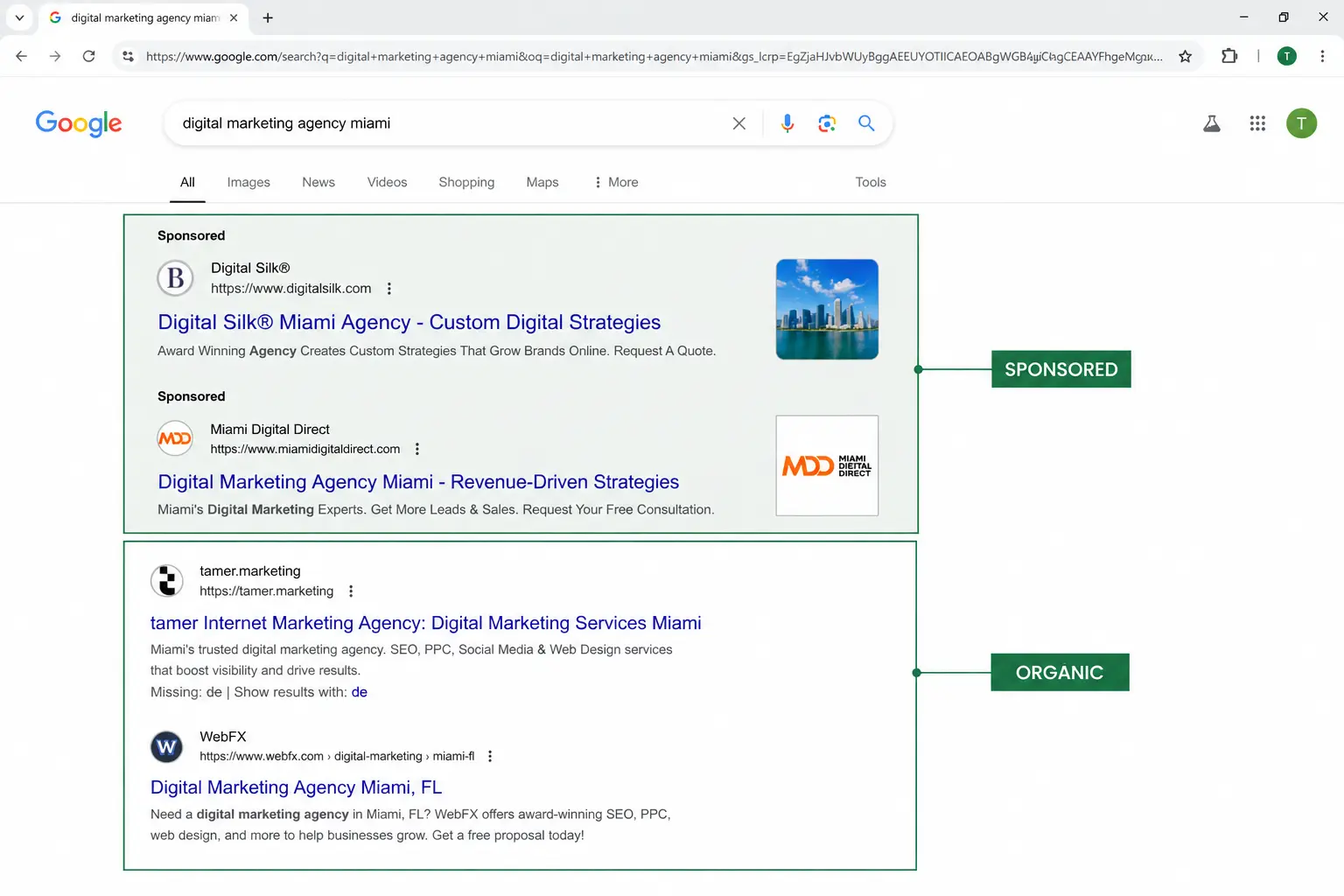
How Google Ads works: where your ads show up
Google Ads is more than an ad in search results. It's a complete ecosystem that can put your business in front of potential customers in many places, and the difference between a campaign that compounds and one that bleeds budget usually lives inside how that ecosystem is managed. Building strategy across all six surfaces is the core of what proper Google Ads and PPC management looks like when it's done with intent.
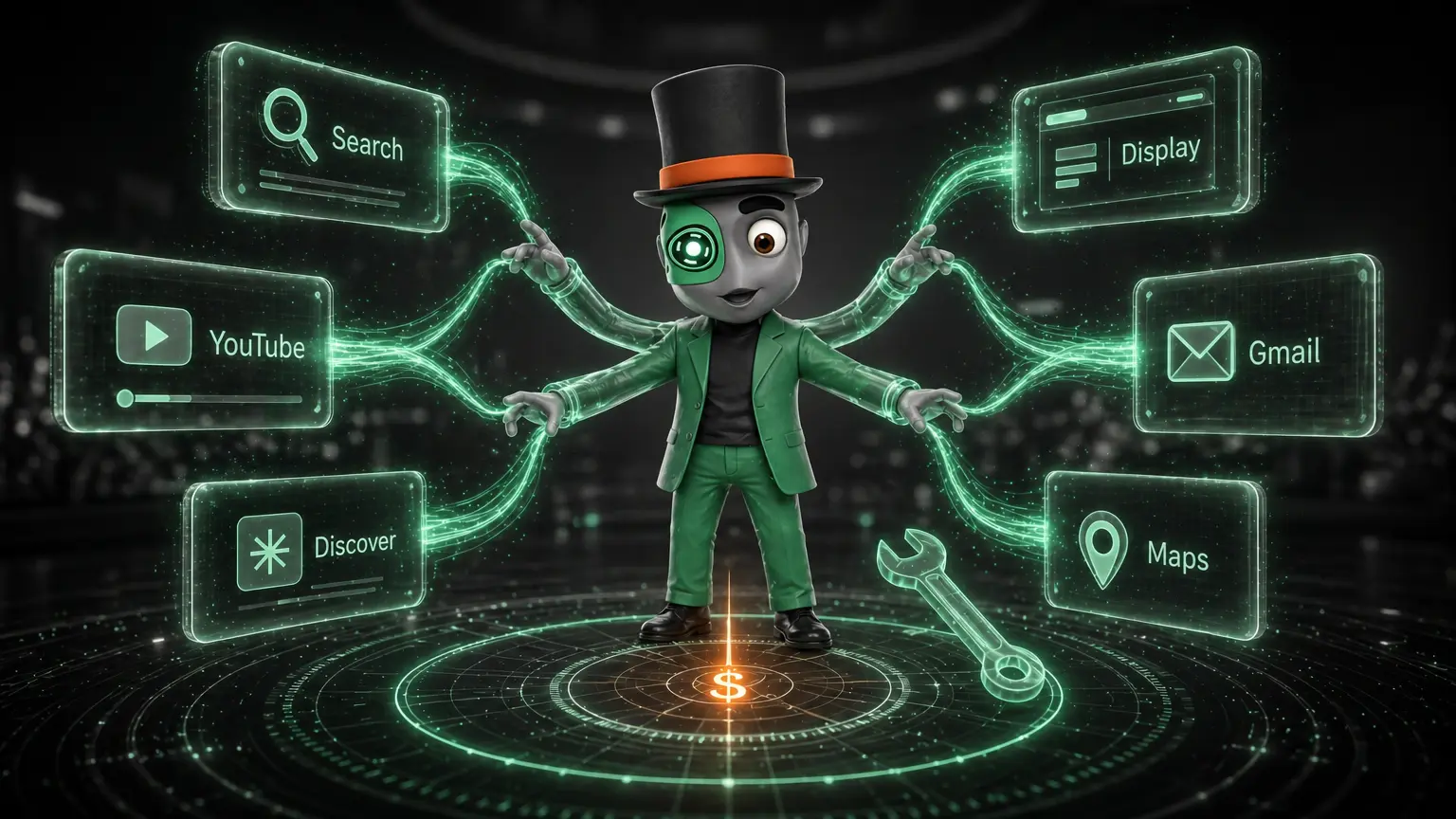
Google Search appears above organic results when someone searches your keywords. High intent. The user is already looking for what you offer. Google Maps highlights you on the map for local searches, critical for businesses with a physical location in Miami. YouTube places video ads before or during content related to your industry. Display Network places banners and visual ads on millions of websites, ideal for retargeting and brand presence. Gmail puts ads in the inbox in a native, less invasive format. Discover reaches users in the personalized mobile feed before they actively search.
| Surface | User intent | Format | Best use for Miami businesses |
|---|---|---|---|
| Google Search | High | Text above results | Services with active demand and local search |
| Google Maps | High · local | Highlighted map pin | Brick-and-mortar businesses: restaurants, clinics, retail |
| YouTube | Medium | Pre-roll, in-stream, shorts video | Brands with video creative and visual categories |
| Display Network | Low | Banners across millions of sites | Retargeting and brand reinforcement after first touch |
| Gmail | Medium | Native ad in inbox | Re-engaging leads and reactivating lists |
| Discover | Low | Card in personalized mobile feed | Discovery before active search |
In Search, someone types a query and Google runs a millisecond auction across every advertiser whose keywords match. The highest bidder doesn't automatically win. Google weighs the bid against ad quality and landing-page relevance. A well-built campaign can outrank a competitor who spends more.
Negative keywords are as important as the main keywords. A residential roofing company that doesn't do commercial work needs "commercial roofing" as a negative keyword, or it'll pay for clicks from people searching for exactly what it doesn't offer. A simple mistake that drains budget month after month without anyone noticing.
The click destination isn't always a landing page. In click-to-call campaigns, the click connects the user directly to your phone. In native lead forms, the prospect fills in their data without leaving Google. The right strategy depends on your business and how you close best.
Performance Max, Shopping, and when to go advanced
Once a business is producing consistent results with basic campaigns, the next layer of Google's ecosystem opens up. This is where we've seen big budgets won and lost in very little time.
Performance Max runs ads across every Google surface simultaneously: Search, YouTube, Display, Gmail, Discover, and Maps. You give it creative assets, audience signals, and a conversion goal. Google distributes the spend across the placements it believes will drive that goal most efficiently.
It can be powerful. It can also burn substantial budgets for businesses that set it up and walked away. The AI optimizes toward what it can measure. If tracking isn't right, it optimizes toward metrics that have nothing to do with actual revenue.
We've had clients arrive after three months on Performance Max with high impression volumes and zero tracked conversions. The system was learning to deliver impressions because that was the only thing it could measure. Three months of spend. Zero useful learning.
Google Shopping shows the product, price, and store directly in results before the user clicks. For businesses with a physical product catalog, possibly the highest-ROI channel inside Google's ecosystem.
Local campaigns appear on Maps and local searches near your address. For restaurants, brick-and-mortar stores, and services with a Miami address, an underrated tool. They all require active management. No Google campaign runs well on autopilot indefinitely.
Budget strategy: the logic behind the number
There is no universal number. Anyone who gives you one without knowing your business, your niche, and your specific objectives is guessing. There is, however, a logic that applies in any market.
Your budget needs to be enough for the algorithm to learn who your customer is in a reasonable time. That depends on your industry's CPC. But there's something more important than cost per lead: the value of what you sell.
If every pool you build leaves $35,000 in profit, three leads a month can be enough for the business to thrive even on a small budget. ROAS, return on ad spend, is what really determines whether ads are profitable. Not lead volume. Not cost per click. What you earn on each closed sale relative to what you spent to get it.
This isn't black and white. A cleaning service with a $120 ticket needs many more leads to justify the same budget as a dental implant clinic with a $4,000 ticket. The budget logic always starts there.
| Business | Average ticket | Leads/month for $3K spend | Budget logic |
|---|---|---|---|
| Recurring cleaning service | $120 | ≥40 leads/month with strong close rate | High volume, low ticket: needs low CPC and tight conversion |
| Dental implant clinic | $4,000 | 5-8 qualified leads/month | Mid ticket: lead quality matters more than volume |
| Pool construction | $35,000 | 1-2 closed leads/month | High ticket: small budgets profitable if the funnel qualifies well |
Measurement strategy: how do I know it's working?
This was the last question in that sixty-second conversation. And it's the one most businesses can't answer after months of investing.
ROAS, return on ad spend, is the number that matters. A ROAS of 3 means $3 in revenue for every $1 spent. Calculating it requires knowing which sales came from which campaigns. A marketing ROI calculator helps you model break-even spend, lead value, close rate, and revenue targets, but it is only useful when the tracking behind those numbers is real. Which requires conversion tracking. Which requires a setup most business owners don't know how to build and many agencies don't bother to do well.
The mistake of measuring the wrong things
We worked with a business that ran Meta Ads for four months measuring click-through rate and site visits. Their actual goals were booked consultations and phone calls. Neither was being tracked. They had no way to know if the campaigns were working.
Tracking as a strategic decision
Tracking isn't just an installation problem. It's a strategic decision that starts long before touching any platform. Choosing what event to optimize, a call, a completed form, a confirmed sale, tells the algorithm exactly what kind of person it needs to find. Tell it to optimize for clicks and it'll find people who click. Tell it to optimize for booked consultations and it'll learn to find people who book. Different audiences, even from the same market.
When that signal is wrong from the start, the algorithm learns fast, and learns the wrong thing. Undoing it takes time, budget, and starting the learning over from zero.
What works in month one doesn't work in month six
The analysis doesn't end in month one. What works in the first ninety days of an account doesn't necessarily work in month six. CPCs change, audiences saturate, creatives wear out. A well-managed account has periodic reviews of which events are converting, which campaigns produce real customers vs. traffic that doesn't go anywhere, and whether attribution data still matches what the business is closing on the ground.
GA4, Google Tag Manager, the Meta Pixel, and the TikTok pixel, when properly configured, do two things. They tell you which campaigns produce customers and which produce traffic that vanishes. And they teach the algorithm who your ideal customer is, because every correctly recorded conversion is a signal Meta or Google uses to find more lookalikes. Without that continuous feedback, AI works blind.
When we set up an account from scratch, tracking goes before the first ad ships. It isn't a technical detail. It's what makes all the analysis afterward make sense.
Apple ATT and why Conversions API matters
Apple's App Tracking Transparency update in 2021 was a real disruption for Meta advertisers. Meta's CFO estimated an impact of approximately $10 billion on the company's 2022 revenue, in statements to CNBC in February 2022. Businesses that pair Conversions API with the Pixel see 17.8% lower cost per result compared to those using the Pixel alone, per Meta's April 2026 announcement. Most small businesses in Miami aren't using it. The ones who do have a real, measurable performance edge.

Multi-channel paid media strategy: how channels work together
The clients producing the strongest results with us aren't running a single campaign on a single platform. They use multiple channels intelligently, each one doing the job it's designed for.
The organic foundation, local SEO and Google Business Profile, handles searches where someone is already actively looking for what you offer. Paid ads work better when the organic presence is credible. Someone who sees a Meta ad, searches the business name, and finds a well-maintained Google profile with 40 reviews has a completely different experience than someone who can barely find you.
Each channel can drive direct sales inside its own ecosystem. They aren't stages in a linear process. They're independent channels with their own conversion logic and internal funnel. What is real is the brand effect: if someone saw you on Meta or TikTok before searching for you on Google, you're not a stranger when your ad shows up. That prior recognition lifts conversion because trust was already being built.
Shared tracking is what ties everything together. GA4, Meta Pixel, and Conversions API, properly configured, tell you exactly which channel is producing real results and which needs adjustment. Without that, you're optimizing blind.

What comes next after reading this
The four questions from that sixty-second conversation have answers. Which platform, how much to invest, how to measure, what counts as a ROAS worth chasing. None of them gets answered in the abstract.
They get answered by looking at your business specifically: your offer, your presence, your tracking setup, your goals in this market. That's what we do with every client before we talk campaigns, and the entry point to that conversation is our paid media management service. Paid media rarely works alone, so it is worth seeing how the channels fit together across our digital marketing services for Miami businesses. We look at all of it, tell you directly what we see, what's missing, and what a realistic path looks like.
Book a free strategy call with tamer Marketing
We'll review your digital presence, your offer, your tracking setup, and your goals. We'll tell you directly what we see, what's missing, and what a realistic path to consistent results looks like for your Miami business.
Frequently asked questions
How much should a small business spend on paid media?
There is no fixed number, but the right one is tied to your target cost per customer and your margins, not a percentage pulled from a blog. In a market like Miami, where legal, aesthetics, real estate, and home services all bid against each other, expect higher costs per click than the national average, so the realistic floor is whatever buys enough clicks to gather conversion data in 30 to 60 days. Start from the math of one customer: if a client is worth $4,000 and you close one in ten leads, you can afford far more per click than a business selling a $120 service.
Is Google Ads or Meta Ads better for my business?
Neither is better in the abstract; it depends on whether your customer is actively searching or being interrupted. Google Ads captures existing demand, so it fits services people look up when they need them, like a plumber or a lawyer. Meta Ads create demand through profile and behavior targeting, so they fit offers people do not search for but respond to once they see them. Most businesses run both once one channel is profitable.
What is a good ROAS for paid media?
A good ROAS is one that clears your break-even, which depends on your margin, not an industry trophy number. A business with 80% margins can thrive on a 2x return, while one with thin margins may need 5x or more just to profit. Read early campaigns by cost per qualified lead first, since ROAS needs enough conversions before it is reliable.
Do I need a landing page and conversion tracking before launching ads?
Yes, and skipping it is the most expensive mistake we see. Paid media only brings traffic; what happens after the click depends on the page and the follow-up you built before launching, so a campaign pointed at a weak page or an inbox nobody checks burns budget at scale. Set up conversion tracking first (GA4, the platform pixels, and a server-side Conversions API where possible), because a campaign you cannot measure is one you cannot improve.
What is Performance Max, and should I use it?
Performance Max is Google's automated campaign type that spreads one budget across Search, Maps, YouTube, Display, Gmail, and Discover. It can work well once you have clean conversion data and creative to feed it, but launching it with no tracking and no historical signal is how businesses end up three months in with spend and no attributable conversions. Treat it as an advanced step, not a starting point.
Should I run TikTok or other channels, or stick to Google and Meta?
Start where your buyer already is, then expand once a channel is profitable. Google and Meta cover most local demand, and adding TikTok, Pinterest, LinkedIn, or Microsoft Ads makes sense when your audience genuinely lives there or your first channels are maxed out. Spreading a small budget across five platforms at once usually produces five underfunded campaigns instead of one that works.