
Does Google Ads Help Your SEO? We Measured It on a Real Account, Month by Month

Summarize with AI
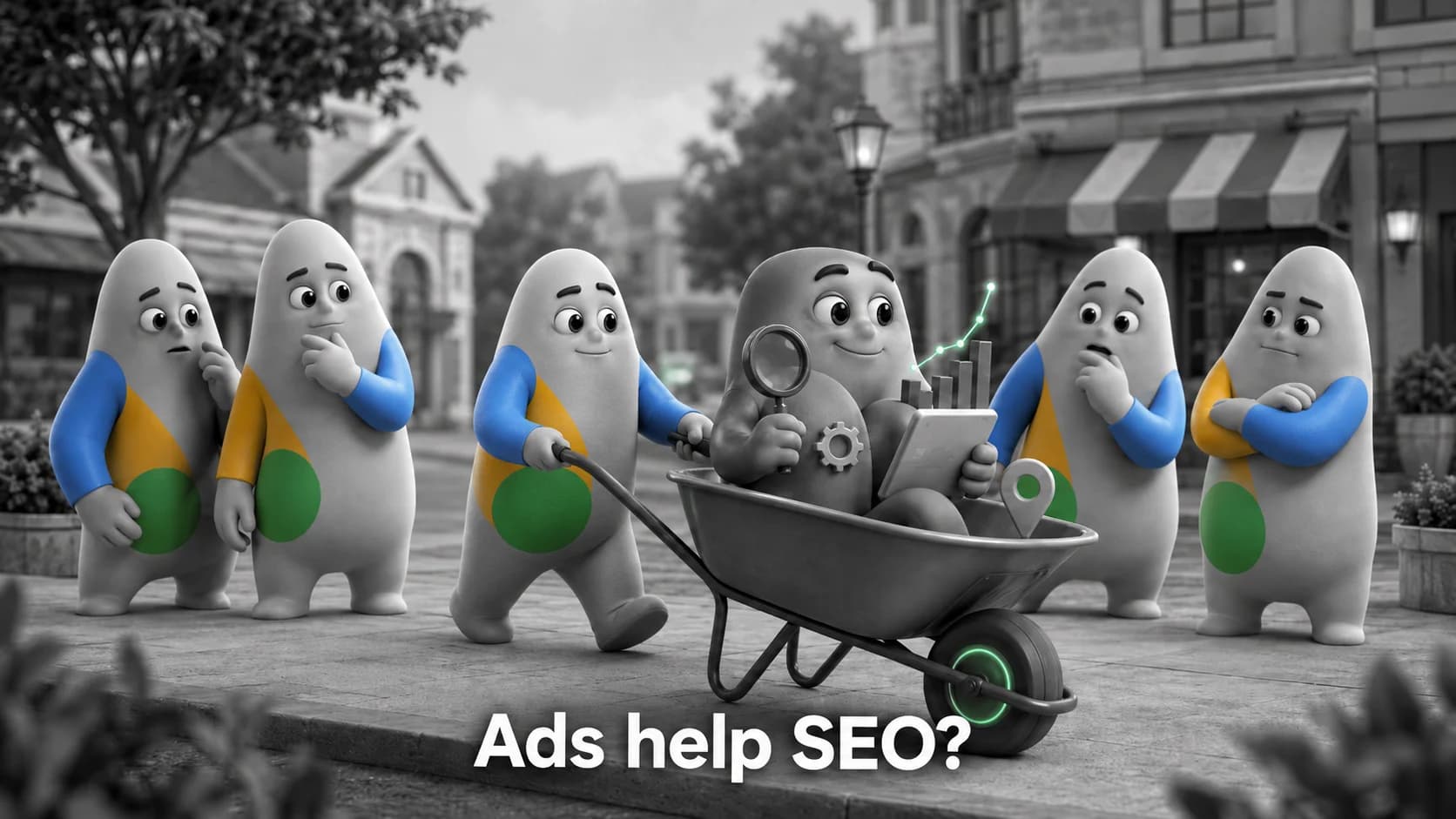
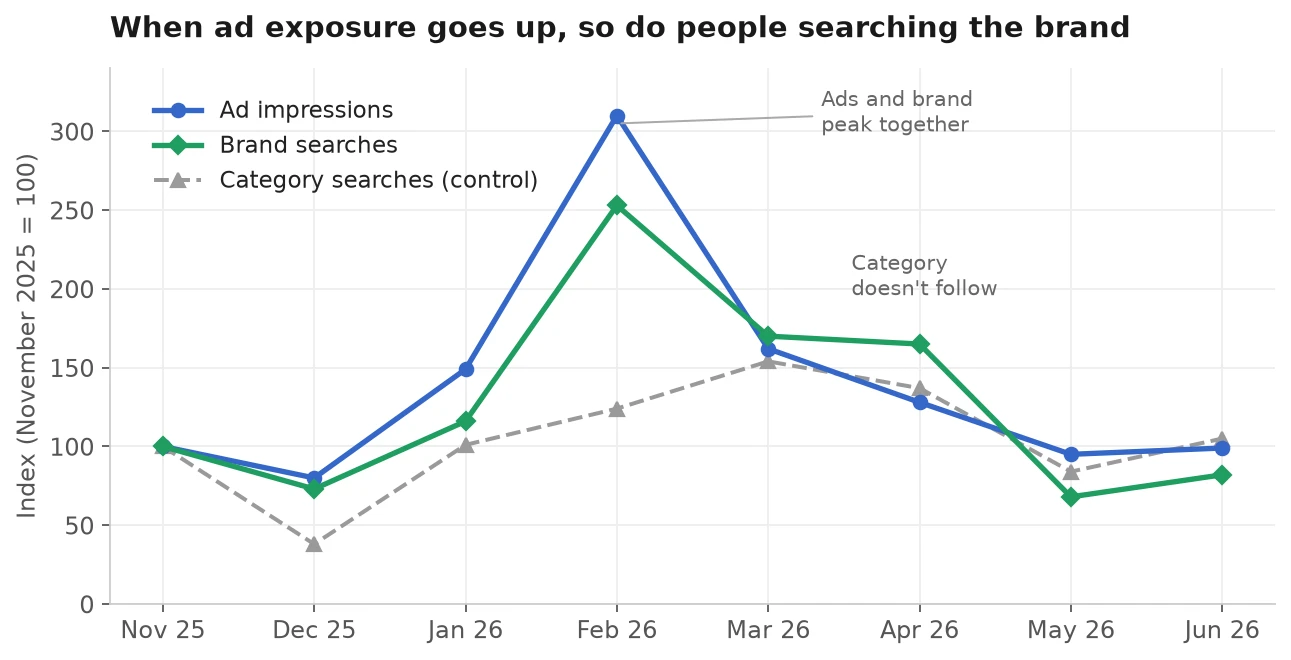
For eight months, every time one of our clients raised its ad exposure, the number of people searching for its name on Google went up too. The correlation between the two is 0.90, and it holds even when you drop the single most extreme month: the pattern does not depend on one lucky data point.
Its ranking position, meanwhile, did not improve. Not even with three times as many people searching for it.
That is the result. Below is the proof, the mechanism that explains it, and what these numbers cannot show.
How we measured it
The account belongs to Piñeiro English & Citizenship Center, a Miami center that prepares immigrants for the U.S. citizenship test. It runs Google Ads search campaigns for the site clasesdeciudadania.com. We crossed Google Ads against Google Search Console. Search Console had stored data since October 19, 2025, and the analysis covers the eight full months of that range, from November to June.
The first step was to split organic searches into two groups, using Search Console's regular expression filter:
Brand searches. People who type the center's name. Queries like piñeiro english & citizenship center, with all their spelling variants. We isolated them with this filter:
pi[ñn]eiro|pecc
Category searches. People who look for the service without knowing yet who provides it. Queries like citizenship classes in miami, citizenship classes near me, or private citizenship classes. You get them by inverting the previous filter, with the Doesn't match regex option.
Then we crossed both series against ad impressions, month by month.
The second group is the control, and it is the piece that decides whether the study is worth anything. The logic is simple. If the ads generate brand awareness, brand searches should move with them. But if the rise were due to seasonality, an industry news event, or SEO simply maturing, then category searches would rise too.
Without that control, any result is an anecdote dressed up as a study.
The numbers
| Month | Ad impressions per day | Brand searches | Avg brand position |
|---|---|---|---|
| Nov 2025 | 112 | 55 | 3.5 |
| Dec 2025 | 90 | 42 | 3.5 |
| Jan 2026 | 167 | 66 | 3.8 |
| Feb 2026 | 348 | 130 | 3.9 |
| Mar 2026 | 179 | 97 | 4.9 |
| Apr 2026 | 143 | 91 | 5.1 |
| May 2026 | 106 | 39 | 4.6 |
| Jun 2026 | 109 | 45 | 3.8 |
February was the month of highest ad exposure, with 348 ad impressions per day. That same month, brand searches hit their peak: 130. December was the month of lowest exposure, with 90 daily impressions. Brand searches fell to 42, almost a third.
What a 0.90 correlation means
A correlation measures how closely two things move together. It is expressed with the letter r and runs from −1 to +1.
| r value | What it means |
|---|---|
| +1.00 | They move perfectly together: when one rises, so does the other |
| +0.90 | They almost always move together |
| 0.00 | They have no relationship with each other |
| −1.00 | They move in opposite directions: when one rises, the other falls |
It comes with a second number, the p-value, which answers a different question: if there really were no relationship between the two things, how often would we see numbers like these by pure chance?
A p-value of 0.002 means that, if there were no real relationship, seeing a pattern like this would be a one-in-five-hundred event. The standard scientific research uses to take a finding seriously is a p-value below 0.05. Above that, it is considered noise.
The results for this account:
| What we compared | r | p | Holds up? |
|---|---|---|---|
| Ads vs BRAND searches | 0.90 | 0.002 | Yes |
| Ads vs CATEGORY searches | 0.48 | 0.22 | No |
And the result does not depend on one good month. February is the peak, the point that pulls hardest on the line, so we stress-tested it by removing it:
| Test | Result |
|---|---|
| Correlation with all 8 months | r = 0.90 |
| Dropping February, the peak month | r = 0.85, still significant |
| Measured by rank order, not exact value | 0.95 |
The finding survives all three. It is not one lucky month dragging the rest.
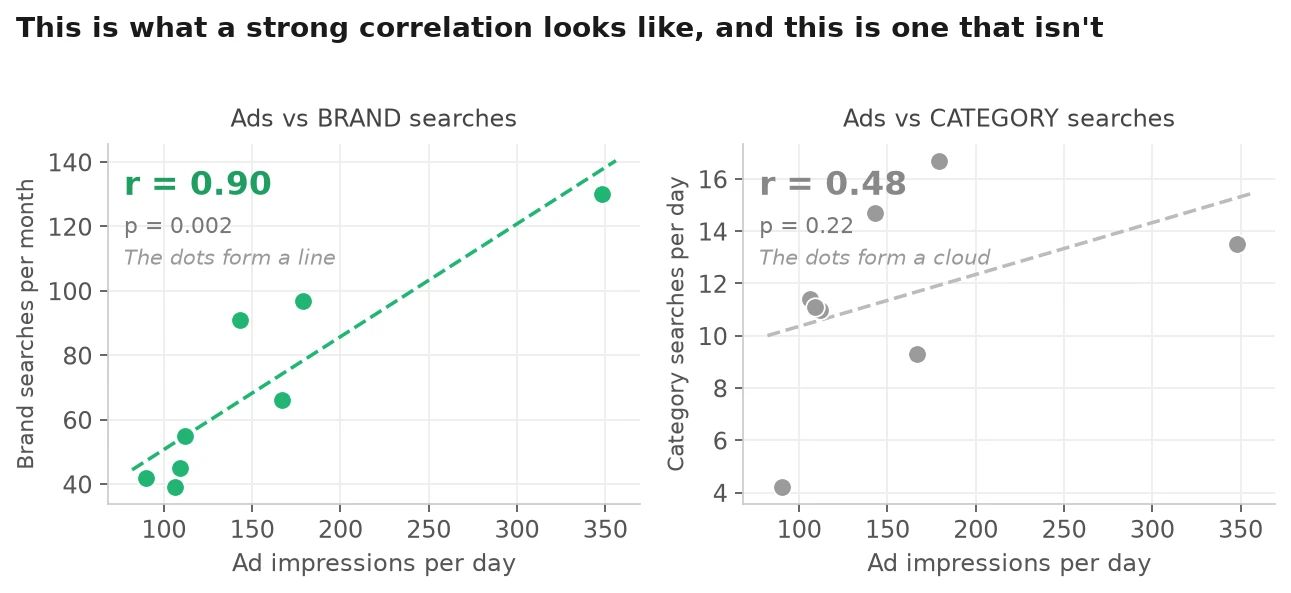
The control holds. The easy explanation, that it was all a wave of market demand or an industry news event, falls apart on its own. If it had been that, the category would have risen too, and it did not.
The ranking did not improve, not even with triple the demand
Here is a detail that at first glance looks like it works against us: the average position in brand searches not only did not improve, it got slightly worse. It started at 3.5, rose to around 5.1 in the middle stretch, and closed near 3.8. In February, with three times as many people searching the business name, it sat at 3.9. Worse than in December, when demand was a third of that.
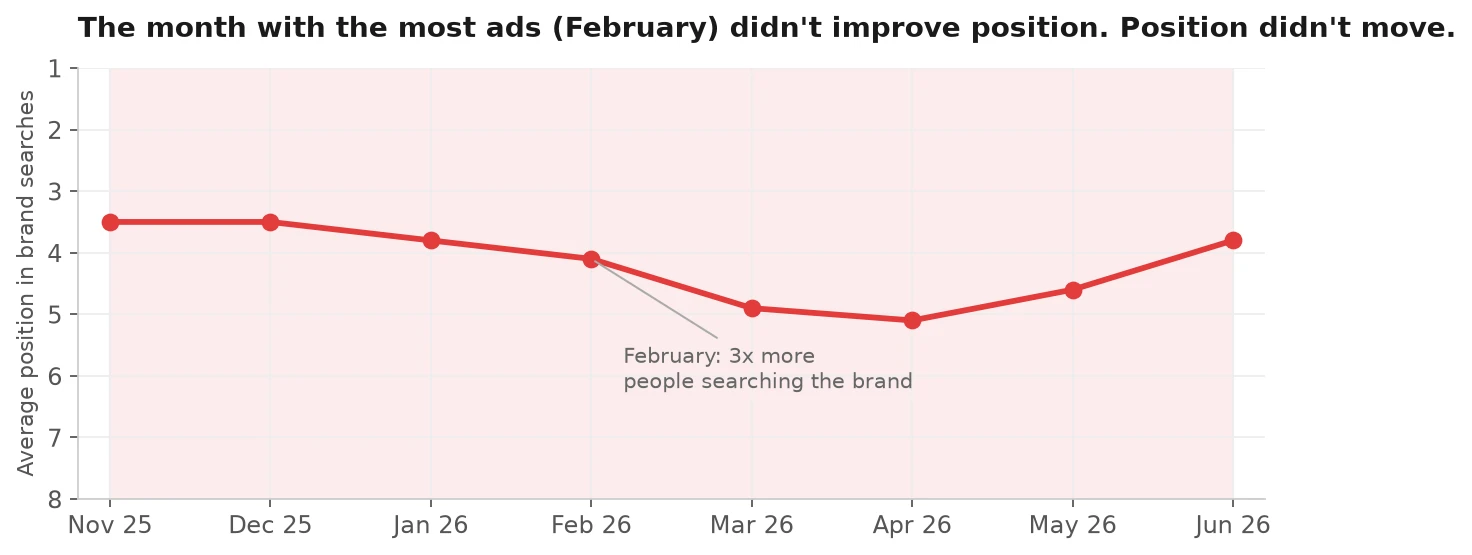
That is not a ranking drop. It is a query-mix effect, and understanding it reinforces the point. When a wave of new people comes in searching the brand, not everyone spells it the same way: some type it in full, and for that query the center ranked first; others type it incomplete or misspelled, and for those variants it showed up lower. Averaging them all together, the new and worse-positioned variants drag the mean down, without the position on the main query having moved at all. It dropped by arithmetic, not because the site lost ground.
What matters for the thesis is what did not happen. With triple the people searching the brand, the position did not rise. If ads improved rankings, that would have been the month to see it, and we did not.
First, what SEO actually is
The debate over whether ads help SEO is almost always settled by quoting Google. And that is the problem, because half the audience does not believe Google when it talks about its own algorithm. There is a better way to answer, and it does not depend on trusting anyone: define what SEO is.
Ranking in search is, above all, satisfying the intent of the user who is searching. When someone types something into Google, there is a need behind it, and the search engine rewards the page that best resolves it. Around that there is a technical layer that also matters (that the site loads fast, that Google can crawl and index the pages, that other sites link to yours), but the heart of the matter is answering, better than everyone else, what the person wanted.
With that definition, the question answers itself. To improve your organic position you have to do one of these things: create content that better answers the search intent, get other sites to link to you, or fix the technical side so Google can read you well.
Paying for an ad does none of the three. It does not write content. It does not earn links. It does not improve your site's speed or indexing. It is money in exchange for showing up, not work on your page's relevance.
That is why ads do not improve your ranking. Google does not need to say it: it falls apart by definition.
And yes, Google confirms it
With that said, Google's official position points to the same place, and it serves as reinforcement.
Google has it in writing in its documentation: a paid ad solution like Google Ads does not produce the same result as SEO and will not improve your positions in organic search [1]. Matt Cutts, for years the public voice of Google on search topics, treated the matter as a myth in a 2014 video. He put it on the level of a conspiracy theory, alongside the opposite theory, that if you do not buy ads Google punishes you [2]. John Mueller, of Google Search, has repeated it in public: the ads and search teams are separated on purpose, and Google avoids crossing information between them even when a large advertiser asks an SEO question [1].
There is no shortcut. Anyone who sells you the opposite is selling you something that does not exist. What explains this study's numbers is something else.
What Google actually sees
To understand why demand rises but ranking does not, you have to know what Google looks at and what it does not. And here the company itself gave, without meaning to, the clearest answer.
For more than a decade, Google publicly denied that user clicks influenced ranking. Matt Cutts said using them would be a mistake. Gary Illyes dismissed the idea every time it came up [3].
That changed in the U.S. Department of Justice antitrust trial against Google. Pandu Nayak, Google's VP of Search, testified under oath on October 18, 2023 about an internal system called NavBoost, and described it as one of the important signals the company has [4]. NavBoost analyzes a rolling thirteen-month window of aggregated user click data and uses it to reorder results [4][5].
A year later came the confirmation in writing. In March 2024, a Google bot accidentally published its internal Content Warehouse API documentation to a public GitHub repository. Erfan Azimi found it and shared it with Rand Fishkin of SparkToro and Mike King of iPullRank, who analyzed it on May 27 and 28, 2024 [6][8]. The leak, 2,596 modules with more than 14,000 attributes, included the exact names of the click signals: goodClicks, badClicks, lastLongestClicks. Google confirmed its authenticity on May 29 [7].
So yes, clicks count for ranking. But the word "clicks" hides a distinction that changes everything. Not all of them are equal, and most of the ones an ad produces tell the organic algorithm nothing.
| What happens | Counts for your organic ranking? |
|---|---|
| Someone clicks your organic result | Yes. It is the signal that feeds NavBoost, confirmed under oath |
| Someone clicks your ad | No. It feeds the ads Quality Score, which is a separate system |
| The time spent on your page | Google does not see it directly. It sees whether the user returns to search and clicks another result |
| The user buys or signs up on your site | No. That happens inside your site, and the algorithm does not go in there |
| Your Google Analytics | No. Google does not look at it |
The ad click and the organic result click look almost identical to a human. To Google they are two separate worlds, measured by two different systems that do not talk to each other.
With that distinction, the real chain looks like this:
- Your ad shows up at the top of Google. The person sees it, even if they do not click it.
- Soon after, when they need the service, they already recognize you. They type your business name.
- They find you and click your organic result, inside the search engine.
- That click, and only that one, is what NavBoost records.
The ad did not speak to the algorithm. It spoke to the person. The person, soon after, is the one who speaks to the algorithm, and does it with an organic click that Google does count. The effect has prior backing: Google's own research on search advertising found that someone who sees an ad first is more likely to click afterward on the corresponding organic result [9].
And this is where it all fits. Those organic clicks accumulated month over month. Even so, the position did not improve. What moved was not the ranking, but the number of people arriving to search for you. The real, measurable effect is demand, not rankings.
"What if my ads landing page ranks?"
Here is where someone experienced raises their hand: if I build a good landing page for my ads, that page can rank organically. So ads do help SEO.
The nuance is real, and it is more interesting than it looks, because the overlap exists and it is not a coincidence.
Google Ads forces your page to be relevant. Quality Score, the grade Google gives your ads, is calculated from three components, and two of them are pure relevance: ad relevance, which Google defines as how closely your ad matches the intent behind the search, and landing page experience, which measures how useful and relevant your page is for whoever clicked [11]. Optimizing a landing for ads is, by design, optimizing it for relevance against a search. Which is the heart of SEO.
It is no coincidence that they overlap. Google built both systems measuring the same thing: relevance to the user's intent. But it does not follow that paying improves your ranking. Three things follow, and all three keep the thesis standing.
- Today's SEO rewards depth, not matching. The organic algorithm understands a page's full topic: synonyms, entities, context. A relevant ads landing starts with an advantage, but usually falls short on the semantic depth that organic rewards. That is why many landings with a good Quality Score do not rank.
- The ads landing is built to convert, not to inform. Its job is to persuade: attack the objection, create urgency, close the sale. The page that ranks is built to satisfy the full search intent. They are two different goals, and optimizing for one does not give you the other for free.
- What helps SEO is the work, not the paid click. If your landing ends up ranking, it is because you built a relevant page, not because you paid Google. The ad click still tells the organic algorithm nothing. What happened is that you built an asset that works for both, because both systems reward the same thing. The money did not push the ranking; the relevance work did.
And there is a second bridge between the two channels that almost nobody mentions: the data. The Google Ads search terms report tells you, in weeks and with real money, which words convert. That information, through pure SEO, would take you months to discover. Using the keywords already proven in ads to decide which organic pages to create is the most concrete way ads help your SEO. And there is no algorithmic magic to it: it is market intelligence you paid for once and reuse.
The objections, one by one
A finding like this invites you to poke holes in it, and rightly so. These are the two most serious objections you can make, and what the data says about each.
"The arrow points the other way: whoever searches the brand is what triggers the ads." This is the strongest objection. If the campaigns showed up when someone searched "Piñeiro," then more people searching the name would produce more ad impressions mechanically, and we would be measuring the effect backwards.
We ruled it out with the account's search terms report. Of the 22,834 ad impressions in the period, only 208 came from searches containing the business name. That is 0.91%. The campaigns target category terms like "citizenship classes" and "English classes," not the brand. We recalculated the correlation removing that 0.91% of brand impressions, and the result did not move: still 0.90. Brand demand is not inflating the ads, because the ads almost never show on brand searches.
"It was a wave of market demand, not the ads." This is what the control group is for. If in February half of Miami had started searching for citizenship classes, that wave would have raised category searches too. It did not: the correlation of ads with category is 0.48, statistically irrelevant. The same search terms report confirms it from another angle: nearly half of the impressions come from real category searches, so that series does reflect market demand, and that demand did not accompany the February peak.
The one that does stand
With those two ruled out, one real limitation remains, and it is honest to put it up front.
Ad impressions quadrupled in February without the budget changing. The auction got cheaper, the system widened the matching, more inventory became available. Google decided to show the ads more times for the same money. In other words: the variable we are measuring moved on its own.
That has a good side. There is no experimenter bias. Nobody turned a knob to force a result or picked the month that suited them best. The numbers came from an account running normally, and the analysis was done afterward.
And a bad side of the same size. A variable that moves on its own does not let you claim causation with total certainty. The control group and the search terms report close the most obvious doors, but closing them all requires the one thing we could not do here: move exposure on purpose, in cycles, and check that brand demand follows it every time. That is the step that turns a correlation into a proven cause, and it is the one that comes next.
The three measurement traps
If you want to repeat this analysis on your account, three things will trip you up.
Search Console does not keep the past. It only starts counting the day you verify the property. Before this account, we tried the same study with another one, and it could not be finished: the property had been verified for three weeks. The months of history we needed did not exist, and never would.
Search Console anonymizes a large share of searches. When you filter by search term, all the queries Google hides for privacy disappear. On this account that was 67% of the impressions. They count in the total, but cannot be segmented.
Misconfigured auto-tagging. If Google Ads auto-tagging is off, or the gclid parameter is lost in a redirect, your paid traffic gets reported as organic. And then the business owner swears the ads are pushing their SEO, when what they are seeing is a measurement error. It is a known problem: on several platforms, ad traffic and organic get treated the same if they are not defined and filtered [10].
All three traps come from the same place: the tools disagree by design, and nobody checked which one owns which question. That is how we tracked the traffic on that account, and the same setup is what makes a study like this possible in the first place.
That third trap explains a good part of the success stories that circulate out there.
So, does it help or not?
The question has two answers, and they are different. That is why this topic has gone twenty years without being resolved.
Does Google Ads improve your rankings? No. It falls apart by definition: paying does not write content, earn links, or fix the technical side, which are the only ways to rise organically. And the data confirms it: with triple the people searching the brand in February, the position did not improve at any point.
Does Google Ads increase your organic traffic? Yes. The ad speaks to the person, and the person, soon after, speaks to the algorithm: they type your name and enter through your organic result. That visitor shows up in your report as organic traffic, but its origin was advertising. What ads produce is brand demand. The organic channel simply collects it.
That distinction, which looks like vocabulary, changes three concrete things:
- You are undervaluing your ads. If you measure Google Ads only by the clicks that come from the ad, you miss the one who saw the placement, did not click, and came back later through organic. That customer was brought by the placement, and the report credits it to SEO.
- The credit is misassigned. If you hire SEO and Ads separately, one may be harvesting what the other sowed. Brand traffic is the clearest case: it arrives with a good CTR and a good position, reads as an SEO win, and much of it came from the placement you paid for separately.
- Turning off the ads costs more than the invoice says. You lose the ad clicks immediately, and with a lag you start to lose part of the brand traffic that was coming in through organic too. That second drop shows up in another report, where nobody connects it to the decision that caused it.
Conclusion
The effect exists and it is measurable. What is wrong is the name we give it.
Google Ads puts your name in front of people who, soon after, type it into the search engine, without your position improving. Those people enter through your organic result and land in your SEO report, with a good CTR and a good position, as if rankings had brought them. What you are reading as organic traffic can be, in good part, advertising billing late.
That is what eight months of data say, with a control group that holds. The experiment that turns it into a proven cause comes next, and we will publish the result exactly as it comes out.
If you want to know how much of your organic brand traffic your ads are actually generating, get in touch. We separate the two signals on your account and show you the numbers.
Frequently asked questions
Does Google Ads help your SEO rankings?
No. Ads do not write content, earn backlinks, or fix technical issues, which are the three ways to improve organic position. In this eight-month study, the month with triple the ad exposure and triple the brand demand showed no ranking improvement. What ads improve is not your position, it is the number of people searching for you.
Then why does my organic traffic go up when I run ads?
Because ads create brand demand. Someone sees your ad, does not necessarily click it, and later types your business name into Google and enters through your organic result. That click is what Google's NavBoost system records, and that visit lands in your report as organic traffic even though the ad is what triggered it.
Do ad clicks count as a Google ranking signal?
No. The 2024 Content Warehouse leak and the DOJ antitrust testimony confirmed Google uses click signals (goodClicks, badClicks, lastLongestClicks) via NavBoost, but those are clicks on organic results. Ad clicks feed the separate Quality Score system for Ads, which does not influence organic ranking.
Can a Google Ads landing page rank in organic search?
It can, but not because you paid for ads. If it ranks, it is because you built a relevant, useful page, and both Ads Quality Score and organic SEO reward relevance to search intent. The paid click still sends no signal to the organic algorithm. You built an asset that serves both systems.
Why does organic traffic sometimes get wrongly credited for ad results?
Two reasons. First, brand searches created by ads arrive through organic and read as an SEO win. Second, misconfigured auto-tagging or a lost gclid parameter can make paid traffic report as organic, so the owner believes ads are boosting SEO when it is a measurement error.
Sources
- Google's official documentation on paid ads and organic ranking, plus John Mueller's statements on the separation between the Ads and Search teams. Collected in: Mavlers, Do Google Ads Affect Organic SEO Rankings. mavlers.com
- Matt Cutts, Google Webmasters video (2014), on the myth of buying ads to improve ranking. Collected in: Search Engine Journal, Is Your Usage Of Google Ads An Organic Search Ranking Factor? searchenginejournal.com
- Public statements from Google denying the use of clicks as a ranking signal, prior to the antitrust trial. Collected in: Hobo Web, The Google Content Warehouse Leak 2024. hobo-web.co.uk
- Testimony of Pandu Nayak, VP of Search at Google, in United States v. Google LLC, October 18, 2023. Official transcript: thecapitolforum.com
- Trial documents published by the U.S. Department of Justice: justice.gov. Full compilation of case documents: jcchouinard.com
- Rand Fishkin, SparkToro, May 27, 2024. Original post that broke the leak: sparktoro.com
- Documented record of the leak, with the full timeline and Google's authenticity confirmation on May 29, 2024: Wikipedia
- Mike King, iPullRank, Secrets from the Algorithm: Google Search's Internal Engineering Documentation Has Leaked, May 28, 2024. First detailed technical analysis of the click module signals.
- AJ Kohn, What Pandu Nayak Taught Me About SEO. Analysis of the trial testimony and how NavBoost works: blindfiveyearold.com
- Lunio, Does Google Ads Help SEO Rankings, on attribution errors between paid and organic traffic in measurement platforms: lunio.ai
- Google Ads Help, About Quality Score and 5 ways to use Quality Score to improve your performance. Official documentation on the three Quality Score components (expected CTR, ad relevance, and landing page experience) and their definitions: support.google.com and support.google.com
Case data. Google Search Console and Google Ads for Piñeiro English & Citizenship Center (clasesdeciudadania.com), an account managed by tamer Marketing and published with the client's authorization. Period analyzed: October 19, 2025 to July 12, 2026, the full history available in Search Console for that property. Correlations were calculated with the Pearson coefficient over the eight full months of the period. Brand and category searches were separated with the Search Console regular expression filter, applying the pattern pi[ñn]eiro|pecc in both directions.